Every time Bitcoin becomes volatile, the same questions come back:
- Is this the bottom?
- Should I wait?
- Did I miss the opportunity?
These questions are natural. But when we look at Bitcoin’s past cycles, one thing becomes clear:
The biggest differences in outcomes rarely came from perfectly timing the market.
They came from the process investors followed over time.
Some approaches consistently held up across multiple cycles. Others repeatedly broke under stress.
This article looks at what historically worked in Bitcoin investing — and what often didn’t, based on public surveys, academic research, on-chain analysis documentation, and regulatory material.
This is not financial advice. It is a look at historical patterns.
What Historically Worked
1. Dollar-Cost Averaging (DCA): Turning Volatility Into a Feature
Dollar-cost averaging (DCA) means investing a fixed amount at regular intervals — weekly or monthly — regardless of price.
It removes one difficult decision:
“Should I buy now or wait?”
Instead of trying to predict short-term price moves, DCA turns investing into a schedule.
A Kraken survey reported that 83.53% of respondents had used DCA, and 59% said it was their primary strategy¹. That makes it one of the most widely adopted approaches in crypto.
Why DCA historically worked well in Bitcoin
Bitcoin has always been volatile. Large swings are normal.
DCA naturally:
- Buys more when prices fall
- Buys less when prices rise
- Reduces emotional decision-making
Over full cycles, this tends to smooth entry prices and reduce behavioral mistakes.
Read our DCA guide
2. Long-Term Holding (“HODL”): Letting Time Do the Work
Another simple approach that historically worked: buy and hold long term.
Unlike most assets, Bitcoin allows us to observe holding behavior directly on-chain. Analytics provider Glassnode explains publicly how it classifies coins as “Long-Term Holder” supply using a threshold centered around 155 days² ³.
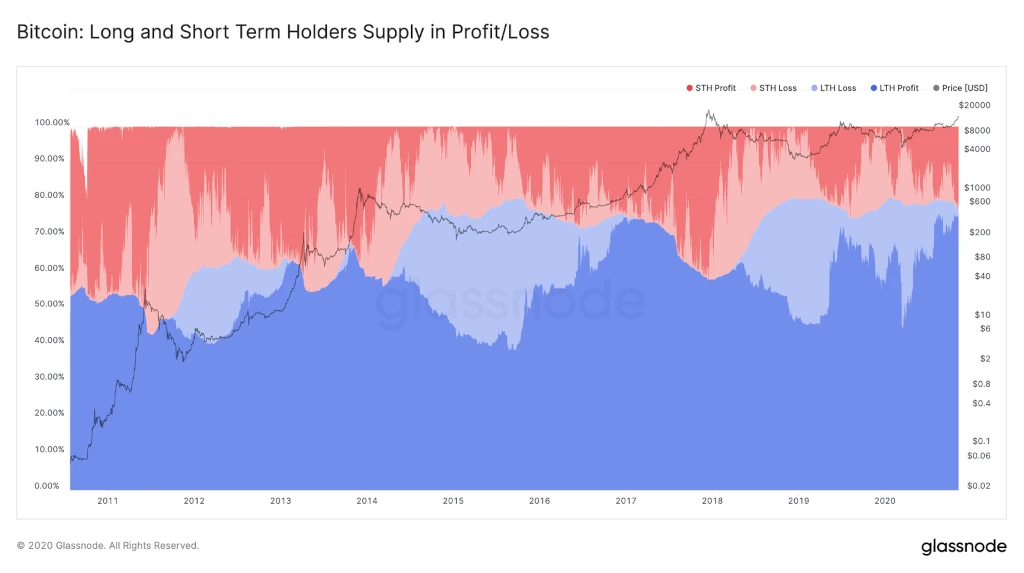
STH: Short Term Holders
LTH: Long Term Holders
Why 155 days?
Because after roughly five months, coins statistically become less likely to move. They behave like longer-term holdings.
The broader takeaway:
A significant portion of Bitcoin supply historically migrates into longer-term hands.
That behavioral pattern — staying invested through volatility — has been a common feature of strong long-cycle outcomes.
3. Continuing to Accumulate During Bear Markets
When prices fall sharply, many investors stop buying. Some sell.
Historically, that reaction has often reduced long-term accumulation.
Bitcoin has experienced several deep downturns. In hindsight, these periods often turned out to be strong accumulation windows — but they rarely felt that way in real time.
The investors who maintained structured buying during those periods were often better positioned during recoveries.
The lesson is not “buy every dip.”
It is: consistency historically mattered more than courage in one single moment.
4. Using Bitcoin’s Halving as a Long-Term Framework
Bitcoin’s supply issuance is reduced roughly every four years in an event called the “halving.”
Public documentation of halving dates is widely available⁴.
The halving reduces new supply entering the market. Many long-term investors use this predictable supply schedule as a structural framework rather than a short-term trading signal.
Importantly:
Halvings do not guarantee price increases.
But they provide a long-term lens that helps investors think in multi-year cycles instead of short-term swings.
What Often Failed (or Created Avoidable Risk)
Now let’s look at patterns that historically underperformed or failed under stress.
1. Constant Active Trading
Bitcoin’s volatility attracts traders.
But frequent trading adds:
- Fees
- Spreads
- Slippage
- Stress
- More opportunities for mistakes
Behavioral finance research consistently shows that frequent traders often underperform simple long-term approaches once costs and psychological biases are considered⁵.
Crypto markets amplify this effect because volatility can change direction quickly.
Many retail investors overestimate their ability to consistently out-trade market swings.
If you want to understand mechanics :
2. Leverage and Margin: The “Forced Exit” Problem
Leverage multiplies gains — but it also multiplies losses.
The real danger is liquidation.
If the market moves against a leveraged position, the exchange can close it automatically. That means:
- You lose exposure
- You lose capital
- You cannot benefit from recovery
Regulatory agencies like the CFTC publicly warn about the amplified risks of leverage in digital asset markets⁶ ⁷.
Market data also shows how extreme liquidations can be. CoinGlass reported that during a volatility event in October 2025, combined liquidations exceeded $19 billion in one day⁸.
Leverage introduces something long-term investors try to avoid: A mechanism that can permanently remove you from the market.
3. Emotional Investing: Fear and Euphoria
Perhaps the most common historical underperformance driver is emotional behavior.
Academic research analyzing Bitcoin transaction flows found evidence consistent with the disposition effect — investors selling winners too early and holding losers too long¹⁰.
In practical terms, this often looks like:
- Buying after strong rallies
- Selling during crashes
- Re-entering after recovery
This cycle of emotional decisions historically reduced long-term results compared to systematic approaches.
4. Over-Complex Systems and Overfitting
Another recurring issue: highly optimized strategies built on historical data.
Bitcoin’s market structure evolves:
- Retail-dominated early years
- Institutional participation
- Growth of derivatives markets
Systems tuned for one regime often fail in another.
In contrast, simple accumulation frameworks adapt more easily to changing conditions.
What History Suggests (Without Predicting the Future)
Looking across Bitcoin’s past cycles, several consistent themes emerge:
- Time in the market mattered more than timing the market.
- Simplicity outperformed complexity.
- Avoiding forced exits preserved compounding.
- Emotional control mattered more than price prediction.
The recurring question
“Are we at the bottom?”
may be less important than:
“What process can I follow consistently, regardless of price?”
Historically, that question has mattered more.
Learn More on our practical execution guides:
- How DCA works → /acquire-crypto/methods/dollar-cost-average-bitcoin/
- Bitcoin allocation → /acquire-crypto/cryptocurrency-allocation-strategy/bitcoin-allocation-portfolio/
- Portfolio rebalancing → /acquire-crypto/rebalancing-a-crypto-portfolio/
- Why self-custody matters → /cryptos-bitcoin-self-custody/why-bitcoin-self-custody/
Ready to Take Control of Your Crypto?
Go deeper into self‑custody, software wallets, hardware wallets, and practical guides.

Java‑certified engineer and P2PStaking CEO, I secure validators across Solana, Polkadot, Kusama, Mina, and Near. My articles reflect hands‑on wallet ops and real recovery drills so you can set up self‑custody safely, step by step.
FAQ — What Worked in Bitcoin Investing?
What strategy historically worked best for Bitcoin investing?
Historically, systematic approaches like dollar-cost averaging and long-term holding were among the most resilient across multiple cycles. They reduced emotional decision-making and avoided reliance on precise market timing.
Is timing the Bitcoin market important?
Market timing can work occasionally, but historically it has been difficult to execute consistently. Many investors underperformed by trying to enter and exit frequently.
Did buying during bear markets work?
In hindsight, prolonged downturns often provided strong accumulation windows. However, they were psychologically difficult in real time. Consistency tended to matter more than perfect timing.
Why is leverage risky in crypto?
Leverage introduces liquidation risk. If the market moves against a position, it can be closed automatically, potentially locking in losses and removing exposure before recovery.
What is the Bitcoin halving and why does it matter?
The halving reduces the rate of new Bitcoin supply approximately every four years. Some investors use it as a long-term framework for understanding supply dynamics, not as a short-term trading signal⁴.
Why do many investors underperform?
Behavioral research suggests emotional reactions — fear and greed — often drive suboptimal decisions, such as panic selling or chasing rallies¹⁰.
Is long-term holding supported by data?
On-chain analytics frameworks show a substantial share of Bitcoin supply is held long term² ³, which aligns with the idea that many participants adopt a multi-year horizon.
Public Sources
- Kraken survey on DCA usage
- Glassnode metric guide — Long-Term Holder Supply
- Glassnode research note on hodler supply
- Investopedia — Bitcoin Halving Overview
- Behavioral finance overview
- CFTC advisory on virtual currency risks
- CFTC Digital Asset Risks PDF
- CoinGlass liquidation report
- ArXiv research on Bitcoin holding behavior