Choosing a software wallet is not about finding a single “best” option.
It’s about understanding how you plan to use your crypto, what level of control you want, and which trade-offs you are willing to accept.
This guide explains how to choose a software wallet in a practical way.
You can read it end to end, or jump directly to our curated rankings if you already know your profile.
Which crypto wallet is best for you?
There is no single answer to this question.
The best crypto wallet for you depends on your experience level, how often you transact, what you value most (simplicity, security, privacy), and what you actually do with your crypto.
A wallet designed for fast interactions and ease of use will not offer the same guarantees as a wallet optimized for privacy or security.
Likewise, a highly secure and minimal wallet may feel frustrating for an active user who interacts daily with decentralized applications.
That’s why asking “Which crypto wallet is best for you?” is the right starting point. The goal is not to find the most popular wallet, but the one that fits your specific use case.
Who should use a software wallet?
A software wallet is designed for users who want direct, flexible access to their crypto, usually from a computer or a mobile phone.
It is particularly well suited for several common situations.
Software wallets are a good choice for everyday transactions because they are fast and easy to access. If you send or receive crypto regularly, opening an app is often more practical than using an external device.
They are also widely used for learning self-custody. Software wallets make it easier to understand how private keys, recovery phrases, addresses, and transactions work, without adding extra hardware complexity.
Another major use case is interacting with decentralized applications. Whether it’s DeFi, NFTs, or other smart contract-based services, most of these tools are built to work directly with software wallets.
Finally, software wallets are commonly used for managing small to medium amounts of crypto. They offer a good balance between control and convenience when the goal is usability rather than maximum isolation.
Note for long-term holders
For holding large amounts over a long period of time, hardware wallets are generally the safer default.
Some experienced users still choose software wallets for long-term storage, but this usually involves a highly controlled setup and a clear security or privacy strategy. In those cases, convenience should not be the priority.
Identify your crypto wallet user profile
Before comparing features, it’s important to understand what kind of user you are.
The same wallet can be an excellent choice for one profile and a poor choice for another.
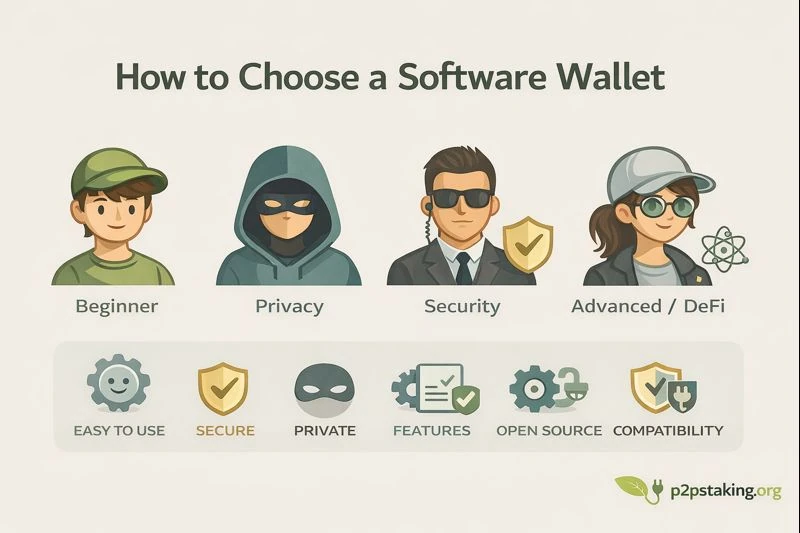
Beginners usually want a wallet that is easy to use and hard to misuse. Clear explanations, good documentation, and safeguards against common mistakes matter more than advanced settings. A beginner-friendly wallet should make basic actions obvious and reduce the risk of irreversible errors.
Privacy-first users care about limiting the information they leak. They tend to pay attention to how wallets connect to the network, how addresses are managed, and whether external services are involved. Convenience is often secondary to reducing tracking and metadata exposure.
Security-first users focus on minimizing risk. They prefer conservative designs, fewer features, and well-tested software. Their priority is not speed or comfort, but reducing trust assumptions and attack surfaces.
Active users, including DeFi users, interact frequently with smart contracts and protocols. They need wallets that are responsive, compatible with multiple platforms, and capable of handling frequent transactions and fee adjustments.
Identifying your main profile helps you filter out wallets that are simply not designed for your needs.
Choose a software wallet by profile (quick decision guide)
If you don’t want to analyze every technical detail, you can start directly with a profile-based recommendation.
In the guides below, we already applied the main factors to consider when choosing a crypto wallet, adjusted to each use case.
We are currently building a series of in-depth guides to help you choose the right software wallet based on your profile and use case.
These guides are published progressively. Some are already available, while others are coming soon.
- Beginners → Best software wallets for beginners
- Privacy-first users → Best privacy-focused software wallets
- Security-first users → Best security-focused software wallets
- DeFi & active users → Best wallets for DeFi and smart contracts
These guides are designed to help you act quickly, without needing to understand every underlying technical choice.
Factors to consider when choosing a crypto wallet
Not all users care about the same things, and not all criteria have the same importance.
A beginner will usually prioritize ease of use and clear documentation. Advanced security features may exist in the background, but they are not the deciding factor.
More experienced users often reverse this logic. Ease of use becomes secondary, while advanced controls, customization, and technical guarantees become essential.
Even within a single criterion, some features may matter a lot for one profile and not at all for another. That’s why choosing a software wallet is a highly personalized process, not a checklist exercise.
Ease of use and user experience (UX)
Ease of use determines how comfortable and safe a wallet feels in daily use.
For beginners, good UX means clear onboarding, understandable language, and confirmations that explain what is about to happen. This reduces stress and prevents common mistakes.
For advanced users, UX is less about simplicity and more about efficiency. They may accept a steeper learning curve if the wallet gives them better control or faster workflows.
In both cases, poor UX increases the risk of user error, which is one of the most common causes of lost funds.
Security
Security is about protecting your private keys and your ability to recover access to your funds.
At a basic level, all serious wallets aim to provide strong key generation and secure storage. Beyond that, differences appear in how recovery works, how transparent the code is, and how the project handles vulnerabilities.
More advanced security features can be useful, but they also add complexity. For beginners, simplicity and proven designs are often safer than sophisticated setups they don’t fully understand.
For experienced users, advanced security options can make sense if they align with a clear threat model and are properly configured.
Privacy
Privacy is not only about hiding balances. It’s also about limiting how much information your wallet leaks when you use it. For example, Tor1 integration is a great option to hide your IP address.
Some wallets rely heavily on third-party services, which can expose metadata such as IP addresses or usage patterns. Others allow more control over network connections and data sharing.
For privacy-first users, these details matter a lot. For others, the trade-off between convenience and privacy may be acceptable, as long as they understand it.
The key point is that privacy is not binary. It’s a spectrum, and different wallets sit at different points on that spectrum.
UTXO management (Bitcoin wallets only)
For Bitcoin users, UTXO management can significantly affect privacy and control.
Being able to choose which coins are spent, label funds, or consolidate outputs helps reduce unwanted links between transactions. These features are especially useful for advanced users and anyone concerned with on-chain privacy.
For beginners, these tools are often unnecessary at first and can even be confusing if introduced too early.
Address and UTXO management matters differently depending on how you use Bitcoin.
During an accumulation phase, it is always good practice to pay some attention to address reuse, but for beginners who are simply stacking sats, it is usually not a critical issue.
For more active Bitcoin users, however, address and UTXO management becomes a real privacy and security concern. Reusing addresses or mixing funds can make it easier for someone you transact with to infer your total holdings. At that point, you are implicitly trusting the other party not to misuse that information—which is rarely a desirable assumption in Bitcoin.
Open source and auditability
Open source wallets allow anyone to inspect the code, which increases transparency.
However, open source alone does not guarantee security.
What really matters is whether the code is actively reviewed, whether audits exist, and how openly issues are discussed and fixed.
Closed-source wallets may still work well, but they require a higher level of trust in the provider.
Features and compatibility
Features should serve a purpose, not just add complexity.
Multi-chain support, smart contract interaction, fee customization, and interoperability can be extremely useful for active users. For others, these same features may be irrelevant or even increase the risk of mistakes.
A good software wallet focuses on useful features for a specific audience, rather than trying to do everything for everyone.
Ready to Take Control of Your Crypto?
Go deeper into self‑custody, software wallets, hardware wallets, and practical guides.

Java‑certified engineer and P2PStaking CEO, I secure validators across Solana, Polkadot, Kusama, Mina, and Near. My articles reflect hands‑on wallet ops and real recovery drills so you can set up self‑custody safely, step by step.
Foot notes
1: Tor goal is to have a way to use the internet with as much privacy as possible, and the idea was to route traffic through multiple servers and encrypt it each step of the way.