At a time when millions of newcomers are buying their first satoshis via centralised exchanges, choosing a platform can feel intimidating. On Pinterest and in our inbox, we see the same question over and over: should I use Binance or CEX.IO to start my crypto journey?
Both exchanges have been around for years and both offer fiat on-ramps, spot trading and staking products. Yet they differ in their product line-up, fee structure and risk profile. In this guide we compare the two side by side and help you decide which one fits your situation while reminding you why self-custody still matters. This article is educational and does not constitute financial advice.
Quick comparison
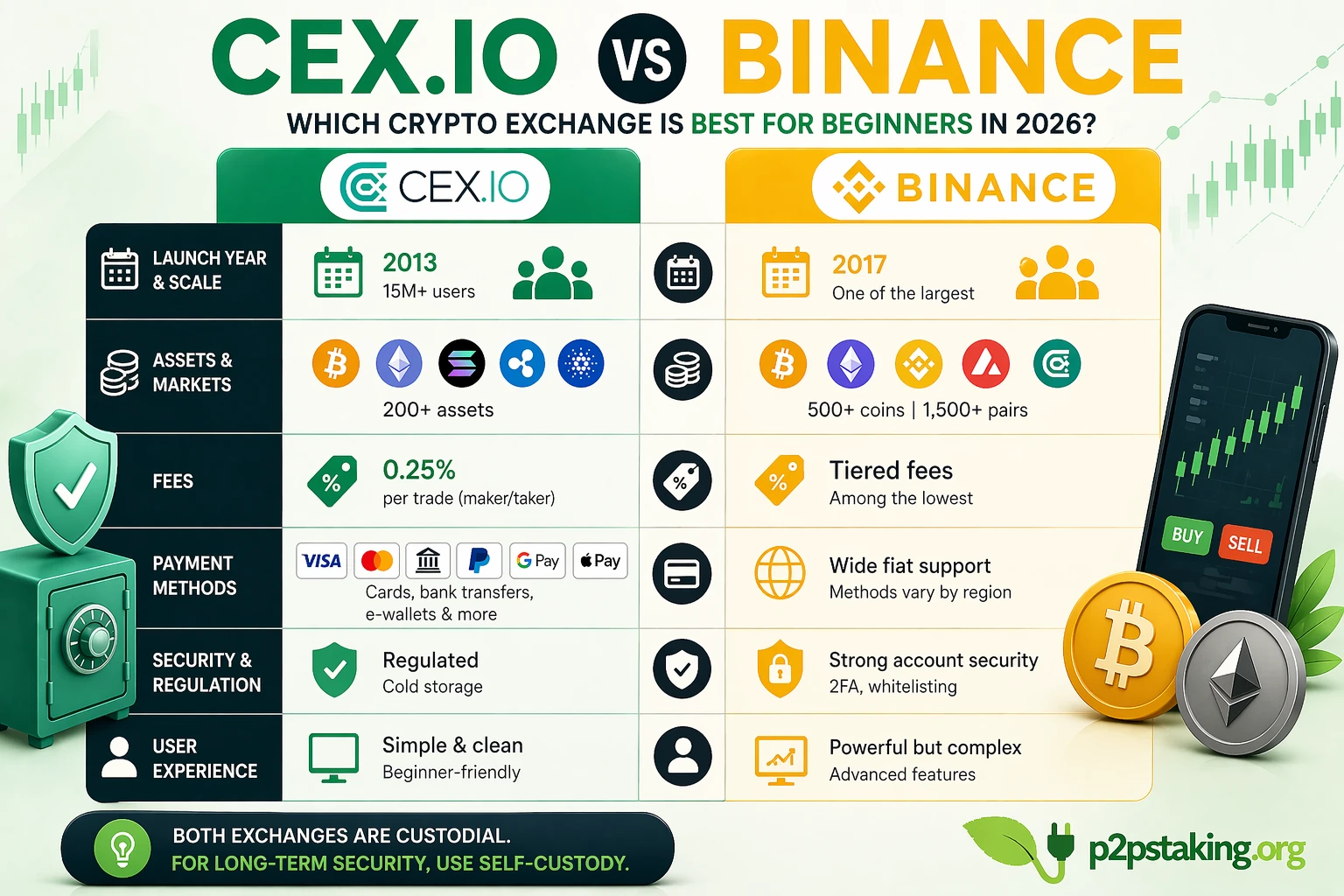
Below is a concise overview of the key differences between CEX.IO and Binance. For more details, jump to the sections below.
| Feature | CEX.IO | Binance |
|---|---|---|
| Launch year & scale | Founded in 2013; claims more than 15 million users. | Founded in 2017; one of the largest exchanges by volume. |
| Assets & markets | Lists over 200 digital assets including BTC, ETH, SOL, XRP, ADA and DOT; offers spot trading, instant buy/sell, limited margin and staking. | Supports 500+ coins and 1,500+ trading pairs; provides spot, margin, derivatives, earn products and more. |
| Fees | Entry-level trading fee of 0.25% per trade for makers and takers; deposit/withdrawal fees vary by method. | Tiered maker/taker fees among the lowest in the market; fees change with volume and region. |
| Payment methods | Accepts Visa/Mastercard, bank transfers (SEPA/SWIFT/ACH), PayPal, Skrill, Neteller, Google Pay, Apple Pay and MoneyGram. | Supports a wide array of fiat corridors; availability of payment methods varies by region. |
| Security & regulation | Regulated with multiple licences; majority of funds stored in cold storage. | Offers strong account-level controls (2FA, whitelisting), but remains custodial. |
| User experience | Simple interface with clear instant-buy options; beginner-friendly. | Powerful but complex; advanced interfaces can overwhelm beginners. |
CEX.IO vs Binance: Key Differences Explained
While both CEX.IO and Binance allow users to buy, sell and stake crypto, they serve slightly different profiles.
- CEX.IO focuses on simplicity, regulation and ease of use for beginners.
- Binance offers a broader ecosystem with lower fees and advanced trading tools.
The right choice depends on your experience level, your goals and how much control you want over your funds.
CEX.IO: where regulation meets simplicity
CEX.IO started life as a Bitcoin mining pool and has since transformed into a regulated crypto exchange with a compliance-first ethos. The platform positions itself as a simple and secure entry point into crypto for beginners while still offering enough depth for more advanced users.
Strengths
- Regulated and transparent – CEX.IO emphasises compliance and security, making it appealing for users who prioritise trust and regulatory clarity.
- Straightforward on-ramp – Buying crypto is simple thanks to multiple payment methods and an easy-to-use interface.
- Useful earn products – Offers staking and savings features directly within the platform.
- Clean user experience – The interface is designed for clarity, making navigation easier for beginners.
Weaknesses
- Higher fees on cards and e-wallets – Convenience comes at a cost, especially for smaller purchases.
- Limited asset selection compared to Binance – Focuses more on established cryptocurrencies.
- Custodial by design – You do not control your private keys when using the platform.
Binance: powerful and expansive
Binance launched in 2017 and quickly became one of the largest crypto exchanges by trading volume. It offers a wide range of services that go far beyond simple buying and selling.
Strengths
- Broad asset coverage – Access to hundreds of cryptocurrencies and trading pairs.
- Competitive fees – One of the lowest fee structures in the industry.
- Advanced trading tools – Margin trading, derivatives, APIs and more.
- Deep liquidity – Reliable execution even for large trades.
Weaknesses
- Complex interface – Can be overwhelming for beginners.
- Regulatory differences by region – Access varies depending on location.
- Custodial risks – As with any centralised exchange, you rely on the platform.
Which exchange should you choose?
- If you’re brand new to crypto, CEX.IO offers a simpler and more guided experience.
- If you want flexibility and lower fees, Binance provides more advanced tools and options.
- If you care about self-custody, remember that both platforms are custodial and should not be used for long-term storage.
In practice, many users combine both platforms depending on their needs.
Best way to get started
If you’re just getting started, the easiest approach is to use a regulated exchange to buy your first crypto, then move toward self-custody as you gain confidence.
- Start with CEX.IO if you want a simple, beginner-friendly experience with clear onboarding.
- Use Binance if you want lower fees and access to a wider range of assets and features.
In both cases, consider withdrawing your crypto to a hardware wallet once you’re comfortable managing your funds.
Using exchanges safely
- Treat exchanges as tools, not vaults – Keep only what you need for trading.
- Enable security features – Use 2FA and withdrawal whitelisting.
- Test withdrawals – Always perform a small test transaction first.
- Stay aware of regulations – Rules vary by country and can change.
- Use hardware wallets – Move long-term holdings to self-custody.
Don’t leave your crypto on exchanges
Exchanges are convenient, but they are not designed for long-term storage. When you keep your crypto on an exchange, you rely entirely on a third party to secure your funds.
A safer approach is to use a hardware wallet, where you control your private keys.
→ See our hardware wallet guide
Get started
Opening an account on either platform is straightforward.
Start small, learn how deposits and withdrawals work, and gradually move toward self-custody as you gain confidence.

Java‑certified engineer and P2PStaking CEO, I secure validators across Solana, Polkadot, Kusama, Mina, and Near. My articles reflect hands‑on wallet ops and real recovery drills so you can set up self‑custody safely, step by step.
Ready to Take Control of Your Crypto?
Go deeper into self‑custody, software wallets, hardware wallets, and practical guides.
Binance vs CEX FAQ
Is Binance better than CEX.IO
Binance offers lower fees and more features, but CEX.IO is often easier to use for beginners.
Is CEX.IO safe?
CEX.IO is a regulated exchange with a strong focus on compliance and security, but like all exchanges, it remains custodial.
Should I keep crypto on Binance or CEX.IO?
Exchanges are best used for buying and trading. For long-term storage, a hardware wallet is generally safer.
Which exchange is best for beginners?
Beginners often prefer simpler platforms like CEX.IO, while more advanced users may choose Binance for its broader feature set.