

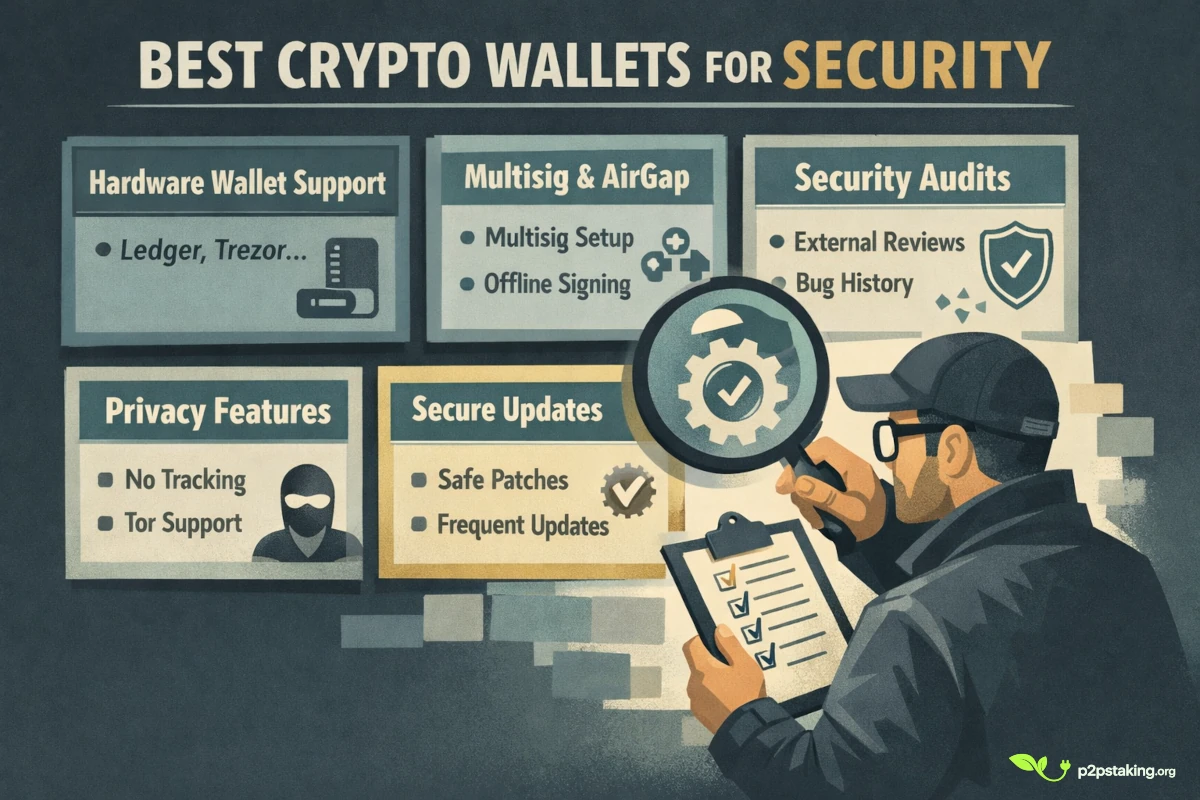
Security is one of the most important aspects of crypto custody. While many users look for convenience or broad asset support, long-term protection depends on how wallets are designed, how well they integrate with hardware devices, and how conservative their security practices are.
This page focuses on the best crypto wallets for security, with a strong emphasis on realistic, security-first setups. It targets users who want to protect meaningful amounts of crypto and are willing to prioritize safety over convenience.
If your needs are different, we also offer dedicated guides for users looking for secure but beginner-friendly wallets, as well as wallets that prioritize privacy and anonymity, depending on your experience level and use case.
Because Bitcoin offers far more mature security tooling than most other blockchains, this guide deliberately separates Bitcoin wallets from other crypto wallets.
Bitcoin makes it easier to implement advanced security practices such as multisignature setups, offline signing, and hardware-agnostic workflows.
For this reason, we present two distinct rankings below.
Best Bitcoin Wallets for Security
These tools are widely regarded as the best Bitcoin wallets for security because Bitcoin’s architecture allows for stronger guarantees, better isolation of private keys, and more advanced signing workflows than most other blockchains.
All wallets listed here support hardware wallets and are commonly used in long-term, security-critical Bitcoin setups.
Bitcoin wallets ranking
| Rank | Wallet | Security Score | Best for |
|---|---|---|---|
| 1 | Sparrow Wallet | 92 | Advanced hardware-based Bitcoin security |
| 2 | Electrum | 88 | Flexible, long-term Bitcoin storage |
| 3 | Specter Desktop | 86 | Multisig and hardware-first setups |
| 4 | Wasabi Wallet | 81 | Network-aware Bitcoin security |
| 5 | Nunchuk | 79 | Accessible multisig for Bitcoin |
| 6 | Blockstream Green | 74 | Strong default security with hardware |
| 7 | BlueWallet | 73 | Secure everyday Bitcoin usage |
These wallets dominate the Bitcoin category because they support multisignature setups, PSBT workflows, air-gapped signing, and compatibility with multiple hardware wallets. This combination makes Bitcoin the easiest ecosystem in which to build very high-security self-custody setups.
Most Secure Crypto Wallets
It includes the most secure options available for Ethereum, Solana, and multi-chain usage, as well as proprietary wallet apps provided by hardware wallet manufacturers.
While these wallets can still offer strong protection, they are more constrained by the underlying blockchains. As a result, even the most secure crypto wallets outside of Bitcoin generally do not reach the same security level as top-tier Bitcoin wallets.
Crypto wallets ranking
| Rank | Wallet | Ecosystem | Security Score | Best for |
|---|---|---|---|---|
| 1 | BitBoxApp | Multi-chain | 78 | Secure multi-chain usage with BitBox hardware |
| 2 | Ledger Live | Multi-chain | 76 | Managing multiple assets with Ledger devices |
| 3 | Trezor Suite | Multi-chain | 75 | Open-source hardware wallet ecosystem |
| 4 | Frame | EVM (Ethereum) | 74 | Security-first Ethereum usage |
| 5 | Phantom | Solana | 71 | Best available Solana wallet security |
Wallets like Frame and Phantom represent the strongest security options available within their respective ecosystems.
Proprietary wallet apps such as Ledger Live, Trezor Suite, and BitBoxApp rank highly because a large part of security is enforced directly by the hardware. They are often the safest and most practical choice for users who manage multiple blockchains from a single device.
Most Secure Crypto Wallets Overviews
Sparrow Wallet overview
Overall security score: 92 / 100
Main blockchains: Bitcoin
Platforms: Windows, macOS, Linux
Hardware wallet compatibility: Yes (Ledger, Trezor, BitBox, Coldcard, Keystone, Passport)
Wallet type: Non-custodial
Tor support: Yes (manual configuration, not enabled by default)
Launch year: 2020
Sparrow Wallet is widely regarded as one of the most secure Bitcoin software wallets available today. It is designed from the ground up for hardware-based and offline-first workflows, making it particularly well suited for long-term Bitcoin storage and advanced security setups.
Its architecture emphasizes explicit transaction signing, PSBT workflows, and deep hardware wallet integration, allowing users to keep private keys fully isolated from internet-connected environments. Sparrow also offers strong support for multisignature wallets and integrates well with personal Bitcoin nodes, which reduces reliance on third-party infrastructure.
Rather than optimizing for simplicity, Sparrow prioritizes transparency and control, making security decisions explicit at every step. This approach significantly reduces the risk of silent failures or accidental key exposure.
| Pros | Cons |
|---|---|
| Excellent hardware wallet support | Steeper learning curve |
| Strong multisig and PSBT workflows | Bitcoin-only |
| Node and Tor compatibility | No mobile version |
| Transparent transaction signing | |
| Actively maintained |
Best suited for
Advanced users seeking maximum Bitcoin security with hardware wallets.
Electrum overview
Overall security score: 88 / 100
Main blockchains: Bitcoin
Platforms: Windows, macOS, Linux, Android
Hardware wallet compatibility: Yes (Ledger, Trezor, BitBox, Coldcard, KeepKey)
Wallet type: Non-custodial
Tor support: Yes (manual proxy configuration)
Launch year: 2011
Electrum is one of the oldest and most battle-tested Bitcoin wallets. Its long track record, combined with a flexible architecture, makes it a strong choice for users who want security without being locked into a single workflow.
Electrum supports a wide range of hardware wallets and allows advanced users to configure multisignature setups, watch-only wallets, and offline signing. Its lightweight design makes it efficient, while its maturity has resulted in well-documented and well-understood security behaviors.
Although its interface can feel technical, Electrum’s explicit approach to key management and signing provides a high level of control, which is critical for secure Bitcoin custody.
| Pros | Cons |
|---|---|
| Long track record | Interface feels technical |
| Strong hardware wallet support | Less beginner-friendly |
| Multisig and offline signing | Bitcoin-only |
| Lightweight and efficient | |
| Open source |
Best suited for
Experienced Bitcoin users who value flexibility and proven security.
Specter Desktop overview
Overall security score: 86 / 100
Main blockchains: Bitcoin
Platforms: Windows, macOS, Linux
Hardware wallet compatibility: Yes (Ledger, Trezor, BitBox, Coldcard, Keystone)
Wallet type: Non-custodial
Tor support: Yes (via node integration)
Launch year: 2019
Specter Desktop is a Bitcoin wallet specifically designed around hardware wallets and multisignature security. It is often used as a coordination layer rather than a traditional hot wallet.
Specter excels at managing complex setups, including multisig vaults, air-gapped signing devices, and personal Bitcoin nodes. By separating key storage from transaction coordination, it minimizes the attack surface and makes security assumptions explicit.
Its design philosophy assumes that users care deeply about custody and are willing to trade simplicity for stronger guarantees.
| Pros | Cons |
|---|---|
| Excellent multisig support | Desktop only |
| Hardware-first design | Requires some setup |
| Strong node integration | Bitcoin-only |
| Air-gapped workflows | |
| Open source |
Best suited for
Users building multisig or hardware-centric Bitcoin security setups.
Wasabi Wallet overview
Overall security score: 81 / 100
Main blockchains: Bitcoin
Platforms: Windows, macOS, Linux
Hardware wallet compatibility: Yes (Ledger, Trezor)
Wallet type: Non-custodial
Tor support: Yes (enabled by default)
Launch year: 2018
Wasabi Wallet focuses on network-level privacy and security. Its default Tor integration helps reduce metadata leakage and makes it harder to link transactions to specific IP addresses.
While its CoinJoin implementation has evolved over time, Wasabi remains a solid option for users who want strong default protections against network surveillance. Hardware wallet support allows users to combine privacy features with key isolation.
Wasabi’s security model emphasizes minimizing data exposure rather than advanced signing workflows, which places it slightly below the most flexible Bitcoin wallets.
| Pros | Cons |
|---|---|
| Tor enabled by default | Limited multisig support |
| Strong network privacy | Hardware support is limited |
| Non-custodial design | Bitcoin-only |
| Clean desktop UX | |
| Active development |
Best suited for
Bitcoin users focused on network privacy and simple hardware integration.
Nunchuk overview
Overall security score: 79 / 100
Main blockchains: Bitcoin
Platforms: Windows, macOS, Linux, iOS, Android
Hardware wallet compatibility: Yes (Ledger, Trezor, Coldcard, BitBox)
Wallet type: Non-custodial
Tor support: Partial (via node setup)
Launch year: 2021
Nunchuk is designed to make multisignature Bitcoin security more accessible. It abstracts much of the complexity typically associated with multisig setups while preserving strong security guarantees.
By encouraging key separation and shared signing, Nunchuk reduces single points of failure. Its mobile support makes multisig more practical for everyday use, although advanced configurations still require careful planning.
Nunchuk’s strength lies in balancing strong security principles with a more approachable user experience.
| Pros | Cons |
|---|---|
| Multisig made accessible | Less flexible than Sparrow |
| Hardware wallet support | Advanced setups still complex |
| Mobile and desktop support | Bitcoin-only |
| Clear signing flows | |
| Actively developed |
Best suited for
Users who want multisig Bitcoin security without heavy technical overhead.
Blockstream Green overview
Overall security score: 74 / 100
Main blockchains: Bitcoin, Liquid
Platforms: iOS, Android, Windows, macOS
Hardware wallet compatibility: Yes (Ledger)
Wallet type: Non-custodial (2FA-based multisig)
Tor support: Yes (optional)
Launch year: 2016
Blockstream Green emphasizes strong default security through a 2-of-2 multisig model with optional two-factor authentication. This approach reduces the risk of single-key compromise.
Green is easier to use than many Bitcoin-focused security wallets, but its reliance on a service component slightly limits flexibility compared to fully self-managed multisig setups.
| Pros | Cons |
|---|---|
| Strong default security | Less flexible multisig |
| Hardware wallet support | Service dependency |
| Mobile-friendly | Bitcoin-focused |
| 2FA protection | |
| Clean UX |
Best suited for
Users who want strong Bitcoin security with minimal configuration.
BlueWallet overview
Overall security score: 73 / 100
Main blockchains: Bitcoin
Platforms: iOS, Android
Hardware wallet compatibility: Yes (Ledger via external setups)
Wallet type: Non-custodial
Tor support: Indirect (via node configuration)
Launch year: 2017
BlueWallet is primarily a mobile Bitcoin wallet, but it supports advanced features such as watch-only wallets and hardware-backed setups when combined with external tools.
While not as powerful as desktop-focused wallets, BlueWallet can be part of a secure architecture when used carefully, particularly as an interface rather than a key holder.
| Pros | Cons |
|---|---|
| Mobile convenience | Limited advanced workflows |
| Watch-only support | Hardware setup less direct |
| Clean interface | Bitcoin-only |
| Open source | |
| Actively maintained |
Best suited for
Everyday Bitcoin usage with optional hardware-backed security.
BitBoxApp overview
Overall security score: 78 / 100
Main blockchains: Multi-chain
Platforms: Windows, macOS, Linux, iOS, Android
Hardware wallet compatibility: Yes (BitBox02)
Wallet type: Hardware-centric
Tor support: No
Launch year: 2019
BitBoxApp is designed to work exclusively with the BitBox02 hardware wallet. Its strength lies in tight hardware-software integration and a conservative security model.
Although it lacks advanced multisig or air-gapped workflows, the combination of a secure hardware device and a clean interface makes it one of the most secure options for multi-chain users.
| Pros | Cons |
|---|---|
| Strong hardware isolation | Single-hardware ecosystem |
| Clean UX | Limited advanced workflows |
| Multi-chain support | No Tor integration |
| Conservative updates | |
| Open source |
Best suited for
Users seeking secure multi-chain storage with minimal complexity.
Ledger Live overview
Overall security score: 76 / 100
Main blockchains: Multi-chain
Platforms: Windows, macOS, Linux, iOS, Android
Hardware wallet compatibility: Yes (Ledger)
Wallet type: Hardware-centric
Tor support: No
Launch year: 2016
Ledger Live provides a secure interface for Ledger hardware wallets, covering a wide range of assets. Most of its security comes from the hardware itself, with the software acting as a controlled gateway.
While less flexible than hardware-agnostic wallets, Ledger Live offers a strong baseline for users managing many assets from a single device.
| Pros | Cons |
|---|---|
| Broad asset support | Closed ecosystem |
| Strong hardware security | Limited advanced workflows |
| Mobile and desktop apps | No Tor |
| Frequent updates | |
| Large user base |
Best suited for
Multi-asset users prioritizing simplicity and hardware-enforced security.
Trezor Suite overview
Overall security score: 75 / 100
Main blockchains: Multi-chain
Platforms: Windows, macOS, Linux
Hardware wallet compatibility: Yes (Trezor)
Wallet type: Hardware-centric
Tor support: Yes (optional)
Launch year: 2021
Trezor Suite is built around transparency and open-source principles. Its optional Tor integration and open development process contribute to a solid security posture.
Although it lacks some advanced Bitcoin workflows, Trezor Suite remains a strong choice for users who value openness and hardware-backed security.
| Pros | Cons |
|---|---|
| Open-source approach | Limited multisig features |
| Tor support | Desktop-focused |
| Hardware isolation | Single-hardware ecosystem |
| Clean UX | |
| Conservative design |
Best suited for
Users who prefer open-source hardware wallet ecosystems.
Frame overview
Overall security score: 74 / 100
Main blockchains: Ethereum (EVM)
Platforms: Windows, macOS, Linux
Hardware wallet compatibility: Yes (Ledger, Trezor)
Wallet type: Non-custodial
Tor support: No
Launch year: 2019
Frame is one of the most security-focused Ethereum wallets available. Its desktop-first approach reduces risks associated with browser-based wallets and provides better isolation for signing operations.
While Ethereum’s architecture limits advanced security workflows, Frame offers a more conservative and transparent alternative to typical browser extensions.
| Pros | Cons |
|---|---|
| Desktop-first design | Ethereum limitations |
| Hardware wallet support | No multisig |
| Clear signing flows | No Tor |
| Open source | |
| Actively maintained |
Best suited for
Ethereum users who prioritize security over convenience.
Phantom overview
Overall security score: 71 / 100
Main blockchains: Solana
Platforms: iOS, Android, Browser extension
Hardware wallet compatibility: Yes (Ledger)
Wallet type: Non-custodial
Tor support: No
Launch year: 2021
Phantom is currently the strongest security option in the Solana ecosystem. Hardware wallet support and clear transaction previews help reduce common user errors.
However, Solana’s architecture limits advanced custody models, and Phantom remains a hot wallet by design.
| Pros | Cons |
|---|---|
| Best Solana security option | Hot wallet architecture |
| Hardware wallet support | Limited advanced workflows |
| Clear UX | No Tor |
| Active development | |
| Large ecosystem support |
Best suited for
Solana users seeking the strongest available security.
What Makes a Crypto Wallet Secure?
A secure crypto wallet is not defined by a single feature. Security emerges from how multiple layers work together to reduce attack surfaces and limit the impact of mistakes.
At a high level, security depends on how private keys are generated, stored, and used, and whether they can remain isolated from internet-connected environments. Wallets that integrate hardware devices, support offline signing, or enable multisignature setups significantly reduce the risk of remote compromise.
Access protection also matters. Strong passwords, biometric locks, and clear transaction confirmation help prevent unauthorized access and user error. In some cases, additional mechanisms such as decoy or duress wallets can reduce risks linked to physical coercion.
Finally, long-term maintenance is essential. A wallet that is actively developed, regularly updated, and conservative in how new features are introduced is far more reliable than software that prioritizes speed or experimentation over safety.
How Our Security Score Works
Our Security Score evaluates wallets on a scale of 100 points. It is designed to reflect real-world security rather than marketing claims, with a strong focus on hardware integration, safe development practices, and long-term reliability.
Security features – 25 points
This category evaluates the mechanisms that directly protect private keys and transaction signing.
We look at support for secure signing workflows, multisignature setups, PSBT compatibility, and safeguards that prevent accidental or malicious transactions. Wallets that allow sensitive operations to be performed without exposing private keys to an online environment score higher.
External audits & track record – 20 points
Security must be evaluated over time.
We consider independent third-party assessments1 when available, along with past security incidents, transparency around vulnerabilities, update responsiveness, and documentation quality. There is an important difference between technical security and security of use, and both are reflected in this score.
Hardware wallet support & consistency – 15 points
Hardware wallet integration is a cornerstone of modern crypto security.
Wallets receive:
- 8 points if they support at least one major hardware wallet among Ledger, Trezor, BitBox, or Coldcard
- up to 12 points if they support several hardware wallets from different manufacturers
The remaining points are awarded for advanced capabilities, including:
- multisignature compatibility with hardware wallets
- air-gapped signing support, which allows transactions to be signed on fully offline devices
This category favors wallets that enable strong hardware-based security without locking users into a single ecosystem.
Privacy features (security-relevant) – 15 points
While this ranking focuses on security rather than anonymity, certain privacy features reduce security risks.
We evaluate whether a wallet can connect to a personal node, limit reliance on third-party infrastructure, and reduce metadata exposure. These features lower the risk of targeted attacks and surveillance-based exploitation.
Architecture, threat model & open-source exposure – 15 points
This category evaluates how a wallet is designed and how transparent it is.
We look at whether the architecture limits attack surfaces, follows established standards, and clearly defines its threat model. Open-source code and responsible vulnerability handling reduce the risk of hidden backdoors and make independent verification possible.
Update policy & secure development – 5 points
Frequent updates alone do not guarantee security.
We evaluate how regularly a wallet is updated and how safely new features are introduced. Conservative update policies, optional or opt-in advanced features, and the use of developer or experimental modes for higher-risk changes score higher.
Wallets that introduce sensitive features by default, without clear safeguards or user consent, score lower in this category.
User experience for security – 5 points
This category focuses on reducing user error rather than ease of use.
Clear warnings, explicit transaction confirmations, predictable workflows, and sensible defaults all contribute to safer real-world usage, especially for high-value operations.
Final Thoughts
Security in crypto is not about finding a single perfect wallet. It is about choosing the right tools, understanding their limitations, and applying consistent security practices.
The best crypto wallets for security are those that integrate well with hardware devices, support advanced workflows, and follow conservative, transparent development practices. Whether you choose a hardware-agnostic wallet or a proprietary app depends on your priorities — flexibility or simplicity — but in all cases, security should be intentional, not accidental.
Ready to Take Control of Your Crypto?
Go deeper into self‑custody, software wallets, hardware wallets, and practical guides.

Java‑certified engineer and P2PStaking CEO, I secure validators across Solana, Polkadot, Kusama, Mina, and Near. My articles reflect hands‑on wallet ops and real recovery drills so you can set up self‑custody safely, step by step.
Common Security FAQ
Is a software wallet secure enough for large amounts?
A software wallet alone can be secure, but for large amounts it is usually not sufficient by itself. Combining a software wallet with hardware devices, multisig, or offline signing dramatically improves security and reduces exposure to malware or remote attacks.
What is the most secure crypto wallet setup?
The most secure setups typically involve a hardware wallet or air-gapped device, used with a software wallet in watch-only or PSBT mode. Multisig configurations and offline backups further reduce risk. The optimal setup depends on the user’s technical comfort and threat model.
Is a hardware wallet required for maximum security?
While not strictly required, a hardware wallet is strongly recommended for maximum security. Hardware devices isolate private keys from internet-connected environments, which significantly reduces the risk of compromise. For high-value holdings, hardware wallets are considered a baseline rather than an optional feature.
What is the safest place to hold crypto?
There is no single “safest place” in absolute terms. For most users, the safest setup combines a hardware wallet with a reputable software wallet interface, offline backups, and disciplined operational practices. Security depends on how well the setup matches the user’s threat model.
Can someone steal crypto from a cold wallet?
In most cases, no — not remotely. A properly used cold wallet keeps private keys offline, which prevents remote attacks. However, physical access, compromised backups, poor seed storage, or user coercion can still lead to loss. Cold storage reduces attack vectors, but it does not eliminate all risks.
Should I keep all my crypto in one wallet?
In most cases, it is not recommended to keep all your crypto in a single wallet. Spreading funds across multiple wallets can reduce the impact of a single failure or mistake.
That said, not all wallets need the same level of security. It is perfectly reasonable to use simple software wallets for experimentation, testing, or small everyday amounts, where convenience matters more than maximum protection.
The key point is consistency for wallets holding significant funds. Any wallet used for long-term storage or meaningful amounts should follow the same high security standards: proper seed backups, strong access protection, and, ideally, hardware wallet integration. Diversification improves security only if it does not introduce a weaker link where it matters most.
What are the specific benefits of using a multi-signature wallet?
Multi-signature wallets require multiple keys to authorize a transaction. This reduces single-point-of-failure risks and makes theft significantly harder. Multisig setups are particularly useful for long-term holdings, shared custody, or protecting funds against physical coercion.
Footnotes
1: Certik Skynet and cer.live
