Prediction markets have existed for decades. Sports betting platforms, political betting sites, and financial derivatives all try—each in their own way—to answer the same question: how do we price uncertainty?
What crypto changes is how trust, custody, and market efficiency are handled. Polymarket is one of the clearest real‑world examples of this shift.
This article explains how crypto‑native prediction markets work, why they are structurally different from traditional sports betting platforms, and why Polymarket prediction market has become a reference point for this new category.
What is Polymarket?
Polymarket is a crypto‑based prediction market where users trade on the outcome of real‑world events.
Each market is framed as a Yes / No question:
- Will the U.S. government shut down before a certain date?
- Will a candidate win an election?
- Which tennis player will win a given game?
Instead of placing a fixed bet against a bookmaker, users buy and sell outcome shares. A “Yes” share priced at $0.62 implies a 62% market‑estimated probability. If the event resolves as Yes, that share settles at $1. If not, it settles at $0.
In other words: Polymarket prices probability in real time.
Polymarket prediction market vs traditional sports betting
At first glance, Polymarket can look similar to a sports betting website. In reality, the mechanics are fundamentally different.
1. Market structure
Traditional betting platforms:
- You bet against the house: On traditional betting platforms, the operator is always your counterparty. The platform profits when users lose and manages its own risk exposure accordingly.
- Odds are set and adjusted by the operator: Odds are determined by internal models and manually adjusted by the bookmaker to balance risk and protect margins. Users have no visibility into how probabilities are calculated.
- Your position is usually locked until the event ends: Once a bet is placed, funds are typically locked until the event concludes. Early exit options, if available, are limited and usually come with unfavorable terms.
Polymarket:
- You trade with other users: On Polymarket, users trade directly with one another rather than against a centralized operator. The platform itself does not take directional positions on outcomes.
- Prices are set by supply and demand: Market prices emerge organically based on user beliefs and available information. As new data appears, participants adjust their positions, and prices update in real time.
- Positions are liquid and tradable before resolution: Prediction shares can be bought and sold at any time before the event resolves. This allows users to take profits, cut losses, or rebalance positions without waiting for the final outcome.
Each prediction behaves more like a financial market instrument than a bet.
2. Order books and liquidity
On Polymarket, each outcome has a live order book.
That means:
- You can buy Yes or No shares: Each outcome is represented by tradable shares that reflect the market’s estimated probability. Buying a Yes or No share is equivalent to taking a position on how likely you believe the event is to occur.
- You can place limit orders: Instead of accepting the current market price, users can set limit orders at specific price levels. This allows for more precise entries and exits, similar to trading on traditional financial exchanges.
- You can sell your position at any time: Positions are not locked until resolution and can be sold whenever there is liquidity in the order book. This enables active risk management, profit-taking, or repositioning as new information emerges.
If you buy a Yes share at $0.40 and market sentiment shifts to $0.65, you can sell before the event happens and lock in profit.
This is a key difference from sports betting, where early exits—if they exist at all—are controlled and priced by the bookmaker.
3. No bookmaker advantage
Sports betting platforms embed:
- Margins
- Odds shading
- Withdrawal restrictions
Polymarket does not price outcomes. The market does.
There is no hidden edge beyond fees and liquidity.
This is why prediction markets are often described as some of the most efficient information aggregation tools ever built.
Since you hold the private key that manage your funds in the smart contract, you can withdraw at anytime.
How does Polymarket work?
Polymarket runs entirely on smart contracts.
Here is the core flow:
- Users deposit USDC: Users fund their Polymarket account by depositing USDC, either directly from their crypto wallet or via a fiat on-ramp. Once deposited, these funds are associated with the user’s wallet address.
- Funds are locked in smart contracts: Deposited funds are held and managed by smart contracts that enforce the market rules. While the funds are locked, they remain fully governed by on-chain logic rather than discretionary platform control.
- Users trade outcome shares via their wallet: All trading actions are authorized through wallet signatures. This ensures that only the wallet owner can initiate trades or allocate funds to specific prediction positions.
- When the event resolves, contracts settle automatically: Once a reliable outcome source confirms the result, the smart contracts automatically settle the market. Winning shares redeem for $1 in USDC, while losing shares settle at $0, with no manual intervention required.
No manual payouts. No operator discretion.
Self‑custody, even when funds are locked
A common question is whether users really control their funds.
The answer is yes, with an important distinction:
- Funds are not stored in your wallet
- Funds are locked in smart contracts
- Only your wallet signature can move or use them
Polymarket cannot:
- Trade on your behalf
- Withdraw your funds
- Change market outcomes
Your wallet acts as:
- Your identity
- Your authorization layer
- Your only key to interacting with the contracts
This is very different from traditional betting platforms, where the operator has full custody and control.
Using crypto on Polymarket
Crypto is not just a payment method here. It is the infrastructure layer.
By using crypto on Polymarket:
- Trades settle programmatically
- Custody risk is minimized
- Transparency is built‑in
- Global access is possible
This is why the platform behaves more like a decentralized exchange than a betting website.
Bet on Polymarket: trading probabilities, not just outcomes
When you bet on Polymarket, you are not simply predicting an outcome.
You are expressing a view on:
- Whether the market is overpricing or underpricing a probability
- How sentiment may change over time
This opens strategies that do not exist in sports betting:
- Trading volatility
- Arbitraging mispriced probabilities
- Exiting positions early
Prediction markets reward information, timing, and market reading, not just luck.
Is Polymarket legal?
Polymarket operates under geographic restrictions.
Availability depends on your jurisdiction, and access can change over time. Users should always check the official page listing supported regions before using the platform.
If you are in a restricted geography, attempting to use Polymarket may violate local regulations.
This is one of the platform’s key limitations today.
Polymarket government shutdown markets
One of the most visible examples of Polymarket’s usefulness has been markets related to U.S. government shutdowns.
These markets often:
- React faster than traditional media
- Reflect insider‑level expectations
- Update continuously as negotiations evolve
They illustrate why prediction markets are often described as real‑time sentiment engines rather than gambling tools.
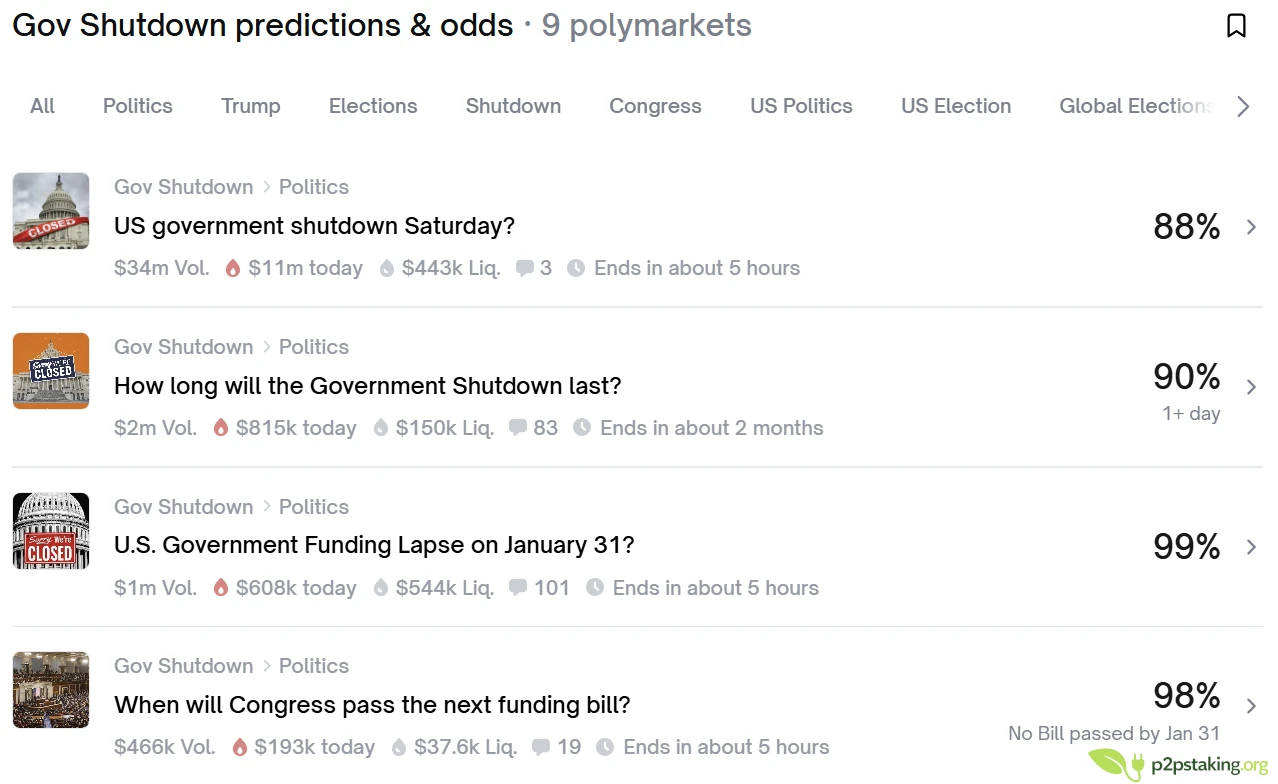
At the time of writing, the most active government-related markets on Polymarket focus on the risk of a U.S. government shutdown. The most popular questions include:
- Will the U.S. government shut down on Saturday?
- How long will the government shutdown last?
- Will U.S. government funding lapse on January 31?
These markets attract significant trading volume and update in real time as negotiations evolve, offering a continuous snapshot of how participants assess political risk.
Advantages and limitations of Polymarket
Advantages
- Non‑custodial architecture: User funds are locked in smart contracts rather than held by a centralized operator. While the assets are not stored directly in the user’s wallet, only the wallet owner can authorize trades or withdrawals, significantly reducing counterparty risk.
- Transparent settlement: All markets resolve according to predefined rules enforced by smart contracts and external data sources. This removes discretionary payouts and ensures that outcomes are settled consistently and publicly.
- Liquid, tradable positions: Unlike traditional betting, positions on Polymarket can be bought and sold at any time before an event resolves. This allows users to take profits, cut losses, or adjust exposure as probabilities evolve.
- Market‑driven pricing: Prices are determined by supply and demand, not by a bookmaker. As a result, probabilities reflect aggregated beliefs from all participants rather than odds set by an operator with a built-in margin.
- Global, permissionless access (where legal): Anyone in a supported jurisdiction with a wallet and USDC can participate. There is no account approval process beyond basic access restrictions, making entry relatively frictionless for crypto-native users.
Limitations
- Regulatory uncertainty: Prediction markets sit at the intersection of finance, gambling, and politics. Legal status varies by jurisdiction and can change quickly, which limits access and creates uncertainty for users.
- Liquidity varies by market: Major political or macroeconomic markets are often highly liquid, but niche topics may have thinner order books. Lower liquidity can lead to wider spreads and more price volatility.
- Outcomes depend on oracle resolution: Market outcomes rely on external data sources to resolve events. While resolution rules are defined in advance, disputes or ambiguity around real-world outcomes can occasionally create friction.
Final thoughts
The Polymarket prediction market shows what becomes possible when crypto replaces trust with code.
Compared to traditional sports betting, the shift is structural:
- From custody to self‑custody
- From fixed bets to liquid markets
- From operator control to smart contract enforcement
This is not just a new betting platform. It is a new way to trade beliefs about the future.
As regulation, UX, and liquidity improve, prediction markets may become one of the most impactful real‑world use cases of crypto infrastructure.
Ready to Take Control of Your Crypto?
Go deeper into self‑custody, software wallets, hardware wallets, and practical guides.

Java‑certified engineer and P2PStaking CEO, I secure validators across Solana, Polkadot, Kusama, Mina, and Near. My articles reflect hands‑on wallet ops and real recovery drills so you can set up self‑custody safely, step by step.