This page provides an exchange-specific safety assessment of Binance, focusing on security history, transparency, regulatory posture, and operational reliability, in comparison with other major centralized exchanges.
Other read: Binance Review 2026
Key Takeaways
Is Binance Safe to use as an Exchange?
- Yes, Binance is generally considered a safe and operationally resilient exchange compared to other large centralized platforms, based on its long operating history, security response capabilities, and scale of internal controls.
- Binance has experienced security incidents in the past, most notably a 2019 hack, but user losses were covered and systems were reinforced afterward.
As with all centralized exchanges, custodial and regulatory risks remain, and safety depends both on the platform and on how users configure their accounts.
What Is Binance?
Binance is a global centralized crypto exchange founded in 2017. It operates through a multi-entity corporate structure with services offered across numerous jurisdictions.
Relevant context for safety assessment:
- Scale: One of the largest exchanges globally by trading volume and user base.
- Geographic footprint: Operates internationally with region-specific entities and compliance frameworks.
- Services: Custodial spot trading, derivatives (where permitted), fiat on-ramps, and ancillary infrastructure services.
- Regulatory posture:
- Registered or licensed in several jurisdictions
- Subject to restrictions or service limitations in certain countries
- Ongoing regulatory engagement has shaped product availability over time
Custodial Model (Brief Context)
Binance operates as a custodial exchange. Users do not control private keys directly, which simplifies access and liquidity but introduces counterparty and compliance exposure typical of centralized platforms.
Binance Security Track Record and Incident Timeline
This section focuses on documented, verifiable events.
2019 Hot Wallet Breach
- Event: Unauthorized access resulted in the theft of approximately 7,000 BTC.
- Impact: Affected funds were fully covered by Binance, with no direct user losses.
- Response: Withdrawals were temporarily paused; internal security architecture was reviewed and strengthened.
- Disclosure: Publicly acknowledged and detailed by Binance shortly after discovery.1
Operational and Regulatory-Related Account Restrictions
- Over the years, some users have experienced account freezes or withdrawal delays, typically linked to:
- Compliance reviews
- Jurisdictional changes
- Enhanced KYC/AML enforcement
- These events are not unique to Binance but are more visible due to its scale.
No subsequent large-scale loss of user funds due to external hacks has been publicly confirmed since 2019 at the time of writing.
User Feedback on Trustpilot: Reasons for Low Ratings
On Trustpilot, Binance’s review profile has historically shown a high proportion of low-star ratings, including many 1-star submissions.2 This reflects perceptions and frustrations expressed by individual users, rather than an objective safety metric for the platform as a whole. Key themes that recur in these negative reviews include:
- Account access and verification issues — Some users report prolonged or unclear verification processes that, in their experience, delayed or prevented withdrawals.
- Customer support challenges — Multiple reviewers describe interactions with support as slow, templated, or insufficiently responsive in resolving account-specific problems.
- Frozen or restricted accounts — Some accounts have been reported as frozen or restricted due to compliance reviews or risk flags, with users expressing frustration about clarity and timelines.
- Interface and process complexity — Users have reported difficulty navigating verification or deposit/withdrawal procedures, citing platform complexity.
These recurring user reports reinforce our recommendations (see in our guide on using exchanges safely):
- Start by testing the platform with small deposits and withdrawals
- Verify your account status, verification level, and withdrawal limits early
- Only then deposit the amount you actually intend to trade
This approach helps surface potential friction points—such as compliance checks or withdrawal constraints—before larger amounts are involved, and reflects a prudent way to interact with custodial infrastructure.
Binance Security Architecture
This section describes Binance-specific controls, not generic best practices.
Fund Protection
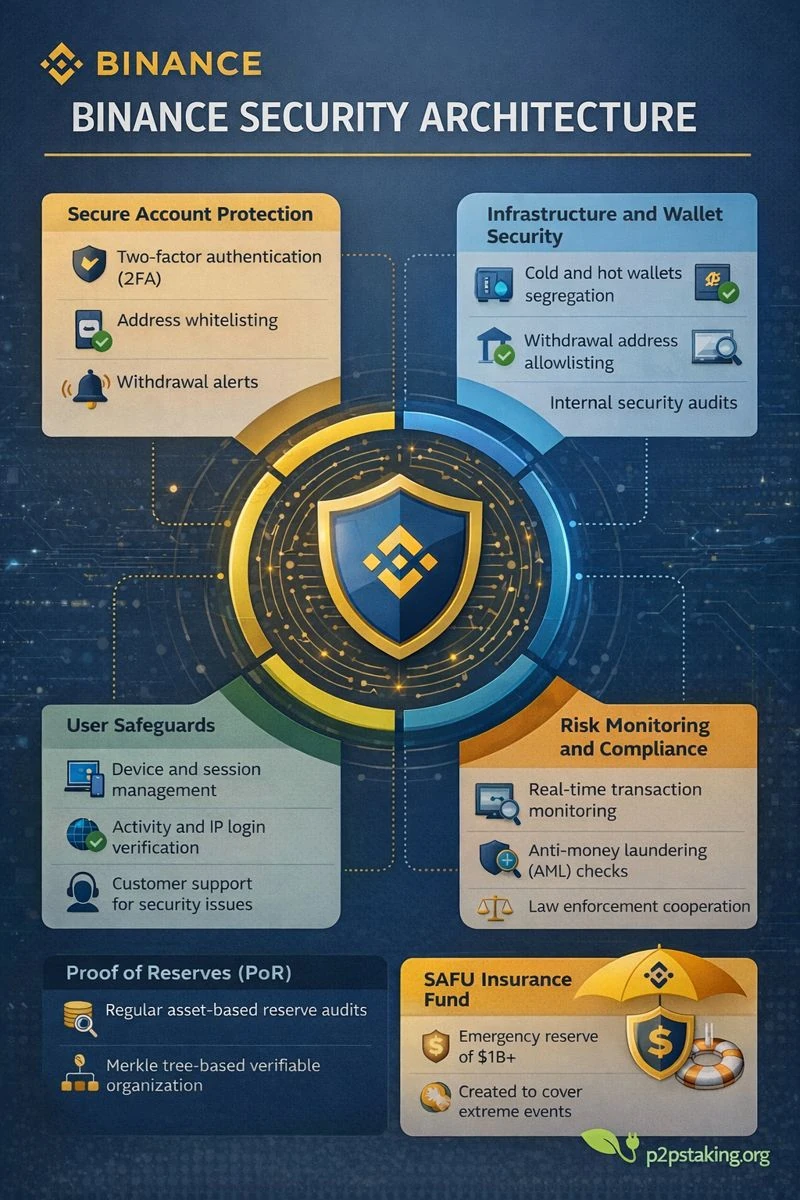
- Segregation between hot and cold wallets, with limited hot wallet exposure
- Internal emergency fund mechanisms designed to absorb losses from incidents
- Withdrawal risk controls that can trigger temporary pauses during anomalies
These measures aim to limit blast radius, not eliminate risk.
Proof of Reserves (PoR) and Transparency
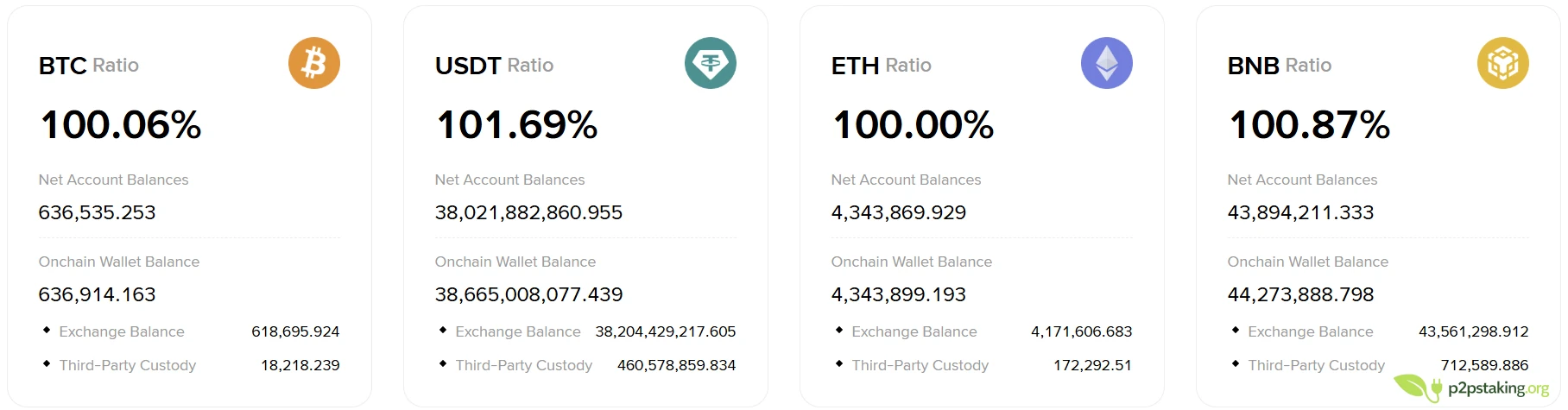
- Binance publishes Proof of Reserves attestations for selected assets.
- PoR disclosures include:
- On-chain asset balances
- Merkle tree-based user balance verification
- Limitations:
- Liabilities coverage depends on scope
- PoR is not equivalent to a full financial audit
This approach increases transparency compared to exchanges without PoR, while remaining incomplete by design.
SAFU (Secure Asset Fund for Users): What it is and what it does
Binance maintains an internal emergency reserve commonly referred to as SAFU (“Secure Asset Fund for Users”). SAFU is presented by Binance as a contingency fund intended to help cover certain losses in the event of specific security incidents.
In practical terms:
- Purpose: SAFU is designed as a risk-buffer for extreme situations (for example, a security breach impacting exchange-controlled wallets).
- Funding model: Binance has historically described SAFU as being funded from a portion of trading fees, with the goal of building a reserve over time.
- What it can help with: In past incidents, Binance has indicated it used SAFU (or similar internal reserves) to cover user losses following security events.
- What it does not guarantee: SAFU is not the same as regulated deposit insurance, and it does not remove custodial risk. Coverage conditions, scope, and decision-making remain internal to Binance and may vary by incident or jurisdiction.
A SAFU-type fund can reduce the impact of certain events, but it should be understood as a platform-level mitigation, not a user-controlled protection. Users still rely on Binance’s internal processes and policies when such mechanisms are triggered.
Organizational Security Controls
- Segmented internal access to production systems
- Dedicated security and incident response teams
- Periodic transparency updates and public disclosures following incidents
Details are partially disclosed, consistent with industry norms for large custodians.
Binance Security Checklist (10 Steps You Should Do Today)
Even on a comparatively secure exchange like Binance, account safety depends heavily on user configuration.
Minimum setup
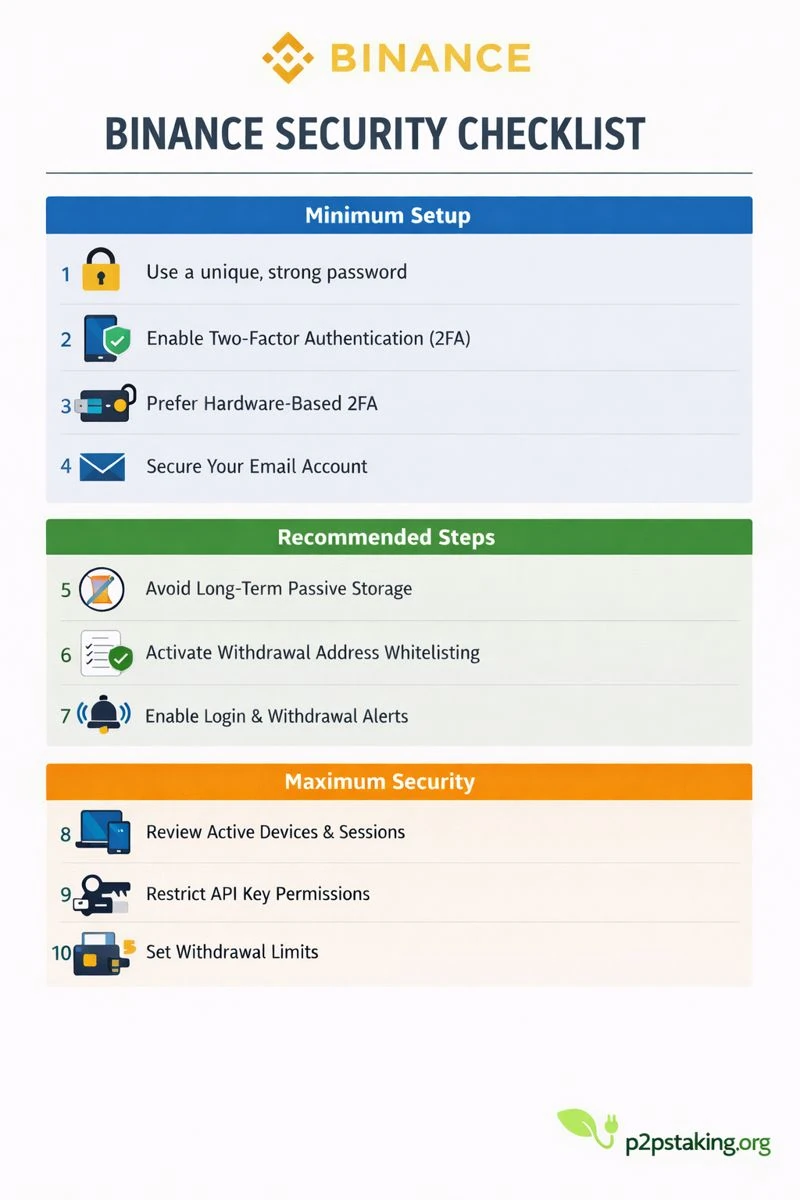
- Use a unique, strong password
- Enable two-factor authentication (2FA)
- Prefer hardware-based 2FA where supported (authentication app on phone)
- Secure the email account linked to Binance
Recommended steps
- Avoid long-term passive storage on the exchange
- Activate withdrawal address whitelisting
- Enable login and withdrawal alerts
Maximum security
- Review active devices and sessions
- Restrict API key permissions
- Set withdrawal limits
For a broader framework, see: How to use exchanges safely.
What Are the Risks of Using Binance?
This section focuses on risks specifically relevant to Binance.
- Custodial risk: Users rely on Binance’s internal controls and solvency.
- Regulatory risk: Service availability and account access can change with jurisdictional requirements.
- Operational risk: During periods of high market stress, withdrawals or services may be temporarily limited.
- Compliance enforcement: Accounts may be frozen pending verification or investigation.
These risks are structural to large custodial exchanges, not unique to Binance, but amplified by its global reach.
Why should I Use Binance?
Users commonly choose Binance over other exchanges for practical and operational reasons:
- High liquidity across a wide range of assets
- Broad global accessibility (where permitted)
- Mature infrastructure with long operational history
- Wide cryptocurrency listing
- Low Fees with 0.1% and lower fees, Binance has the lowest fees.
Comparative SAfety Overview vs competitors
| Aspect | Binance | Coinbase | Kraken |
|---|---|---|---|
| Major external hack history | Yes (2019, user losses covered) | No major external hack publicly confirmed | No major external hack publicly confirmed |
| Proof of Reserves | Yes (asset-based PoR published) | No on-chain PoR (public financial disclosures instead) | Yes (PoR with third-party attestations) |
| Regulatory posture | Multi-jurisdiction, evolving | Strong U.S.-centric regulatory alignment | Strong U.S./EU regulatory alignment |
| Global availability | Very broad (with regional restrictions) | More limited outside supported jurisdictions | More limited but stable |
| Operational complexity | High (wide product scope) | Moderate | Moderate |
Binance Security Features
Binance provides multiple user-facing security tools, including:
- App-based and hardware-based 2FA
- Device and IP management
- Withdrawal whitelists and limits
- Real-time account alerts
- API permission controls
These features reduce user-side risk when properly configured, but do not remove custodial dependency.
Final Thoughts on Binance Safety
Binance stands out among centralized exchanges for its scale, incident response history, and breadth of security controls. Its handling of past security events and continued investment in transparency contribute to a generally strong safety profile compared to peers.
It is typically well-suited for:
- Users needing deep liquidity and global access
- Active users who configure security features carefully
- Short- to medium-term custodial use cases
It may be less appropriate for:
- Long-term passive storage
- Users in jurisdictions with evolving regulatory restrictions
Safety on Binance, as with any exchange, remains a shared responsibility between platform and user.
Ready to Take Control of Your Crypto?
Go deeper into self‑custody, software wallets, hardware wallets, and practical guides.

Java‑certified engineer and P2PStaking CEO, I secure validators across Solana, Polkadot, Kusama, Mina, and Near. My articles reflect hands‑on wallet ops and real recovery drills so you can set up self‑custody safely, step by step.
FAQ
Is the Binance app safe?
The Binance app uses the same security infrastructure as the web platform, including two-factor authentication, device management, and withdrawal controls. App safety primarily depends on the security of the user’s device and account configuration rather than the app itself.
Has Binance ever been hacked?
Yes. Binance experienced a significant security breach in 2019 affecting a hot wallet. The exchange covered the losses and no users permanently lost funds. No comparable external hack resulting in user fund losses has been publicly confirmed since.
Can Binance freeze accounts?
Yes. Binance can freeze or restrict accounts when required for compliance, security reviews, or regulatory reasons. This behavior is standard for centralized custodial exchanges and is not unique to Binance.
Is Binance suitable for long-term storage?
Binance is generally better suited as a trading and access platform rather than for long-term asset storage. Long-term custody on centralized exchanges exposes users to custodial and regulatory risks that cannot be fully controlled by the user.
Is Binance safe compared to other exchanges?
Binance is generally considered safe compared to other large centralized exchanges due to its long operating history, ability to absorb past security incidents, and the breadth of security controls it provides. However, it remains a custodial platform and therefore carries counterparty and regulatory risk.