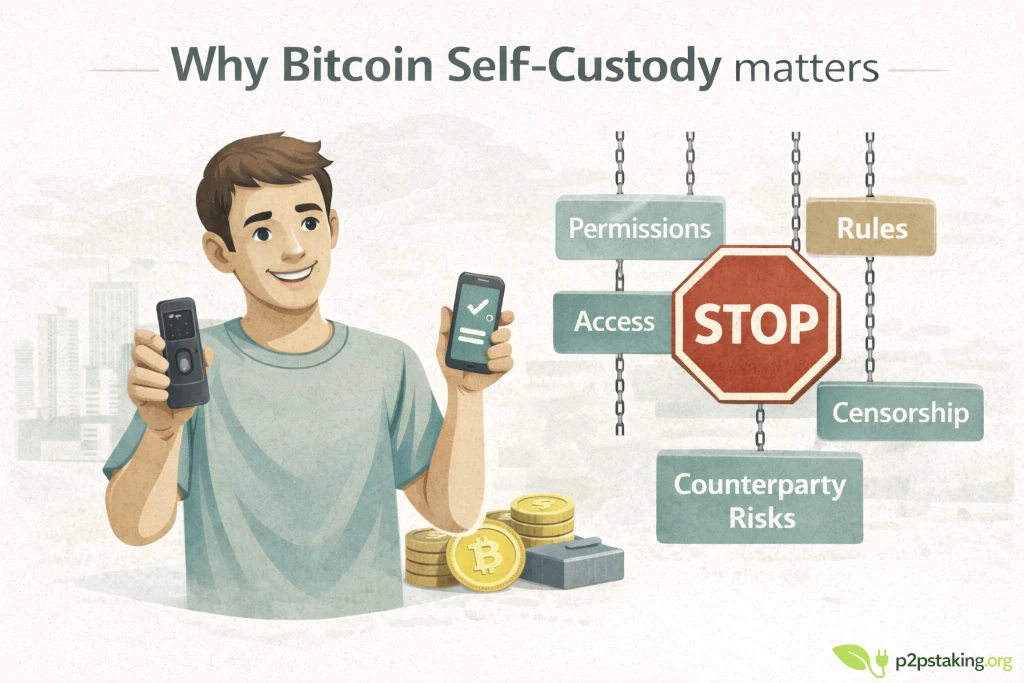
Bitcoin self-custody means you hold your own keys and control your funds directly from your wallet.
This guide explains, in plain English, why Bitcoin self-custody matters for Bitcoin and for any cryptocurrency, how it reduces risks, and how to start safely—without prior technical knowledge.
In other words: everything here applies not just to Bitcoin, but to any crypto you hold.
What Is Crypto or Bitcoin Self-Custody?
Self-custody means you alone control the cryptographic keys to your crypto assets. You keep a seed phrase (12–24 words) that can recreate your self-custody wallet on your own.
Your device signs transactions locally; the network verifies them.
Only the owner of the funds can move them, and no third party can reverse, block, or roll back a confirmed transaction.
No bank, exchange, or entity can move your coins without your keys.
Full Control of Your Assets
With crypto self-custody, you decide when and where funds move—no withdrawal limits, pauses, or account freezes.
- Spend on-chain without approvals.
- Use L2s (Lightning for Bitcoin, and Ethereum L2s like Base/Arbitrum/Optimism) for lower fees.
- Move funds 24/7, even on weekends and holidays.
Beginner tip: Read our Self-custody guide to Secure your recovery phrase offline. It’s the core of Bitcoin self-custody and all crypto wallets.
Spend Crypto Reliably
Owning your address improves reliability and refunds.
- Prove origin and ownership by signing a message from your wallet.
- Receive refunds to the same address or specify a new one you control.
- Don’t receive refunds to an exchange deposit address; funds can be lost.
Self-Custody Matters for Network Power and Politics
Self-custody doesn’t just protect your coins; it also strengthens the politics of the network itself.
When you hold your own keys and participate directly in the network.
Bitcoin
Self-custody means you verify and spend coins directly from your own wallet, instead of trusting a bank-like intermediary.
This keeps Bitcoin closer to its original design: a peer-to-peer system where monetary control is spread across many individuals, not a few large platforms.
Proof-of-Stake (PoS) chains
Self-custody allows staking (or to delegate your stake). It means you help secure the chain and validate blocks without handing that power to centralized custodians.
The more users stake directly, the harder it is for any single exchange, custodian, or state actor to dominate consensus.
Security: Remove Counterparty Risk
Crypto self-custody reduces centralized risk by removing the need to trust a single company.
- Mt. Gox (2014): A major Bitcoin exchange collapsed after losing customer funds. Many users waited years for partial repayments because their coins were held by a centralized custodian.
- FTX (2022): A large exchange went bankrupt, freezing withdrawals and trapping user assets. Customers had little control once funds were deposited.
The key lesson is: “Not your keys, not your coins.” If a custodian fails, your access can vanish overnight.
With self-custody, you hold the keys, so you hold the coins.
Beginner tip: Use a hardware wallet for larger balances; keep a small hot wallet for daily use.
Censorship Resistance and Permissionless Access
Transact peer-to-peer on public networks.
- No KYC needed to move funds on-chain between your own wallets or peers.
- Multiple fee paths and nodes reduce reliance on any single provider.
- If one relay or RPC is down, use another. If mainnet is congested and fees increase, try a Bitcoin Lightning payment or an Ethereum L2.
Self-Sovereignty and Financial Inclusion
Hold and transfer value globally with just the internet.
- No bank account, proof of address, or document needed.
- Programmable money enables shared wallets, automations, and escrow.
- Instant access—no paperwork.
Interoperability Across Chains and DeFi
Self-custody lets you actually use your crypto across different chains and apps—not just watch the price.
Use multiple chains from one wallet
With a self-custody wallet, you can hold and use:
- Ethereum for DeFi and NFTs
- Solana for fast, cheap transactions
- Stablecoins (like USDC) on different networks
- Popular altcoins your exchange may not support
For example, let’s say that you’re paid in USDC on Ethereum. If Eth fees are high, you can bridge some USDC to Solana and use it there for cheaper, everyday payments.
Access DeFi tools you don’t get with ETFs or exchanges
By connecting your wallet directly to dApps, you can:
- Earn yield by staking on proof-of-stake chains
- Lend your crypto to earn interest
- Swap tokens on decentralized exchanges
- Pay people directly with stablecoins, 24/7, globally
With a self-custodial wallet, you stake some ETH to earn yield, swap a bit for another token, and send stablecoins to a friend in another country—no bank, no support tickets, no withdrawal delays.
Self-custody turns your wallet into a universal key for crypto apps and chains, not just a balance you look at on a centralized platform.
Getting Started Checklist
- Choose a wallet: Start with a well-reviewed software wallet; add a hardware wallet as funds grow.
- Back up recovery phrase: Write on paper or metal; store offline; never share it.
- Fund safely: Buy on an exchange if needed, then withdraw to your wallet. Verify addresses carefully.
- Learn basics: Receive, send, view history, sign a message, connect to a reputable dApp.
- Manage fees: Compare mainnet vs L2; test with a small transaction first.
- Device security: Update OS, strong passcodes, hardware key/2FA for accounts, beware of phishing.
- Start small in DeFi: Try a simple swap or stablecoin transfer; review permissions before approving contracts.
Why Bitcoin Self-Custody : Key Takeaways
- Self-custody puts you in full, 24/7 control of your crypto—no withdrawal limits, freezes, or approvals.
- Owning your address makes payments and refunds reliable; you can prove ownership by signing messages.
- Security improves by removing exchange counterparty risk—Mt. Gox and FTX show how custodial failures can trap funds.
- Permissionless public networks enable global, peer-to-peer transfers without banking barriers.Using L2s (e.g., Bitcoin Lightning, Ethereum L2s) reduces fees and speeds up transactions.
- Self-sovereignty expands access: hold, send, and program value with only an internet connection.
- DeFi features (staking, lending, swaps, NFTs, payments) go beyond what ETFs/exchanges offer.
- Start small, secure your recovery phrase offline, verify networks/addresses, and test with low-value transactions.
- The core principle being “not your keys, not your coins”—self-custody is the foundation of safe crypto and Bitcoin self-custody.
Ready to Take Control of Your Crypto?
Go deeper into self‑custody, software wallets, hardware wallets, and practical guides.

Java‑certified engineer and P2PStaking CEO, I secure validators across Solana, Polkadot, Kusama, Mina, and Near. My articles reflect hands‑on wallet ops and real recovery drills so you can set up self‑custody safely, step by step.