Self-custody staking is the most direct and sovereignty-focused way to participate in Proof-of-Stake (PoS) blockchains.
This self-custody staking guide focuses on how users retain control when staking. For a broader overview of custody models in crypto, see our self-custody overview.
What Is Self-Custody Staking?
Self-custody staking is a staking model in which users retain full control of their crypto assets and private keys while participating in network staking.
Instead of depositing funds into a third-party platform, users stake directly from:
- A personal wallet or a hardware wallet
to :
- A self-managed validator or a external one
In this model:
- Assets never leave the user’s custody
- Private keys remain under user control
- Validator choice is explicit and intentional
Self-custody staking aligns closely with the original principles of blockchain technology: ownership, autonomy, and decentralization.
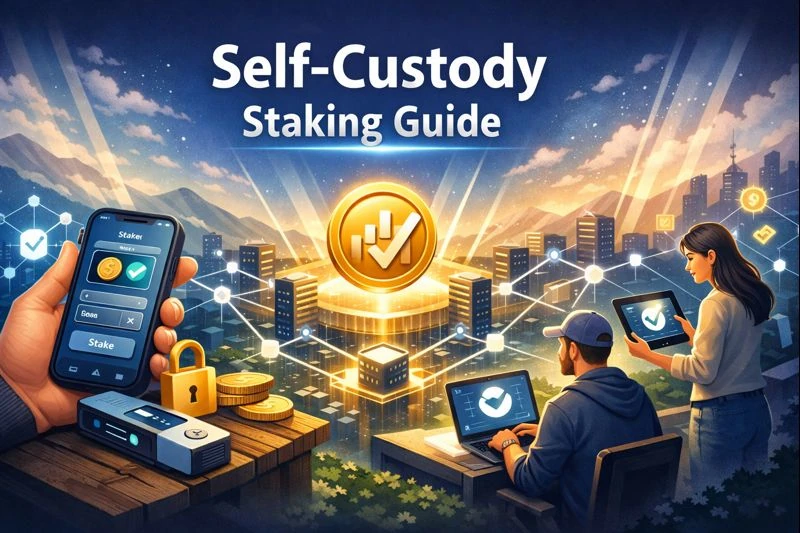
How Self-Custody Staking Works
While implementations vary by blockchain, the general process is consistent:
- Wallet setup
The user installs or configures a compatible non-custodial wallet. - Asset control
Tokens remain in the user’s wallet at all times. - Validator selection
The user chooses one or more validators based on performance, fees, and decentralization criteria. - Delegation or self-validation
Tokens are delegated or directly staked without transferring ownership. - Reward distribution
Rewards are sent directly to the user’s wallet, minus transparent validator commissions.
This process requires more involvement but offers maximum control.
Self-Custody Staking vs Custodial Staking
| Aspect | Self-Custody Staking | Custodial Staking |
|---|---|---|
| Asset custody | User | Third party |
| Private keys | User controlled | Platform controlled |
| Validator choice | Direct | Indirect or none |
| Fee transparency | High | Often limited |
| Network impact | Decentralizing | Potentially centralizing |
Self-custody staking favors sovereignty and network health, while custodial staking favors simplicity and abstraction.
Self-Custody Staking Advantages
Self-custody staking offers several important advantages.
Full Ownership and Control
Users retain exclusive access to their private keys and assets at all times.
Transparent Fees
Validator commissions are typically:
- Clearly disclosed
- Fixed or predictable
- Visible on-chain
This often results in higher net rewards compared to custodial alternatives.
Active Network Participation
Users actively:
- Choose validators
- Influence stake distribution
- Support decentralization
This reinforces the security and resilience of Proof-of-Stake networks.
Governance and Alignment
In many blockchains, staking also enables:
- Voting on protocol upgrades
- Participation in governance decisions
Self-custody staking strengthens alignment between users and the protocol.
Risks and Responsibilities of Self-Custody Staking
Self-custody staking also introduces responsibilities that users must understand.
Key Management Risk
Users are fully responsible for:
- Private key security
- Backup and recovery phrases
Loss of keys usually means permanent loss of funds.
Technical Complexity
Self-custody staking may require:
- Wallet configuration
- Validator research
- Understanding lock-up and unbonding rules
Slashing Risk
If a chosen validator misbehaves, delegated stake may be penalized.
However, users retain the freedom to switch validators.
Self-Custody Staking and Decentralization
From a network perspective, self-custody staking plays a critical role.
Proof-of-Stake systems are designed to benefit from:
- Distributed validator selection
- Broad stake participation
- Reduced reliance on centralized intermediaries
When users stake via self-custody:
- Stake concentration decreases
- Network resilience improves
- Governance power remains distributed
For most blockchains, self-custody staking is structurally healthier for decentralization.
Who Is Self-Custody Staking Best For?
Self-custody staking is generally suitable for:
- Users comfortable managing wallets
- Long-term holders
- Participants aligned with decentralization values
- Users seeking transparent rewards
It may be less suitable for:
- Absolute beginners
- Users unwilling to manage keys
- Those prioritizing maximum convenience
Self-Custody Staking Guide: Key Evaluation Criteria
Before staking via self-custody, users should consider:
- Wallet security and backup strategy
- Validator performance and reputation
- Commission rates and slashing history
- Unbonding and withdrawal periods
A strong self-custody staking guide emphasizes preparation, education, and risk awareness.
Final Summary: Self-Custody Staking Explained Clearly
Self-custody staking provides maximum control, transparency, and alignment with blockchain principles. It empowers users to actively participate in network security and governance, often with better net rewards and a positive impact on decentralization.
In exchange, users accept greater responsibility and technical involvement.
For those willing to engage directly, self-custody staking represents the most robust and resilient staking model in Proof-of-Stake ecosystems.
Ready to Take Control of Your Crypto?
Go deeper into self‑custody, software wallets, hardware wallets, and practical guides.

Java‑certified engineer and P2PStaking CEO, I secure validators across Solana, Polkadot, Kusama, Mina, and Near. My articles reflect hands‑on wallet ops and real recovery drills so you can set up self‑custody safely, step by step.