Many people ask whether they should leave their crypto on an exchange or move it elsewhere. The right answer depends on your goal, your timeframe, and how much you can afford to lose in a worst-case scenario.
This page provides the key elements to help you decide whether leaving crypto on an exchange makes sense for your situation, and how much is reasonable to keep there versus moving to self-custody.
Quick Answer (TL;DR)
Leaving crypto on an exchange is suitable for short-term use only.
For long-term holding or meaningful amounts, it increases counterparty, access, and regulatory risk.
If self-custody is not an option, spreading funds across multiple exchanges reduces single-platform failure, but does not eliminate jurisdiction-based freezes.
What “leave crypto on exchange” actually means
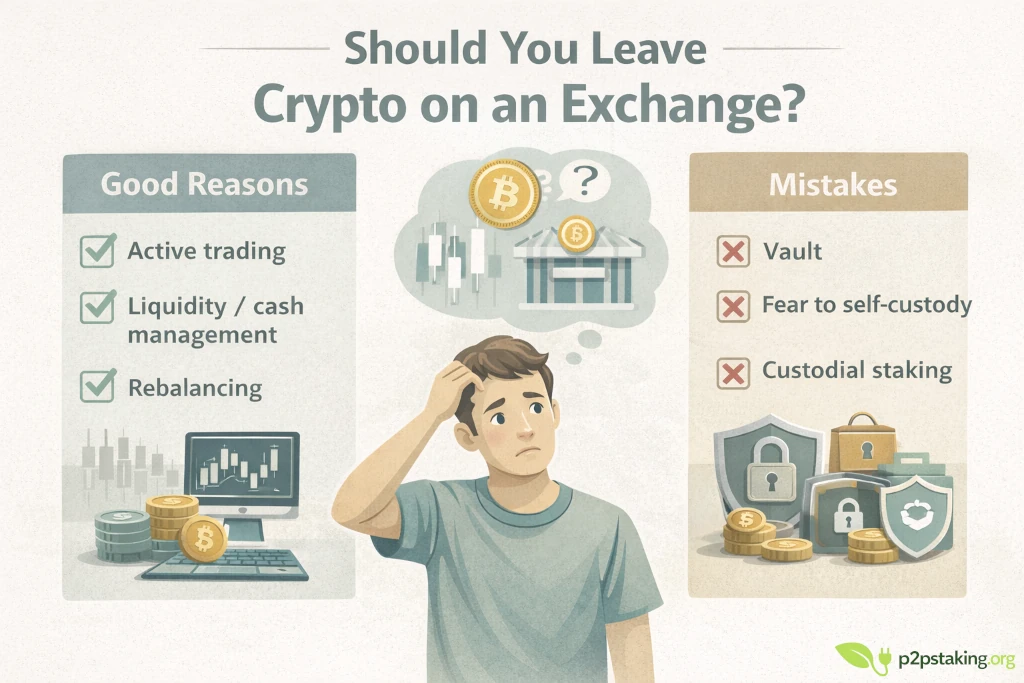
When you leave crypto on an exchange, the exchange controls the private keys and you access funds through an account. It’s convenient, but it’s custodial: your access depends on the platform, your account status, and the rules where you live.
Why people leave crypto on an exchange
Most beginners leave crypto on exchange because it’s simple for buying, selling, trading, or cashing out. That’s fine short-term. The risk appears when an exchange becomes a long-term storage place “by default”.
The 3 risks you accept when you leave crypto on exchange
Counterparty risk
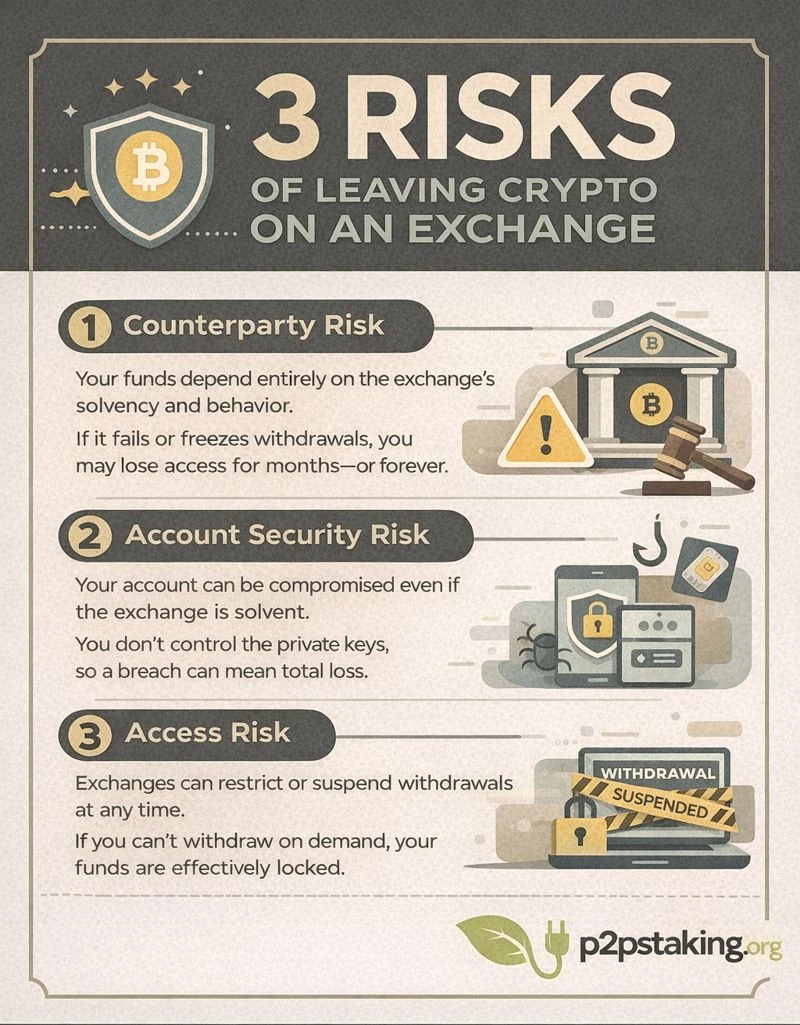
When you leave your crypto on an exchange, you are trusting a third party to safeguard your assets. This means your funds depend entirely on the exchange’s financial health, governance, and operational integrity.
If the company becomes insolvent, mismanages customer funds, or faces legal action, withdrawals can be halted with little warning. In such cases, users often become unsecured creditors, and asset recovery can take months or years—if it happens at all. Unlike self-custody, you have no direct control over your funds.
Account security risk
Even if the exchange itself remains solvent, your individual account can still be compromised. Common attack vectors include phishing emails, fake websites, SIM swap attacks, malware, or email account takeovers.
While exchanges offer security features such as two-factor authentication, withdrawal whitelists, and device verification, these measures only reduce risk—they do not eliminate it.
Ultimately, you do not control the private keys, which is an additional attack vector.
Access risk
Keeping crypto on an exchange also means accepting the risk of losing access to your funds when you need them most.
During periods of high market volatility, exchanges may suspend withdrawals, experience outages, or impose temporary restrictions due to liquidity issues, maintenance, or regulatory pressure.
Policy changes, account reviews, or regional restrictions can also limit access without prior notice. Funds that cannot be withdrawn on demand are effectively locked, regardless of their on-screen balance.
Valid Reasons to Leave Funds on an Exchange
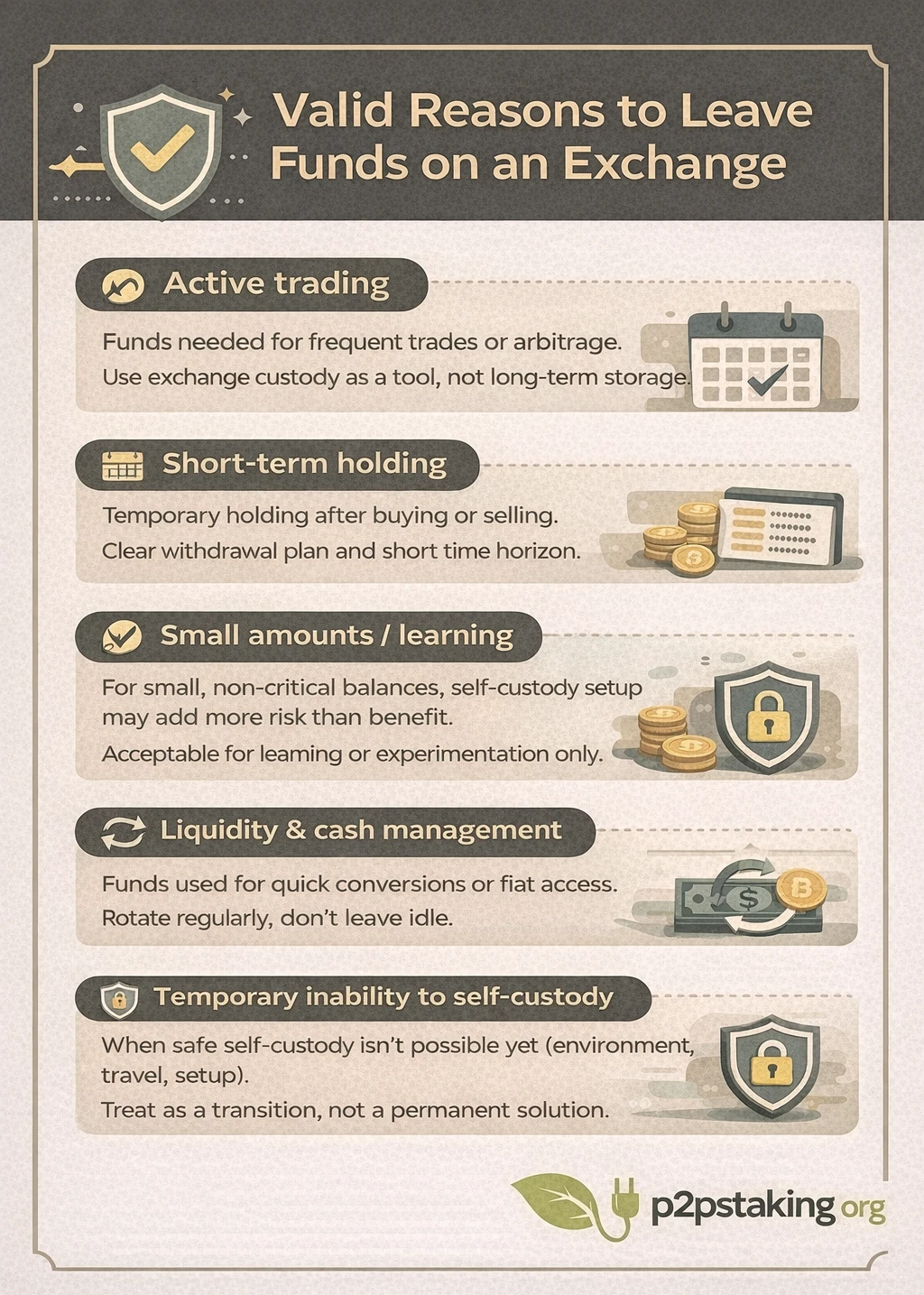
Leaving crypto on an exchange is not always a mistake. It becomes a problem mainly when it happens by default, without a clear purpose or time limit. Below are situations where keeping funds on an exchange can be a rational, intentional choice.
Active trading or frequent transactions
If you are actively trading, arbitraging, or moving in and out of positions, keeping funds on an exchange is often necessary.
Moving funds in and out of self-custody repeatedly can be slow, costly, and operationally complex. In this context, exchange custody is a tool, not storage.
Funds should remain limited to what is required for trading activity, not long-term holdings.
Very short-term holding before withdrawal
It is reasonable to leave crypto on an exchange for a short period after buying, selling, or converting, especially if a withdrawal is planned shortly after.
Examples include:
- Recently purchased crypto awaiting transfer to self-custody
- Funds waiting for a specific network condition (fees, confirmations, timing)
- Temporary parking while setting up a wallet or custody solution
There should be a clear intention and timeline for withdrawal.
Small amounts where self-custody risk outweighs benefit
For very small balances, the operational risk of self-custody (lost keys, setup errors, poor backups) may outweigh the custodial risk of an exchange.
In such cases, keeping a small amount on an exchange can be acceptable, especially for learning or casual use. The amount should be genuinely non-critical and affordable to lose.
A typical example is a crypto asset that requires:
- Installing a dedicated or ecosystem-specific wallet
- Creating and securely backing up a new seed phrase
- Learning a new interface, address format, or transaction model
For a small amount, the added complexity of setting up yet another wallet and managing an additional recovery phrase can introduce more risk than benefit. User mistakes—misplaced backups, confusion between wallets, or incorrect setup—are a common cause of permanent loss, especially for beginners.
In this context, leaving a small exploratory balance on an exchange can be a reasonable temporary choice until:
- The amount grows large enough to justify the effort
- This crypto is integrated to your existing hardware wallet
Operational liquidity and cash management
Some users keep funds on exchanges to maintain liquidity for:
- Fast conversions between assets
- Access to fiat on-ramps or off-ramps
- Paying expenses or managing cash flow
Here, the exchange functions more like a transaction layer than a vault.
Such funds must rotated regularly, not left idle for long periods.
Temporary inability to self-custody safely
In some situations, self-custody may not yet be realistic or safe:
- Lack of a secure environment
- Travel, unstable housing, or shared living conditions
- Legal, administrative, or practical constraints
- Insufficient familiarity with wallet setup, backups, and recovery
In these cases, using an exchange can be a temporary compromise, not an ideal solution.
Importantly, this does not mean doing nothing. Further below, we outline a practical strategy to reduce risk while funds remain on exchanges, including how to limit exposure and avoid single points of failure during this period.
At the same time, this phase should be used to gradually become familiar with self-custody. You can find on our website many resource for that.
Decision table: should you leave crypto on exchange?
| Your situation | Time horizon | Amount size | Risk level | Recommended action |
|---|---|---|---|---|
| Active trading | Minutes to days | Small | Low | OK to leave crypto on exchange |
| Recently bought, moving soon | Days | Small to medium | Low | OK temporarily, set a move date |
| No clear plan | Weeks | Medium | Medium | Reduce exposure, define purpose |
| Long-term holding | Months or years | Any meaningful amount | High | Don’t leave crypto on exchange long-term could wallet |
| Savings / strategic funds | Long-term | Large | Very high | Use a non-custodial solution hardware wallet |
Even when there are valid, intentional reasons to keep funds on a crypto exchange, the guiding principle should remain the same: leave as little as possible, for as short a time as necessary. Exchanges can be useful operational tools, but they are not designed to be long-term storage.
Amounts left on an exchange should be strictly limited to what is required for the specific purpose at hand, and regularly reassessed as your situation, habits, and needs.
Strategy if you leave everything on exchanges
If you don’t want to take the self-custody step, you can still reduce one major risk: concentration.
Practical strategy
Don’t keep everything on a single exchange. Use at least two or three reliable exchanges and spread your funds across them. This reduces dependence on one single point of failure if one platform freezes withdrawals, has technical issues, or fails.
Important limitation
If regulation or enforcement affects your jurisdiction, multiple exchanges can freeze accounts within a short time window, especially when accounts are linked to the same identity and KYC data. Diversifying exchanges reduces platform risk, but it does not remove regulatory or jurisdiction risk.
If you want the long-term alternative, see: Crypto & Bitcoin self-custody beginner guide
For the broader custody context, go back to: Custodial Crypto hub
Personal Experience
In my experience, custodial risk increases with time: the longer funds remain on an exchange, the greater the exposure — regardless of brand or regulation.
Exchanges that require KYC are particularly likely to block withdrawals until identity verification is fully completed. This can happen even on well-known, regulated platforms, and discovering it after depositing or trading can leave funds temporarily locked.
One very important step is to check your account settings: most exchanges clearly display deposit and withdrawal limits based on user status or verification level. Knowing exactly what your limits are — and where you stand — helps avoid unpleasant surprises and situations where you simply cannot withdraw your funds when you need to.
Final Thoughts
Leaving crypto on an exchange is a temporary convenience, not a long-term storage strategy.
It can make sense for short-term use, such as trading or preparing a withdrawal, but it becomes increasingly risky as time and amounts grow.
The main risks are not only hacks, but loss of access, account restrictions, and regulatory freezes, all of which can happen even on well-known platforms.
Diversifying funds across two or three exchanges can reduce dependence on a single platform, but it does not eliminate jurisdiction or regulation risk.
A simple rule applies worldwide:
only leave crypto on an exchange if you know why it is there, how long it will stay, and what happens if you cannot withdraw it.
For long-term holdings or meaningful amounts, exchange custody should never be the default choice.
Ready to Take Control of Your Crypto?
Go deeper into self‑custody, software wallets, hardware wallets, and practical guides.

Java‑certified engineer and P2PStaking CEO, I secure validators across Solana, Polkadot, Kusama, Mina, and Near. My articles reflect hands‑on wallet ops and real recovery drills so you can set up self‑custody safely, step by step.
Leave Crypto on Exchange FAQ
Is it safe to leave crypto on exchange?
It can be reasonable for small amounts and short periods. The longer you leave crypto on exchange, the more you are exposed to counterparty, account, and access risks.
How long can I leave crypto on exchange?
If you’re actively trading, keeping funds there briefly can make sense. For long-term holding (months or years), leaving crypto on exchange is generally a high-risk default.
What is the biggest risk when you leave crypto on exchange?
For beginners, the most common real-world problem is loss of access: withdrawals disabled, account reviews, or regional restrictions. Even without hacks, access risk can hit at the worst moment.
Should I leave crypto on exchange or move it to a wallet?
If the funds are long-term savings or meaningful amounts, a wallet (non-custodial) is usually the better fit. If the funds are for trading or short-term use, an exchange can be acceptable.
If I refuse self-custody, what is the best way to leave crypto on exchange?
Spread funds across two or three exchanges instead of one. It reduces single-platform failure risk, but remember that jurisdiction-based freezes can still affect multiple exchanges quickly.