An crypto exchange freeze is one of the most important risks to understand when using centralized crypto platforms. This page explains, in clear and practical terms, what an exchange freeze is, how exchange withdrawal limits work, why freezes happen, how long they usually last, when users should worry, and how these risks relate to custody and staking choices.
What Is an Exchange Freeze?
An exchange freeze occurs when a centralized cryptocurrency exchange temporarily restricts or completely blocks user actions such as withdrawals, deposits, or transfers.
An exchange freeze can apply to:
- A single cryptocurrency
- A specific blockchain network
- A category of users
- The entire platform
In parallel, many exchanges enforce exchange withdrawal limits, which cap how much users can withdraw per day or per month. These limits may apply even when withdrawals are technically open.
From the user’s point of view, both mechanisms result in the same outcome: reduced or blocked access to funds held on the exchange.
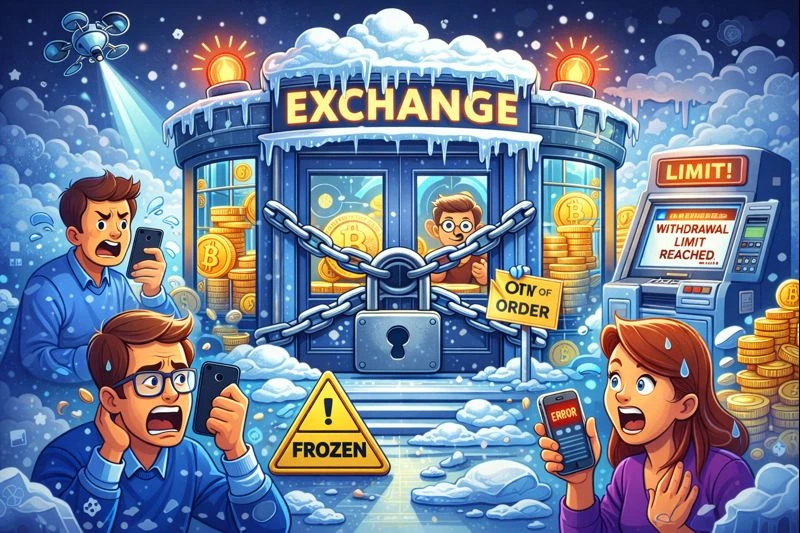
Exchange Withdrawal Limits
Most centralized exchanges apply daily or monthly withdrawal limits. Reaching one of these limits is not a withdrawal freeze, but normal platform behavior.
Withdrawal limits define how much can be transferred within a given time window. Once the limit is reached, further withdrawals are simply unavailable until the next period begins—such as the following day or the start of a new month.
In this situation, access is restricted by design, not by an exceptional event. The exchange remains operational, and withdrawals will resume automatically when the limit resets.
Exchange withdrawal limits are often based on:
- Account verification level (KYC tier): Exchanges typically offer different verification levels. Each level grants a different set of permissions, including withdrawal capacity (more checks give high verification level and withdrawal limits).
- Account age: New accounts may face tighter withdrawal limits, especially in their early days or weeks. This allows exchanges to detect suspicious behavior and reduce fraud and risks.
- Asset type: Withdrawal limits may vary depending on the asset being withdrawn.
- Local regulations: Exchanges operate under multiple legal frameworks, depending on the user’s country of residence. Local regulations can impose: maximum transfer thresholds, or additional reporting requirements.
These limits are usually clearly documented, consultable in the user account dashboard, or described in the exchange’s help or fee pages.
Withdrawal limits are not exceptional events. They are a standard part of exchange risk management and regulatory compliance. The key issue is that many users only discover these limits when they urgently need liquidity.
Exchange Status Pages and Network-Level Freezes
Many exchanges maintain public status pages where users can check:
- Whether withdrawals are operational: This indicates whether users can currently move assets off the exchange. Suspensions may be temporary and are often linked to maintenance, security checks, or network-level issues.
- Which blockchain networks are paused: Exchanges support multiple blockchains. A pause may apply to one specific network, not the entire platform. For example, withdrawals may be available on one network but disabled on another. These pauses usually reflect technical conditions on the underlying network, not a problem with the user’s account.
- Whether deposits are delayed: This shows whether incoming transactions from the blockchain are being credited to user accounts. Delays occur when the blockchain is congested, exchange is waiting for block confirmation requirements, or performing internal checks.
- Whether maintenance is ongoing: Maintenance refers to scheduled or unscheduled operational work performed by the exchange. During maintenance, certain functions—such as deposits or withdrawals—may be temporarily unavailable, even if trading remains active.
Network statuses are often labelled as operational, delayed, under maintenance, or temporarily suspended.
Consulting these pages helps distinguish between a routine technical pause, or a broader platform-level issue. However, transparency varies significantly between platforms, and updates may lag behind real conditions.
In such situations, users should not hesitate to consult the exchange’s support channels before initiating any operation, especially when timing or liquidity is critical.
Why Do Exchange Freezes Happen?
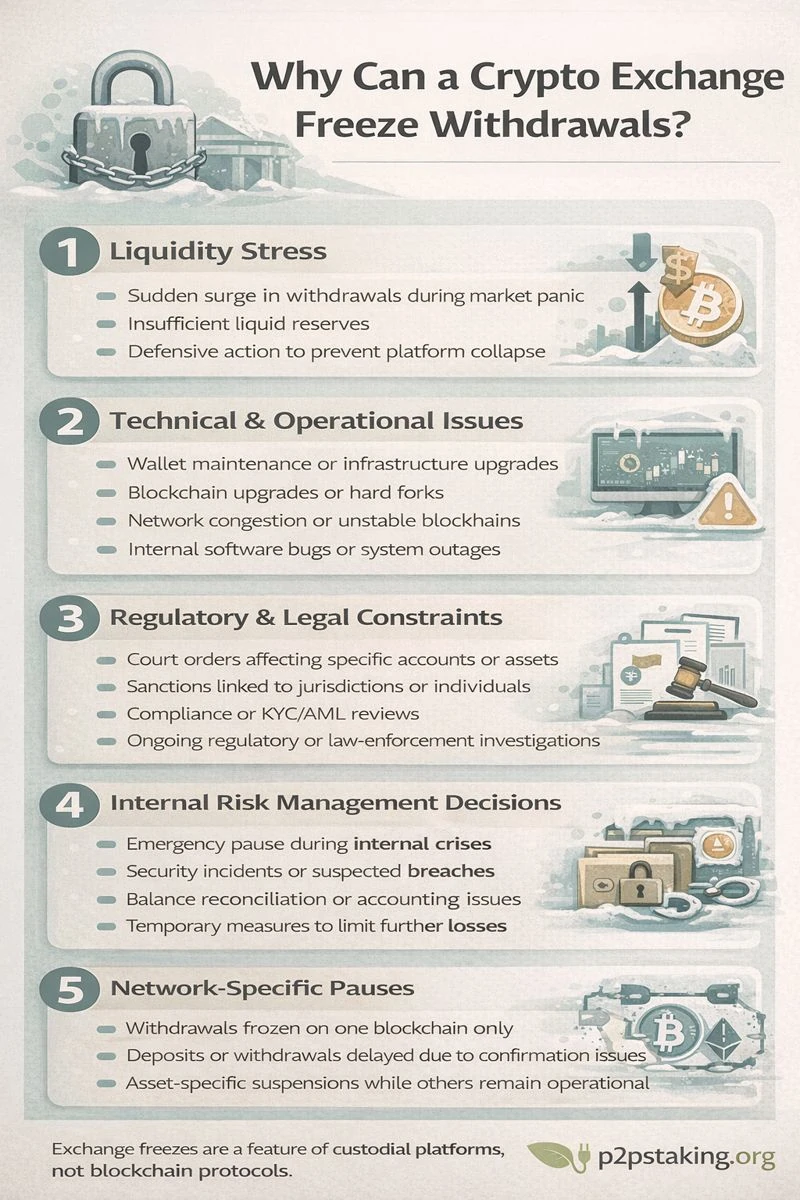
Exchange freezes are not random. They usually result from a small number of structural causes.
Liquidity Stress
During periods of market panic, many users attempt to withdraw funds simultaneously. If an exchange does not hold sufficient liquid reserves, it may temporarily halt withdrawals to prevent collapse.
This can occur during sharp market crashes, loss of confidence events, or rumors or public investigations.
In these situations, a freeze acts as a defensive measure for the platform, but shifts risk directly to users.
Technical and Operational Reasons
Exchanges may pause withdrawals due to:
- Wallet maintenance: Exchanges periodically maintain or upgrade their wallet infrastructure to ensure security and compatibility. During these operations, withdrawals may be paused to prevent transaction errors or fund loss.
- Blockchain upgrades: When a blockchain undergoes a protocol upgrade or hard fork, exchanges may suspend withdrawals until the network stabilizes. This ensures transactions are sent on the correct version of the chain.
- Network congestion: High network usage can slow confirmations or increase failure risk. Exchanges may temporarily pause withdrawals to avoid stuck transactions or unexpected costs.
- Internal software failures: Exchanges rely on complex internal systems to manage balances and transactions. Software bugs or infrastructure outages can lead to precautionary withdrawal suspensions while issues are diagnosed and resolved.
These pauses are often temporary, but communication may be limited or delayed, especially during unscheduled events.
Regulatory or Legal Actions
Withdrawals can be frozen following:
- Court orders: A court may require an exchange to restrict access to certain accounts or assets as part of a legal proceeding. In these cases, the exchange is legally obligated to comply, regardless of user intent or activity.
- Sanctions: International or national sanctions can prohibit exchanges from processing transactions involving specific individuals, entities, or jurisdictions. This can result in immediate withdrawal restrictions for affected accounts.
- Compliance reviews: Exchanges may temporarily freeze withdrawals while conducting internal reviews related to regulatory compliance, such as identity verification or transaction monitoring. These reviews are often precautionary and may require additional user information.
- Investigations: Law enforcement or regulatory investigations can lead to asset freezes while authorities assess potential violations. During this period, withdrawals may remain restricted until the investigation concludes or instructions change.
It is important to distinguish between blockchain protocols and exchanges.
Public blockchains, at the protocol level, do not implement court orders, sanctions, or compliance restrictions. Transactions are processed according to network rules only.
Exchanges, however, are registered companies operating within specific jurisdictions. As such, they are subject to local—and sometimes international—laws and regulations, which can require them to restrict accounts, freeze withdrawals, or limit access under certain legal conditions.
Internal Risk Management Decisions
Some freezes are deliberate actions taken to:
- Buy time during internal crises: When an exchange faces operational, financial, or security stress, withdrawals may be paused to allow teams to assess the situation. This pause can help prevent rushed decisions while internal conditions are stabilized.
- Prevent further losses: Freezing withdrawals can limit additional outflows during incidents such as security breaches or accounting discrepancies. The goal is to contain potential damage while corrective measures are put in place.
- Reorganize liabilities: If an exchange needs to reconcile balances or address mismatches between assets and liabilities, withdrawals may be temporarily restricted. This allows internal records to be reviewed and adjusted before normal operations resume.
From a user perspective, the underlying motivation matters less than the outcome: access to funds is restricted for an uncertain period.
How Long Do Exchange Freezes Usually Last?
The duration of an exchange freeze varies widely depending on the cause.
Technical maintenance may last from minutes to a few hours. When withdrawals are paused for routine technical maintenance, the interruption is usually short. These pauses are often planned in advance and relate to wallet upgrades, infrastructure updates, or security checks. Once maintenance is completed and systems are verified, withdrawals typically resume quickly.
Network-related issues may take hours or days. Freezes caused by blockchain-level issues—such as network congestion, chain reorganizations, or protocol upgrades—can take longer. In these cases, the exchange must wait for the underlying network to stabilize before safely processing transactions. Resolution depends largely on external conditions beyond the exchange’s direct control.
Liquidity or legal freezes can last weeks, months, or longer. When withdrawals are restricted due to liquidity shortages, legal actions, or regulatory interventions, freezes can last significantly longer. These situations often involve audits, court proceedings, or restructuring processes, none of which follow predictable timelines. In some cases, access may remain restricted for extended periods.
In more severe cases, withdrawals may resume only partially, with
- Withdrawal queues: Requests may be processed in batches or in chronological order, creating delays even after withdrawals are technically re-enabled. Users may need to wait until their request reaches the front of the queue.
- Reduced limits: Exchanges may temporarily lower withdrawal limits to manage outflows and preserve remaining liquidity. This means users can access funds, but only gradually and within tighter constraints.
- Asset-specific restrictions: Not all assets may become withdrawable at the same time. Some cryptocurrencies or networks may remain frozen while others resume normal operation, depending on liquidity, technical readiness, or legal status.
In rare but serious cases, full access to funds may never return. This can occur if an exchange becomes insolvent, is shut down by authorities, or enters a prolonged legal process. These outcomes highlight the structural risks inherent in custodial services.
What an Exchange Freeze Means for Users
An exchange freeze changes the user’s position in fundamental ways.
Loss of Immediate Liquidity
Loss of immediate liquidity means that users cannot freely move or use their funds when they need to. During a withdrawal freeze, it may be impossible to exit open market positions or adjust exposure in response to changing conditions. Users may also be unable to access funds for everyday personal expenses or business obligations. Even if balances remain visible on the platform, the inability to transfer assets externally can create practical constraints and financial stress, especially when timing is critical.
Shift in Legal and Financial Status
When withdrawals are frozen, the relationship between users and the exchange changes in a fundamental way. Instead of having direct access to their assets, users hold a claim against the platform itself.
In practical terms, this places them in a creditor position, meaning their ability to recover funds depends on the exchange’s legal, financial, and operational situation.
If the platform enters restructuring, insolvency proceedings, or legal disputes, user claims may be delayed, reduced, or subject to formal resolution processes. This shift highlights the difference between holding assets on a blockchain and holding a balance within a custodial institution.
Psychological and Market Impact
Exchange freezes can have significant psychological and market-wide effects beyond the platform directly involved.
For users, sudden restrictions on access often create uncertainty and anxiety, which can lead to panic and rushed decision-making. At a broader level, freezes may prompt accelerated withdrawals from other exchanges as users reassess counterparty risk, increasing stress across the ecosystem. Over time, repeated or poorly communicated freezes can erode trust not only in a single platform but in custodial models more generally.
Historical cases show that what begins as a “temporary” suspension can, in some situations, evolve into prolonged insolvency or liquidation processes.
When Is an Exchange Freeze Normal?
Not all withdrawal freezes indicate a serious problem. In many cases, temporary restrictions are part of normal exchange operations.
A freeze is generally considered normal when it is limited in scope and clearly explained. Asset-specific freezes are common, especially during wallet maintenance, blockchain upgrades, or temporary network congestion. In these situations, other assets and services often remain unaffected.
When Is an Exchange Freeze Concerning?
A freeze becomes concerning when uncertainty and scope begin to expand. If communication becomes vague, delayed, or stops entirely, users lose the ability to understand what is happening or why.
Freezes that spread across multiple assets or networks may indicate deeper operational or liquidity issues rather than isolated technical problems.
Repeated reductions in withdrawal limits, especially without clear justification, can signal stress on the platform’s reserves. Similarly, timelines that are repeatedly extended or left undefined increase risk, as they suggest unresolved internal or external constraints.
When these symptoms accumulate, they indicate that relying on the platform may no longer be appropriate and that users should consider moving to a different exchange.
Freeze and Custodial Wallets Model
Exchange freezes are a direct consequence of custodial wallets model, where a third party controls user assets on their behalf.
When funds are held in a custodial wallet on an exchange:
- Assets are pooled with those of other users
- Withdrawals depend on the platform’s internal liquidity and operational decisions
- Access to funds can be restricted without user consent
In this model, users do not interact directly with the blockchain. They rely entirely on the exchange to process withdrawals and honor balances.
As a result, any internal issue—technical, financial, or regulatory—can immediately translate into a withdrawal freeze or stricter limits.
In contrast, self-custody wallets allow users to hold their own private keys, interact directly with blockchain networks, and withdraw funds independently of exchange policies.
For users looking to reduce exposure to exchange freezes, a common mitigation step is to get started with self-custody and limit the use of custodial wallets to short-term trading or liquidity needs rather than long-term storage.
How to Reduce Exposure to Exchange Freezes
While exchange freezes cannot be fully eliminated, risk can be reduced by:
- Keeping only short-term funds on exchanges
- Understanding withdrawal limits in advance
- Monitoring exchange status pages
- Avoiding long lock-ups on custodial staking products
- Using self-custody for long-term assets
Risk is often not about avoiding exchanges entirely, but about using them intentionally.
Final Takeaway
Exchange freezes are not exceptional events. They are part of how centralized crypto platforms operate and can occur for a variety of technical, regulatory, or market-related reasons.
What matters most for users is not to fear these situations, but to understand them in advance. Knowing why freezes and withdrawal limits exist helps users make informed decisions about where to hold their assets, how much liquidity to keep on exchanges, and which custody model best fits their needs.
In crypto, access to funds depends not only on market conditions, but also on how and where assets are stored. Awareness and intentional use of exchanges are key to managing this reality effectively.
Ready to Take Control of Your Crypto?
Go deeper into self‑custody, software wallets, hardware wallets, and practical guides.

Java‑certified engineer and P2PStaking CEO, I secure validators across Solana, Polkadot, Kusama, Mina, and Near. My articles reflect hands‑on wallet ops and real recovery drills so you can set up self‑custody safely, step by step.
FAQ: Exchange Freeze and Withdrawal Limits
What is an exchange freeze?
An exchange freeze occurs when a centralized cryptocurrency exchange temporarily restricts or completely blocks user actions such as withdrawals, deposits, or internal transfers. During a freeze, users cannot freely move their funds on or off the platform, even though balances may still appear in their account.
Exchange freezes can affect a single asset, a specific blockchain network, or the entire platform. They usually result from liquidity stress, technical failures, regulatory actions, or internal risk management decisions. While some freezes are short and technical, others can signal deeper financial or operational problems.
What are exchange withdrawal limits?
Exchange withdrawal limits are predefined caps that restrict how much cryptocurrency a user can withdraw over a specific period, such as per day or per month. These limits are typically determined by account verification level, local regulations, asset type, and internal risk policies.
Withdrawal limits are usually documented in account settings or help pages and apply even when withdrawals are technically open. Although they are a normal feature of centralized exchanges, withdrawal limits can significantly reduce user liquidity during volatile market conditions or emergencies.
Are exchange freezes always a sign of insolvency?
No, an exchange freeze does not automatically mean insolvency. Some freezes are caused by routine technical maintenance, blockchain upgrades, or temporary network congestion and may last only a few hours.
However, freezes become more concerning when they are prolonged, poorly communicated, or affect multiple assets at once. In past cases, long or repeated freezes have preceded more serious issues such as insolvency, restructuring, or legal intervention. Users should evaluate transparency, duration, and scope rather than assuming all freezes are harmless.
How can users check if an exchange is frozen?
Most centralized exchanges provide public status pages where users can see whether deposits and withdrawals are operational. These pages often display the status of individual blockchain networks, indicating whether they are running normally, delayed, or under maintenance.
Users can also consult official announcements, social media updates, and help centers. A lack of updates or vague messaging during a withdrawal disruption can be a warning sign, especially if users cannot verify the issue through multiple official channels.
How long do exchange freezes usually last?
The duration of an exchange freeze depends on its underlying cause. Technical or network-related freezes often last from minutes to a few hours. More complex issues, such as liquidity shortages or regulatory actions, can result in freezes lasting days, weeks, or longer.
In some historical cases, withdrawals resumed gradually with reduced limits or asset-specific restrictions. In more severe situations, access to funds was never fully restored. The longer a freeze persists without clear timelines, the higher the associated risk for users.
Does self-custody eliminate exchange freeze risk?
Self-custody eliminates exchange-level freeze risk because users hold their own private keys and interact directly with blockchain networks. This means withdrawals do not depend on a centralized platform’s liquidity or operational decisions.
However, self-custody introduces different responsibilities, including key management and security. While it does not eliminate all risks, self-custody removes the specific risk of exchange-imposed withdrawal freezes and is often used to reduce reliance on centralized custodial wallets for long-term asset storage.