Custodial staking is one of the most widely used methods to earn rewards from Proof-of-Stake (PoS) blockchains.
What Is Custodial Staking?
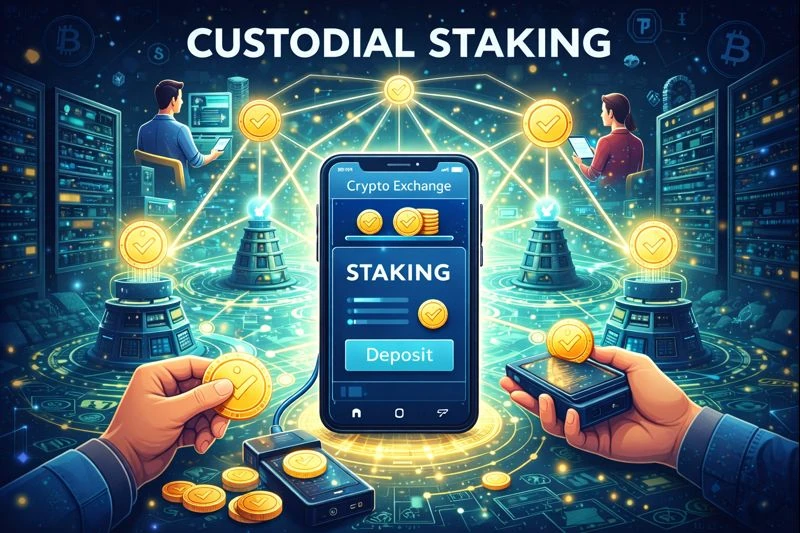
Custodial staking is a staking model in which a third-party platform takes custody of your crypto assets and performs staking operations on your behalf.
Instead of staking directly from a personal wallet, users deposit their tokens into a custodial service—typically an exchange or a staking provider—which:
- Holds the private keys
- Selects and operates validator nodes
- Manages delegation, uptime, and maintenance
- Distributes staking rewards to users
In this model, users earn rewards without directly interacting with the blockchain, but they relinquish control over their assets.
How Custodial Staking Works
The custodial staking process is generally consistent across platforms:
- Asset deposit
Users transfer supported tokens to a custodial platform. - Delegation by the custodian
The platform pools funds and delegates them to one or more validators. - Network participation
Validators contribute to block production and network security. - Reward distribution
Staking rewards are collected, fees are deducted, and net rewards are credited to users.
From the user’s perspective, the experience is often simplified to a few clicks.
Custodial Staking vs Non-Custodial Staking
| Aspect | Custodial Staking | Non-Custodial Staking |
|---|---|---|
| Asset custody | Third party | User |
| Private keys | Platform controlled | User controlled |
| Validator choice | Indirect or none | Direct |
| Technical complexity | Very low | Moderate to high |
| Network participation | Passive | Active |
Custodial staking emphasizes ease and abstraction, while non-custodial staking emphasizes sovereignty and direct participation.
Custodial Staking Advantages
Custodial staking offers several advantages that explain its widespread adoption.
Ease of Use
No need to run nodes, manage wallets, or understand validator mechanics.
Accessibility
Many platforms offer:
- Low minimum staking thresholds
- One-click activation
- Automatic reward compounding
Operational Stability
The custodian handles:
- Validator uptime
- Software upgrades
- Slashing mitigation strategies
These factors make custodial staking attractive to beginners and users seeking a low-effort experience.
Custodial Staking Risks
Despite its simplicity, custodial staking introduces several important risks.
Loss of Control
Users do not hold their private keys. Asset ownership depends entirely on the platform’s integrity and solvency.
Counterparty Risk
Custodial platforms may be exposed to:
- Security breaches
- Insolvency
- Regulatory intervention
If a custodian fails, users may face delays or losses.
Slashing Exposure
If validators operated or selected by the platform are penalized, users bear the consequences, despite having no operational control.
Withdrawal Constraints
Some custodial staking services impose:
- Lock-up periods
- Unstaking delays
- Temporary withdrawal restrictions
These constraints can reduce liquidity during volatile market conditions.
Fees, Transparency, and Reward Stability
A key characteristic of custodial staking is fee opacity.
Unlike non-custodial staking—where validator commissions are usually explicit—custodial platforms often bundle multiple costs, such as:
- Validator commissions
- Platform service fees
- Reward smoothing mechanisms
As a result, net rewards received by users are often lower than the protocol’s base staking yield.
Custodial staking prioritizes reward stability and convenience, but typically sacrifices yield optimization and transparency.
Custodial Staking and Decentralization
Staking is not only a financial mechanism—it is also a governance and security function.
The original design of Proof-of-Stake systems assumes that:
- Many independent participants stake tokens
- Delegators actively choose validators
- Stake distribution remains diverse
When large amounts of stake are concentrated within custodial platforms—especially major exchanges—several systemic effects may occur:
- Validator concentration increases
- Network diversity decreases
- Governance influence becomes centralized
- Systemic risk rises if a major custodian is disrupted
From a decentralization standpoint, custodial staking is generally less favorable for blockchain networks than distributed, non-custodial participation.
Who Is Custodial Staking Best For?
Custodial staking is typically suitable for:
- New users discovering staking
- Small or moderate portfolios
- Users prioritizing simplicity over control
- Those unwilling to manage private keys
It is less suitable for:
- Users focused on decentralization
- Large holders seeking governance influence
- Advanced users optimizing yield and sovereignty
➡️ Read next: Self-custodial Staking Guide
Custodial Staking Guide: Key Evaluation Criteria
Before using a custodial staking service, users should assess:
- Fee transparency
- Validator concentration policies
- Withdrawal and lock-up conditions
- Security track record
- Regulatory exposure
A responsible custodial staking guide evaluates both user-level convenience and network-level impact.
Final Summary: Custodial Staking Explained Clearly
Custodial staking offers a stable and accessible entry point into staking, removing technical barriers and operational complexity. In exchange, users accept lower net rewards, opaque fees, custody risk, and reduced participation in decentralization.
Understanding these trade-offs is essential for making informed decisions—both as an individual participant and as part of a broader Proof-of-Stake ecosystem.
Ready to Take Control of Your Crypto?
Go deeper into self‑custody, software wallets, hardware wallets, and practical guides.

Java‑certified engineer and P2PStaking CEO, I secure validators across Solana, Polkadot, Kusama, Mina, and Near. My articles reflect hands‑on wallet ops and real recovery drills so you can set up self‑custody safely, step by step.