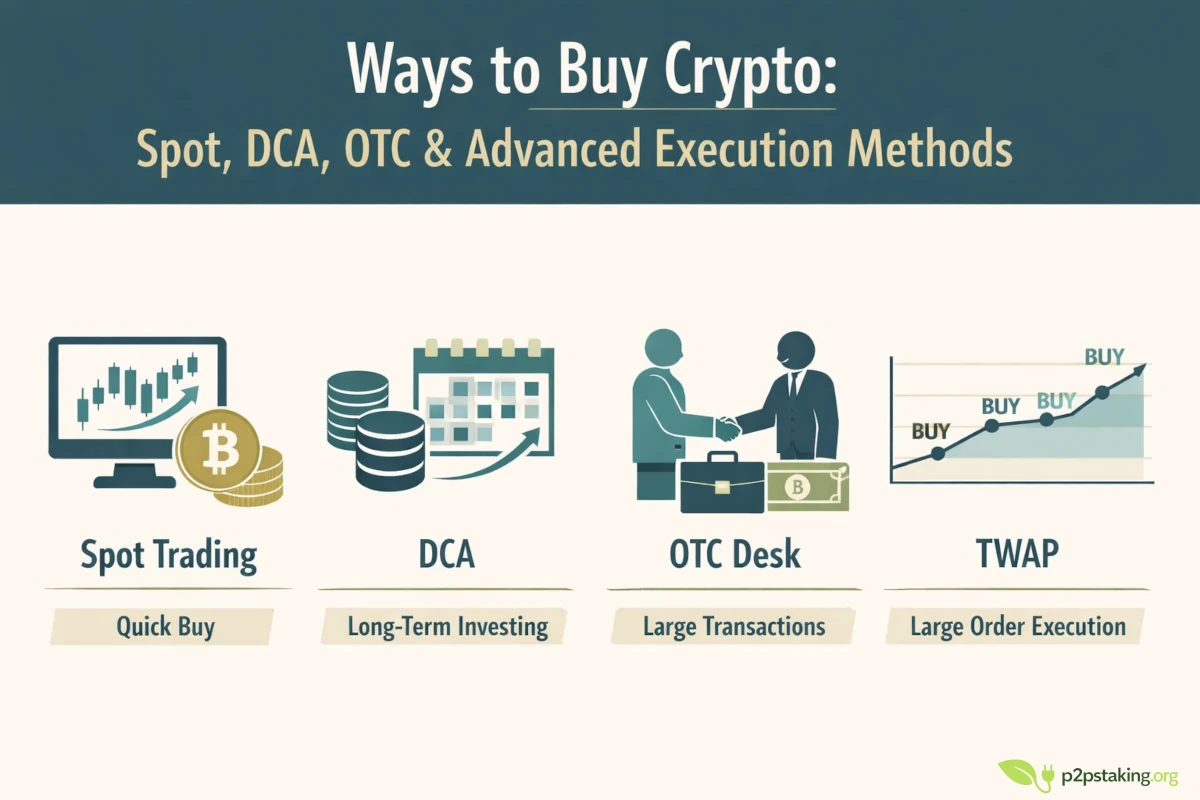
Custodial crypto refers to a setup where a third party holds and manages your crypto assets on your behalf. This usually includes exchanges, brokers, and platforms offering custodial staking or yield products. The trade-off is simple: you gain convenience and accessibility, but you accept counterparty risk.
If you’re new to crypto, considering ETFs or custodial “earn” products, or simply want to reduce the risk of losing access to your funds, this page is designed to give you a clear mental model before you go deeper.
Key takeaways
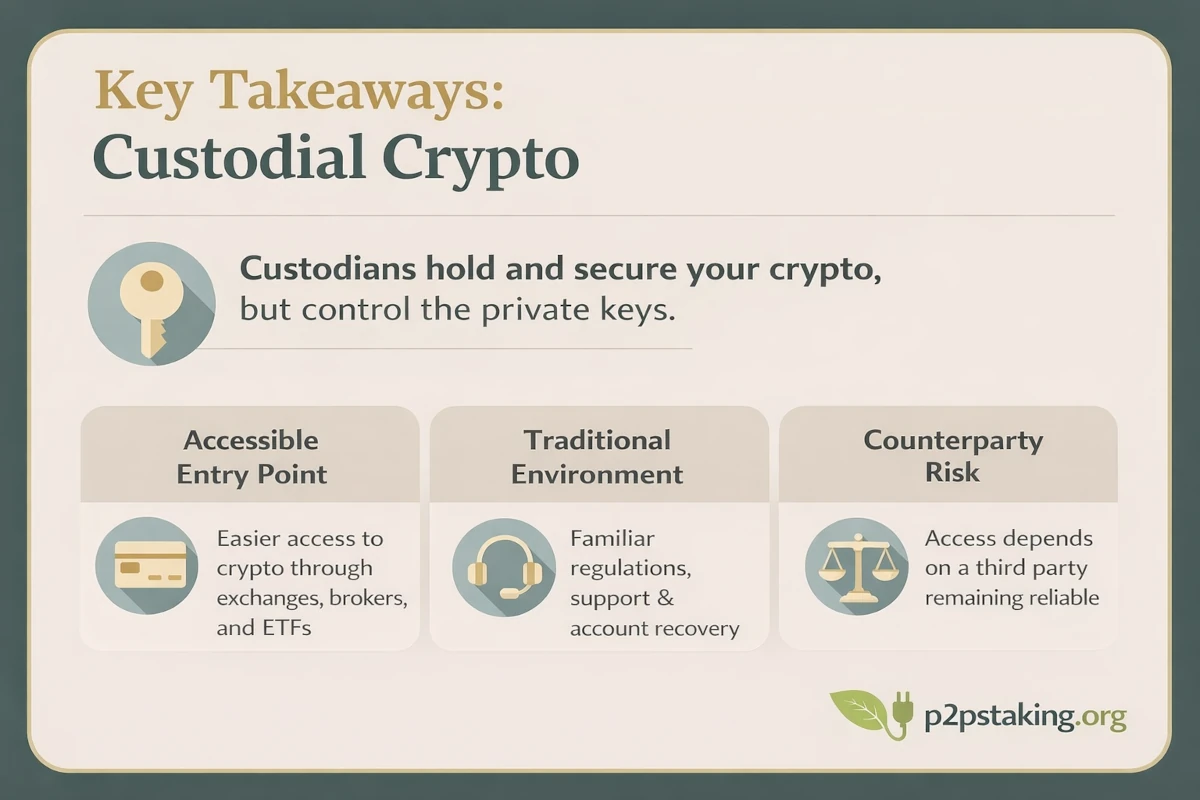
Custodial crypto means your assets are held and secured by a third party rather than by keys you control directly. You can access and use a balance through an account, but the underlying private keys that authorize transactions on the blockchain are managed by the platform.
This model exists for a reason. By relying on an exchange, broker, or ETF provider, users avoid the complexity and responsibility of self-custody. There is no need to generate, store, or protect private keys, no risk of losing a seed phrase, and no requirement to understand wallet security from day one. For many users and businesses, this lowers the barrier to entry significantly.
Custodial platforms also operate in a familiar, regulated environment. Account-based access, customer support, compliance processes, and traditional reporting make custodial crypto feel closer to online banking or brokerage accounts. This is particularly valuable for users who are new to crypto, as well as for companies that need structured processes and clear accountability.
In practice, custodial services are often the first and most accessible way to acquire crypto. Fiat on-ramps, card payments, bank transfers, and ETFs all rely on custodial infrastructure. For most people, interacting with a custodian is not a choice but a starting point.
The trade-off is control. Because ownership in crypto is enforced by cryptography rather than by account credentials, access ultimately depends on the custodian remaining solvent, operational, and willing to process withdrawals. Custodial crypto replaces user-level key risk with counterparty and platform risk.
Understanding this exchange of responsibilities is the key to using custodial crypto intentionally rather than by default.
Custodial vs non-custodial (in 30 seconds)
Custodial setups feel familiar because they work like online accounts. You log in with a password, maybe confirm with two-factor authentication, and see a balance. The platform handles keys, transactions, and recovery.
Non-custodial setups feel more foreign at first. Instead of an account, you hold a seed phrase or private key. There is no approval process, no support desk that can reset access, and no intermediary between you and the network.
The difference is not philosophical. It is operational. With custody, access depends on a company. With self-custody, access totally depends on you.
A realistic view of custodial Crypto platforms
Custodial crypto platforms are not inherently bad. For many people, they are the first and sometimes only practical way to access crypto.
Most users need a crypto exchange at least once to convert fiat currency into crypto. On-ramps, off-ramps, and liquid markets exist primarily in custodial environments. For short-term actions, custody can be efficient and appropriate.
Problems arise when custodial platforms are treated as long-term vaults rather than service providers. History shows that when markets are stressed, the risks tend to surface through withdrawal freezes, delays, and operational failures — often before outright insolvency becomes visible.
When custodial Crypto makes sense
Custodial services are best understood as tools for specific actions rather than permanent storage.
Crypto exchanges
They are commonly used to enter crypto for the first time, because blockchains do not accept bank transfers or card payments directly. Exchanges bridge that gap by accepting fiat, executing conversions, and temporarily holding assets.
They are also essential for moving between crypto and fiat later on. Any time funds need to touch the traditional banking system, a custodial intermediary is involved.
Custody is also used for swaps and trading. Centralized platforms offer liquidity, pricing, and execution speed that most users cannot replicate on their own. For active trading or frequent rebalancing, custody reduces friction.
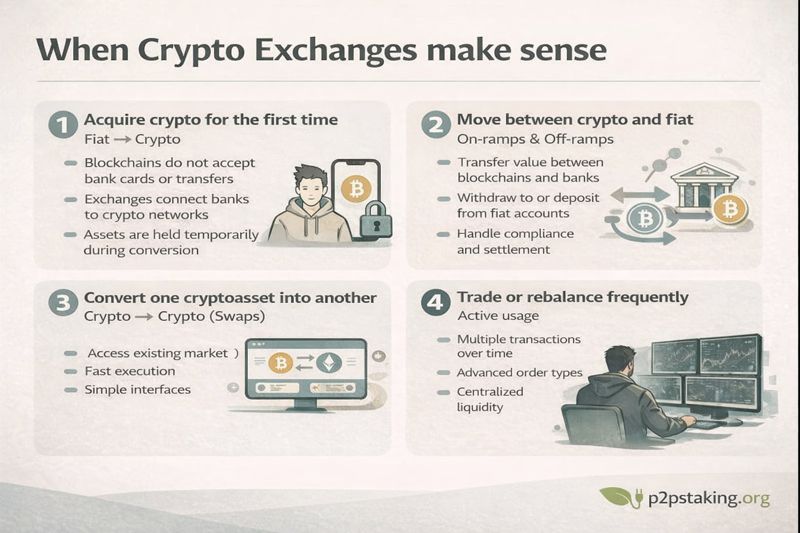
Large centralized exchanges are commonly used for these purposes because they provide integrated markets and fiat access. In this context, custody is a tool that enables specific actions, not a long-term storage solution.
➡️ Go deeper: Crypto Exchange Guide (TODO)
Crypto ETFs and ETPs
A different custodial use case exists with crypto ETFs and ETPs. These products are not designed for on-chain interaction or asset portability. Instead, they offer price exposure through familiar investment vehicles that fit naturally into brokerage accounts, corporate treasuries, and regulated investment frameworks. For businesses, funds, or individuals already accustomed to traditional ETFs, this model allows crypto exposure without introducing self-custody processes, wallet management, or operational crypto risk.
In practice, crypto ETFs tend to serve a different audience than exchanges. They are often used by companies allocating treasury assets, institutions operating under strict compliance rules, or individuals who prefer to keep crypto exposure alongside other traditional investments within existing accounts.
What all custodial models share is a common limitation: they are not designed for long-term, risk-free storage. Whether through an exchange or an ETF structure, assets remain dependent on intermediaries, regulations, and operational continuity. The longer crypto remains under custodial control, the more exposure shifts away from the user and toward external factors they cannot influence.
➡️ Go deeper: Crypto ETFs/ETPs vs Owning Crypto (pros, cons, and trade-offs)
When custodial crypto doesn’t make sense
Custodial crypto stops making sense once the goal shifts from access to ownership.
Bitcoin, and the cryptoassets that followed its design principles, introduced a fundamental change: the ability to hold and use digital value without relying on trusted third parties. Control is enforced by cryptography, not by institutions, intermediaries, or account permissions.
This shift is not just technical. It represents a break from custody models where assets are held by banks, brokers, or platforms, and from monetary systems where issuance and control are centralized at the state level. Crypto networks were designed to allow individuals to hold, transfer, and use value directly, without asking for permission.
For long-term investors, crypto is not just a price exposure but a new asset paradigm. Keeping assets under custodial control for long periods turns them into traditional instruments and limits access to the functionality these networks enable. To fully benefit from this shift, long-term holders generally choose to control their own keys.
For users who want to explore this rabbit hole and understand how self-custody works in practice, we recommend going deeper into our guide : Non-custodial wallets explained.
Quick comparison of crypto exchanges vs ETFs and self-custody
Holding crypto on an exchange, buying a crypto ETF, and holding assets in self-custody may all track similar prices, but they represent fundamentally different exposures.
Exchange accounts prioritize liquidity and usability but introduce direct counterparty risk. ETFs and ETPs simplify access through brokerage accounts but offer price exposure only, without on-chain ownership or portability.
Self-custody maximizes control and censorship resistance, but shifts responsibility entirely to the user. There is no recovery desk and no intermediary to absorb mistakes.
| Crypto Exchange Account | Crypto ETF | Self-Custody | |
|---|---|---|---|
| Control of keys | ❌ Custodian holds keys | ❌ Fund custodian holds keys | ✅ You hold the keys |
| Liquidity & ease of trading | ✅ High liquidity, instant trading | ✅ High market liquidity | ⚠️ On-chain execution required |
| Convenience & user experience | ✅ Simple UI, fiat on/off, support | ✅ Easy via brokerage account | ⚠️ Wallet setup and learning curve |
| Security model | ✅ Security handled by the exchange | ✅ Regulated custodian, centralized | ⚠️ User-managed wallet & backups |
| DeFi / staking / spending access | ⚠️ Limited or restricted | ❌ None (price exposure only) | ✅ Full on-chain access |
| Recovery / inheritance options | ✅ Simpler recovery, delegated management | ✅ Standard brokerage estate process | ⚠️ User-defined (backups, multisig, legal) |
| Censorship resistance | ❌ Low–Medium (account freezes possible) | ❌ Low (fund/broker rules) | ✅ High (peer-to-peer) |
| Counterparty risk | ❌ High (exchange / insolvency risk) | ⚠️ Medium (fund + custodian risk) | ✅ Minimal (protocol risk only) |
| Privacy | ❌ Low (KYC, monitoring) | ❌ Low (broker + fund records) | ⚠️ Potentially higher; depends on practices |
| Fees / costs | ❌ Trading fees, spreads, withdrawals | ❌ Management fee + spread | ➖ Hardware + network fees |
| Jurisdictional exposure | ❌ High (exchange jurisdiction) | ❌ High (fund + broker jurisdictions) | ✅ Lower; self-managed, cross-border |
Custodial crypto: advantages and trade-offs of third-party custody
Using custodial crypto services means delegating asset custody to a third party. This choice is not inherently good or bad, but it comes with structural advantages and limitations that differ significantly from self-custody. Understanding these trade-offs is essential before choosing a custodial setup as a long-term solution.
The main advantages of custodial custody
The primary benefit of custodial crypto is operational simplicity. By relying on a third party, users do not need to manage private keys, backups, or recovery procedures themselves. This reduces the risk of irreversible user errors, such as lost seed phrases or misconfigured wallets, which remain one of the most common causes of permanent loss in self-custody.
Custodial platforms also operate within familiar financial frameworks. Account-based access, customer support, identity verification, and structured reporting make custodial crypto easier to integrate into existing personal or corporate financial workflows. For many users, this familiarity lowers the cognitive and operational barrier to entry.
Regulation plays a role here as well. In many jurisdictions, custodial providers are licensed, supervised, and required to follow compliance standards. This can increase confidence for users who value legal clarity, dispute resolution mechanisms, and alignment with local financial regulations.
Finally, custodial custody is often unavoidable at the entry point. Fiat on-ramps, ETFs, ETPs, and broker-based products all rely on third-party custody, making it the most accessible way to gain initial exposure to cryptoassets.
The structural limitations of third-party custody
The same features that make custodial crypto convenient also introduce dependency. When assets are held by a third party, access depends on that entity’s solvency, operational stability, compliance decisions, and willingness to process withdrawals. Users no longer interact directly with the blockchain, but through an intermediary layer.
This dependency becomes more visible during periods of market stress. Withdrawal delays, account restrictions, or policy changes can occur without warning, even when assets technically exist. In such cases, users hold a claim on a platform rather than direct control over on-chain assets.
Custodial custody also limits how crypto can be used. While price exposure remains intact, access to on-chain functionality such as native staking, decentralized applications, smart contracts, or peer-to-peer transfers is often restricted or unavailable, depending on the product.
From a regulatory perspective, compliance can also become a constraint. KYC requirements, monitoring, jurisdictional restrictions, and evolving regulatory interpretations can affect access in ways that are unrelated to user behavior or intent.
Regulation: where custody helps — and where it doesn’t
Regulation is often perceived as a safety net, but its impact depends on the user profile and use case.
For beginners and traditional investors, regulation can be advantageous. It provides clearer legal frameworks, consumer protection mechanisms, and alignment with existing tax and reporting systems. This is particularly relevant for ETFs, ETPs, and broker-based products, which are designed to fit into regulated investment environments.
However, regulation does not eliminate risk. It redistributes it. Compliance obligations can lead to freezes, reporting requirements, or access restrictions that would not exist in a self-custody model. Regulation also ties custodial crypto more closely to national jurisdictions, reducing cross-border neutrality.
In other words, regulation improves predictability in some areas while reducing flexibility in others.
Special considerations for professionals and businesses
For professionals, funds, and companies, custodial custody often becomes a practical necessity rather than a philosophical choice.
Corporate treasuries, regulated entities, and institutional investors typically require custodial arrangements to meet accounting, audit, governance, and risk management standards. Third-party custody simplifies internal controls, segregation of duties, and legal responsibility, making it compatible with corporate structures.
At the same time, these entities face additional layers of exposure. Custodial risk is combined with regulatory, counterparty, and operational risk, all of which must be managed through contracts, diversification, and internal policies.
For this audience, custodial crypto is less about sovereignty and more about controlled exposure. The trade-off is accepted consciously, often in exchange for compliance, reporting clarity, and operational scalability.
Conclusion: using custodial crypto intentionally
Custodial crypto is not an exception in the crypto landscape, it is part of its ecosystem. Exchanges, brokers, ETFs, and ETPs all rely on third-party custody, and regardless of your profile, there will almost always be a moment where interacting with a custodian is necessary. Onboarding, fiat access, portfolio allocation, or compliance-driven use cases all pass through custodial layers.
The real question is not whether custodial crypto should be used, but when and for what purpose.
This page has outlined the main custodial models, their advantages, their limitations, and the role regulation plays in shaping them. Some use cases benefit from simplicity, legal clarity, and operational support. Others are constrained by counterparty risk, limited on-chain access, or dependency on intermediaries.
Using custodial crypto intentionally means recognizing which situations justify third-party custody — and which ones don’t. Short-term access, liquidity, and regulated exposure often fit well within custodial frameworks. Long-term ownership, direct participation in networks, and full use of crypto-native functionality generally do not.
For users who want to go further, understand self-custody, or explore how to reduce reliance on intermediaries over time, we provide a dedicated set of guides and documentations.
Ready to Take Control of Your Crypto?
Go deeper into self‑custody, software wallets, hardware wallets, and practical guides.

Java‑certified engineer and P2PStaking CEO, I secure validators across Solana, Polkadot, Kusama, Mina, and Near. My articles reflect hands‑on wallet ops and real recovery drills so you can set up self‑custody safely, step by step.
Third party Custody FAQ
What does custodial mean in crypto?
Custodial means a third party holds the private keys and assets on your behalf, and you access funds through an account.
Are ETFs/ETPs the same as owning crypto?
No. You usually own a regulated instrument, not a wallet you control, and you generally can’t withdraw the underlying asset on-chain.
Is custodial staking the same as native staking?
Often it’s a wrapper around staking or yield generation. You may take on extra counterparty risk and different redemption or slashing terms than native staking.
What’s the simplest way to reduce risk today?
Move long-term holdings to self-custody and keep only a spending bucket on custodial platforms.