Crypto Exchange regulation defines how governments and regulators oversee centralized platforms that hold crypto assets on behalf of users.
This page explains crypto exchange regulation in clear, practical terms: what it covers, how it differs across jurisdictions, what it does and does not protect, and why regulation does not eliminate custodial risk.
What Is Custodial Crypto Regulation?
Custodial crypto regulation refers to the legal and regulatory frameworks that apply to crypto exchanges and platforms that:
- Hold user funds in custodial wallets
- Process deposits and withdrawals
- Act as intermediaries between users and blockchains
Under these models, users do not control private keys. As a result, regulators focus on institutional safeguards rather than cryptographic self-sovereignty.
What Does Crypto Exchange Regulation Typically Cover?
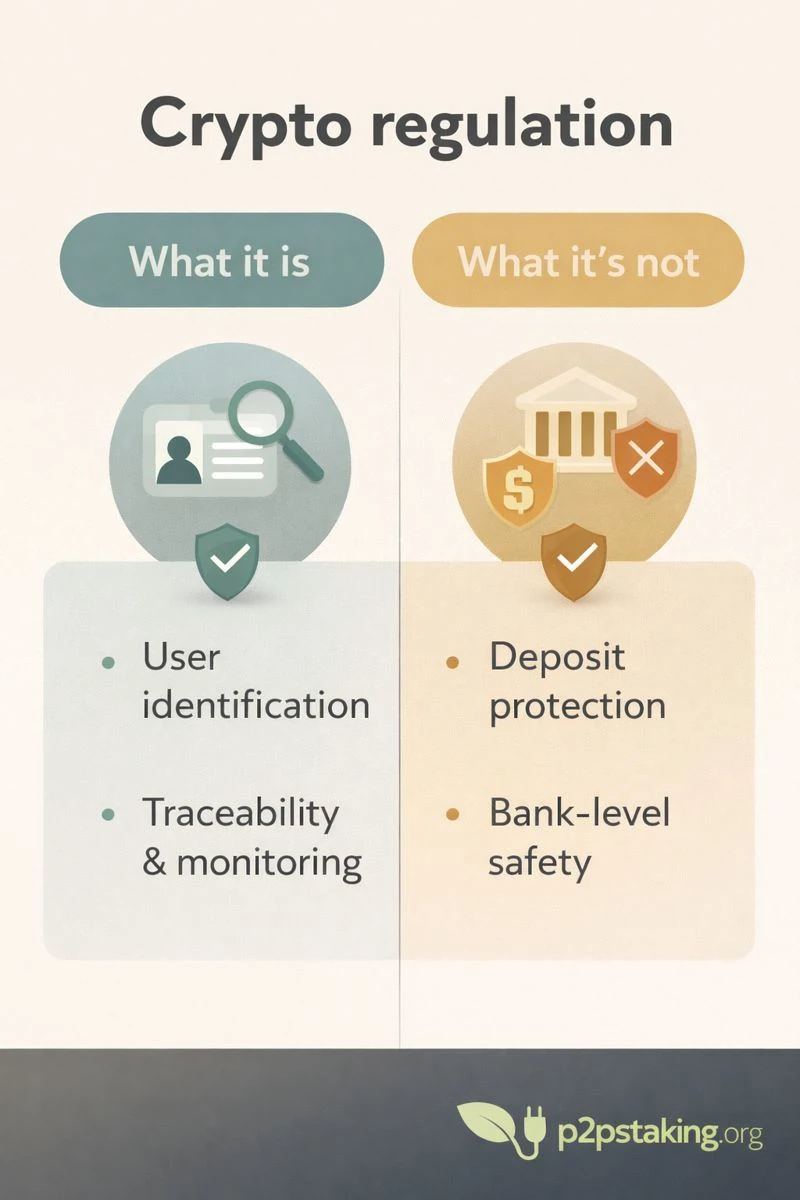
Crypto exchange regulation primarily focuses on traceability, transparency, and monitoring obligations, rather than on direct financial guarantees for users.
In most jurisdictions, regulated exchanges are required to implement KYC/AML procedures, transaction monitoring, record-keeping, and reporting mechanisms to help prevent fraud, money laundering, and illicit activity. While these requirements are not uniform globally and vary significantly by country or region, they are consistently the most common regulatory targets.
In practice, regulation tends to prioritize the ability to identify users, track funds, and ensure compliance with financial crime standards, rather than safeguarding deposits in the same way traditional financial institutions do.
Licensing and Registration
Exchanges may be required to:
- Register with a financial authority
- Obtain a specific crypto or virtual asset license
- Operate through a locally incorporated entity
Licenses are jurisdiction-specific and often limited in scope.
Compliance Obligations
Regulated exchanges are commonly subject to:
- Know Your Customer (KYC) requirements
- Anti-Money Laundering (AML) rules
- Transaction monitoring and reporting
These obligations primarily serve law enforcement and financial oversight, not user fund guarantees.
Custody and Operational Rules
Some jurisdictions impose requirements related to:
- Custody practices
- Internal controls
- Risk management procedures
- Record keeping
However, the level of detail and enforcement varies widely.
How Crypto Exchange Regulation Differs by Jurisdiction
Crypto regulation is fragmented globally. There is no single, unified regulatory framework.
Some countries:
- Regulate crypto exchanges under existing financial laws
- Create bespoke crypto or digital asset regimes
Others:
- Allow exchanges to operate with minimal oversight
- Enforce rules only after incidents occur
Large global platforms, such as Binance, often operate through multiple legal entities, each subject to different regulatory standards. This means user protections depend heavily on where the exchange is legally based, not just on brand recognition.
What Crypto Exchange Regulation Does Not Guarantee
A common misconception is that regulation equals safety. In practice, regulation has clear limits.
Crypto exchange regulation does not guarantee:
- Continuous access to withdrawals
- Protection against exchange freezes
- Immunity from insolvency
- Full reimbursement in case of failure
Even regulated exchanges can:
- Limit withdrawals
- Freeze accounts
- Enter restructuring or liquidation
In summary: even when a crypto exchange is regulated, users do not benefit from the same financial guarantees on their deposits as they do with banks. Regulation in crypto largely aims at compliance and risk monitoring, not at ensuring capital protection or deposit insurance comparable to traditional banking systems.
| Aspect | Regulated Crypto Exchanges | Banks |
|---|---|---|
| Deposit protection | No statutory deposit insurance in most jurisdictions | Deposit insurance schemes (e.g. government-backed guarantees up to a fixed amount) |
| Segregation of client funds | May be required, but enforcement and standards vary | Strict and well-established legal separation |
| Insolvency protection | Limited; users may be unsecured creditors | Strong frameworks to protect depositors |
| Prudential supervision | Partial and evolving | Continuous, mature regulatory oversight |
| Financial guarantees | Generally none | Explicit guarantees on deposits (within limits) |
Regulation improves oversight, but does not remove custodial dependency.
Why Regulation Exists in Custodial Crypto
Regulators focus on custodial platforms because:
- Assets are pooled
- Transactions are intermediated
- Platforms resemble financial service providers
From a regulatory perspective, custodial exchanges are easier to supervise than decentralized protocols or self-custody wallets.
This explains why regulation tends to favor centralized custody models, even though they introduce additional trust assumptions for users.
What Is KYC and What Does It Involve?
KYC stands for Know Your Customer. It refers to a set of regulatory requirements that oblige financial institutions — including crypto exchanges — to identify and verify the identity of their users before allowing access to certain services.
In practice, KYC generally involves:
- Identity verification, such as providing a government-issued ID (passport, national ID card, or driver’s license);
- Personal information checks, including name, date of birth, nationality, and address;
- Proof of address, for example a utility bill or bank statement;
- Ongoing monitoring, where transactions are reviewed to detect suspicious or unusual activity over time.
The primary goal of KYC is not investor protection or fund guarantees, but rather the prevention of illegal activities such as money laundering, terrorist financing, fraud, and sanctions evasion. By linking accounts to real, verified individuals or entities, regulators aim to improve traceability and accountability within financial systems, including crypto markets.
While KYC requirements are now widespread across regulated crypto exchanges, their scope, strictness, and enforcement vary by jurisdiction, and they should not be confused with financial safeguards like deposit insurance or capital protection.
How Regulation Interacts With Other Custodial Risks
Crypto exchange regulation interacts closely with:
- Licensing frameworks
- Audits and proof-of-reserves
- Insurance disclosures
However, regulation does not replace these mechanisms, nor does it guarantee their effectiveness. Each layer addresses different types of risk, and gaps remain between them.
What Crypto Exchange Regulation Means for Users
For users, regulation changes how risk is structured, not whether risk exists.
Regulated exchanges may offer:
- Greater transparency
- Clearer legal accountability
- Defined compliance standards
But users still:
- Depend on platform liquidity
- Rely on internal governance
- Lack direct control over assets
In custodial models, access to funds remains conditional.
Custodial Regulation vs Self-Custody
Custodial crypto regulation applies to platforms that hold user funds.
It does not apply in the same way to self-custody wallets, where users control private keys and interact directly with blockchains.
For users concerned about exchange-level risks, a common mitigation step is to get started with self-custody, using regulated exchanges mainly for short-term trading rather than long-term storage.
Ready to Take Control of Your Crypto?
Go deeper into self‑custody, software wallets, hardware wallets, and practical guides.

Java‑certified engineer and P2PStaking CEO, I secure validators across Solana, Polkadot, Kusama, Mina, and Near. My articles reflect hands‑on wallet ops and real recovery drills so you can set up self‑custody safely, step by step.
FAQ: Custodial Crypto Regulation
What is crypto exchange regulation?
Crypto exchange regulation refers to the set of laws and regulatory rules that govern centralized cryptocurrency platforms that offer trading and custodial services. These regulations typically cover licensing requirements, compliance obligations such as KYC and AML, reporting duties, and operational standards.
Crypto exchange regulation is designed to supervise intermediaries, not blockchains themselves. It focuses on how exchanges operate as businesses rather than on guaranteeing the safety or availability of user funds.
Does crypto exchange regulation protect user funds?
No. Crypto exchange regulation does not guarantee user fund protection. While regulation can improve oversight, transparency, and accountability, it does not ensure that users can always withdraw funds or recover losses in the event of insolvency.
Most jurisdictions do not offer deposit insurance for crypto exchanges comparable to traditional banking systems. As a result, regulated exchanges can still experience withdrawal freezes, liquidity crises, or failures.
What does a regulated crypto exchange have to comply with?
A regulated crypto exchange typically must comply with licensing conditions, customer identification rules (KYC), anti-money laundering requirements (AML), transaction monitoring, and reporting obligations to authorities.
These requirements primarily serve regulatory and law enforcement objectives. They are not designed to guarantee liquidity, prevent exchange freezes, or shield users from custodial risk.
Are regulated crypto exchanges safer than unregulated ones?
Regulated crypto exchanges may offer higher transparency and clearer legal accountability, but they are not inherently risk-free. Regulation does not eliminate operational failures, liquidity shortages, or governance issues.
Safety depends not only on regulation, but also on internal risk management, custody practices, and liquidity controls. Regulation reduces uncertainty, but it does not remove custodial dependency.
Why does crypto regulation vary so much between countries?
Crypto regulation varies by country because it depends on local financial laws, regulatory traditions, and policy priorities. Some jurisdictions integrate crypto exchanges into existing financial frameworks, while others create dedicated digital asset regimes or apply limited oversight.
As a result, the level of protection and enforcement differs significantly depending on where an exchange is legally registered and which entity holds user funds.
Does crypto exchange regulation prevent withdrawal freezes?
No. Crypto exchange regulation does not prevent withdrawal freezes.
Exchanges may still freeze withdrawals due to liquidity stress, technical failures, regulatory actions, or internal risk decisions.
Regulation may influence how freezes are handled or disclosed, but it does not give users direct control over access to their funds.
Is crypto regulation focused on users or institutions?
Crypto regulation is primarily focused on institutions, not individual users. Its main goals are to reduce illicit activity, enable supervision, and enforce compliance standards.
User protection mechanisms, such as guaranteed fund recovery or deposit insurance, are generally limited or absent in crypto regulation frameworks.
How does custodial regulation differ from self-custody?
Custodial crypto regulation applies to platforms that hold user funds and control private keys. In these models, users depend on intermediaries to access and withdraw assets.
Self-custody wallets operate differently: users control their private keys and interact directly with blockchains. As a result, self-custody is not subject to the same exchange-level regulatory controls and does not expose users to exchange-imposed withdrawal restrictions.
What should users understand about regulation before using an exchange?
Users should understand that regulation improves oversight but does not guarantee access to funds or protection from losses. Regulatory status should be seen as contextual information rather than a safety guarantee.
Managing risk often involves limiting long-term reliance on custodial platforms and understanding how custody models affect control over assets.