A crypto exchange is often the first point of contact between users and the cryptocurrency ecosystem. Whether you are buying Bitcoin for the first time, trading altcoins, or converting crypto back to fiat currency, exchanges play a central role.
This guide explains what a crypto exchange is, how it works, and what risks and limitations you should understand before using one. The goal is not to recommend platforms or rank exchanges, but to provide a clear, honest explanation of how crypto exchanges actually function in practice.
Throughout this guide, we focus primarily on centralized crypto exchanges (CEXs), as they represent the default meaning behind most searches for “crypto exchange”. Decentralized exchanges (DEXs) are briefly explained and covered in more detail in dedicated resources.
What Is a Crypto Exchange?
A crypto exchange is a platform that allows users to buy, sell, and trade cryptocurrencies. In most cases, it also acts as an intermediary between users and the blockchain networks where cryptocurrencies exist.
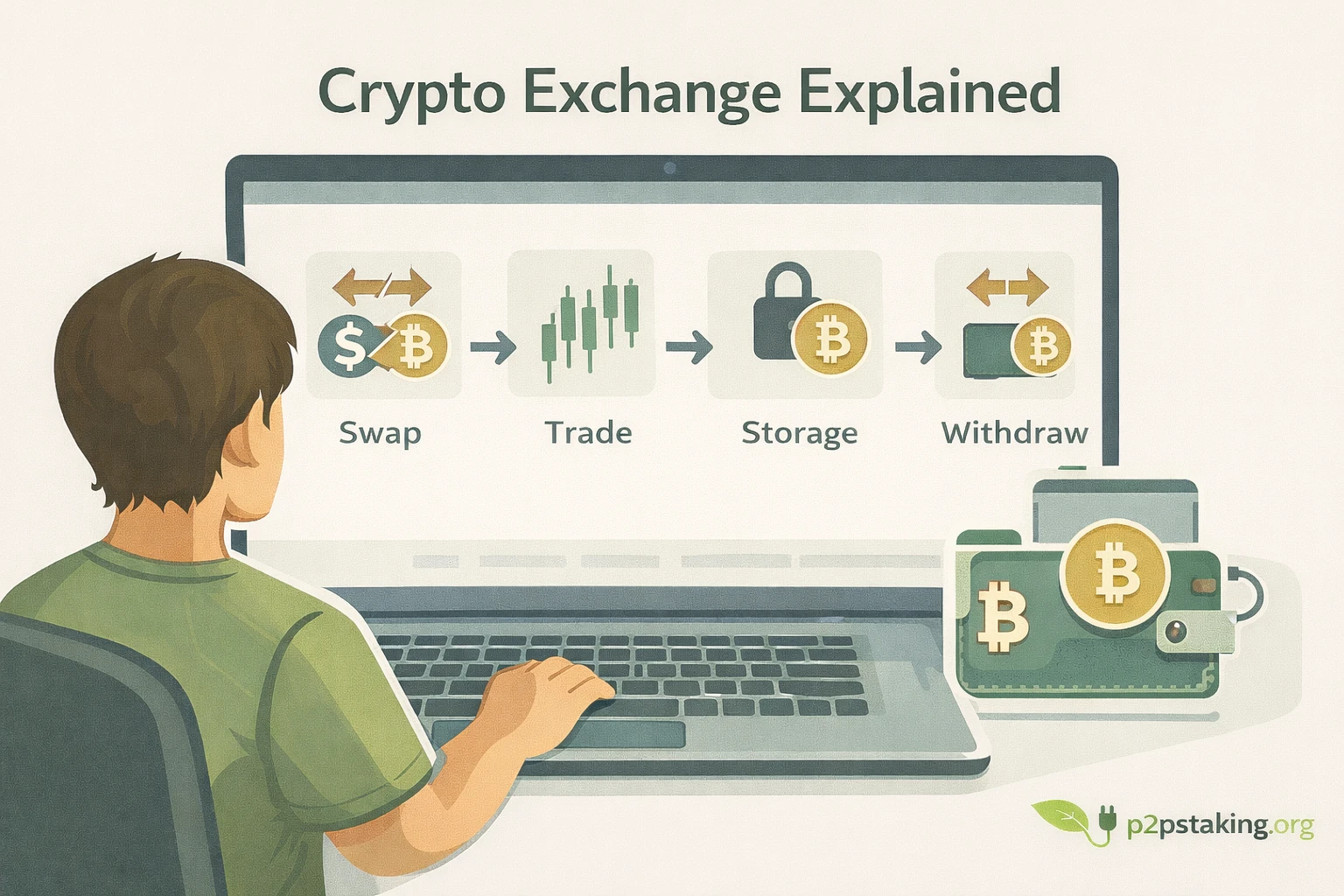
From a functional perspective, a crypto exchange allows you to:
- Convert fiat money (USD, EUR, etc.) into cryptocurrencies
- Trade one cryptocurrency for another
- Temporarily store crypto assets while trades are executed
- Withdraw crypto to a personal wallet or convert it back to fiat
When people refer to a “crypto exchange”, they are almost always referring to a centralized exchange. However, there are two main categories.
More broadly, a crypto exchange is one form of custodial service provider. When funds are held on the platform, the exchange acts as a third party that safeguards assets on behalf of users. Other financial products, such as crypto brokers or exchange-traded products (ETFs), rely on similar custodial models, even though their user experience and regulatory frameworks differ.
We explore these different types of custodial services—crypto exchanges, brokers, and ETFs—in a dedicated guide for readers who want to understand how custody works across the crypto ecosystem.
Centralized Exchanges (CEX)
A centralized crypto exchange is operated by a company that controls the platform, manages user accounts, and holds custody of user funds while they are on the exchange.
Key characteristics of centralized exchanges:
- User accounts are created with email credentials
- Identity verification (KYC) is often required
- The exchange holds private keys on behalf of users
- Trades occur on internal order books, not directly on-chain
- Deposits and withdrawals are processed by the platform
For most beginners and many experienced users, centralized exchanges are the most accessible way to interact with crypto markets.
Important limitation:
When your funds are on a centralized exchange, you do not directly control your private keys. This means you are exposed to the operational, legal, and financial risks of the exchange itself.
This distinction becomes critical when discussing security, regulation, account freezes, and insolvency.
Note: Some centralized exchanges also offer self-custodial wallets as separate products. This does not change the nature of the exchange itself.
When you use a centralized exchange account, the platform typically holds custody of your assets and controls the private keys on your behalf. By contrast, a self-custodial wallet provided by the same company allows you to hold your own private keys and retain full control over your funds.
These are two distinct products with very different trust and risk models. Even if they are offered by the same provider, using a custodial exchange account remains the use of a centralized exchange, while using a self-custodial wallet means you are responsible for key management and security. It is therefore important to clearly understand which product you are using at any given time.
Decentralized Exchanges (DEX)
A decentralized exchange allows users to trade cryptocurrencies directly from their own wallets using smart contracts, without relying on a central intermediary.
Typical characteristics of decentralized exchanges:
- No user accounts or custody by a company
- Trades are executed on-chain via smart contracts
- Users retain full control of their private keys
- No KYC in most cases
- Higher technical complexity and self-responsibility
DEXs are generally more suitable for advanced users who are comfortable managing wallets, gas fees, and smart contract risks. In practice, they also require users to already hold cryptocurrencies, as decentralized exchanges do not support direct fiat on-ramps. To use a DEX, users must typically fund their wallet through a centralized exchange first, or already hold assets such as stablecoins or other cryptocurrencies that can be swapped on-chain.
Coming Soon: Decentralized Exchanges (DEXs)
How Crypto Exchanges Actually Work (CEXs)
At a practical level, centralized crypto exchanges act as intermediaries between users, fiat payment systems, and blockchain networks. While the underlying infrastructure can be complex, the user-facing workflow generally follows a clear and predictable sequence.
Depositing Funds
When using a centralized exchange, users typically start by depositing funds in one of two forms:
- Cryptocurrency deposits:
Users send crypto assets directly from an external wallet to an address controlled by the exchange. Once the transaction is confirmed on the blockchain, the exchange credits the user’s account balance internally. - Fiat money deposits:
Users deposit traditional currencies such as USD or EUR through bank transfers, payment cards, or other supported payment methods. These funds are held by the exchange or its payment partners and reflected in the user’s account balance.
In both cases, the deposited funds are no longer directly controlled by the user once credited to the exchange account. Balances are tracked within the exchange’s internal ledger rather than on-chain.
Trading and Asset Conversion
After funds are credited, users can execute trades on the exchange. This typically includes:
- Converting fiat currency into cryptocurrencies
- Converting cryptocurrencies back into fiat currency
- Trading one cryptocurrency for another
These transactions are usually matched through internal order books and settled off-chain within the exchange’s system. This design enables fast execution and high liquidity, but it also means that trades do not immediately result in blockchain transactions.
Withdrawing Funds
Once trading is complete, users can withdraw their funds from the exchange in one of two ways:
- Fiat withdrawals:
Fiat balances can be sent back to a personal bank account or payment method, subject to the exchange’s withdrawal policies and regulatory requirements. - Cryptocurrency withdrawals:
Crypto assets can be transferred from the exchange to a personal wallet by specifying a blockchain address. In this case, the exchange initiates an on-chain transaction, and the user regains direct control of the assets once the transaction is confirmed.
A Key Structural Point
Throughout this entire process, centralized exchanges operate using off-chain accounting systems combined with pooled on-chain wallets. While this model enables efficiency and scale, it also means that users rely on the exchange’s operational integrity until funds are fully withdrawn.
Understanding these basic flows—deposit, trade, and withdrawal—helps clarify both the convenience and the limitations of centralized crypto exchanges.
Regulation, KYC, and Identity Verification
Crypto exchange regulation has changed significantly over the past decade.
In the early years of crypto, many exchanges operated with little or no identity verification. Users could deposit, trade, and withdraw funds with minimal friction. That environment no longer exists in most jurisdictions.
Today:
- Most regulated exchanges require Know Your Customer (KYC) verification
- Identity checks may be triggered before or after deposits
- Withdrawal limits often depend on verification status
- Accounts can be temporarily restricted during compliance reviews
This evolution has important practical consequences for users. If identity verification is required, it is generally safer to complete it before depositing significant funds, rather than risking account restrictions while assets are already on the platform.
Read our detailed explanation of KYC and how crypto exchange regulation works.
Are Crypto Exchanges Safe?
Crypto exchanges are not inherently unsafe, but they are not risk-free.
Over the years, the industry has seen:
- Exchange hacks1 resulting in loss of user funds
- Insolvencies2 caused by mismanagement or fraud
- Account freezes linked to compliance or regulatory actions
- Withdrawals halted during liquidity crises
Even large, well-known exchanges are still third parties. They are not banks, and in most jurisdictions, user funds are not protected by deposit insurance.
This does not mean exchanges should be avoided altogether. It means they should be used for what they are designed for: exchanging assets, not long-term custody.
Leaving Funds on an Exchange: Practical Considerations
There are valid reasons to keep funds on an exchange temporarily:
- Active trading
- Portfolio rebalancing
- Providing liquidity for frequent transactions
However, keeping large or long-term holdings on an exchange increases exposure to risks that can be avoided by self-custody.
A practical approach used by many experienced users is:
- Keep only the amount needed for trading on the exchange
- Withdraw excess funds to a personal wallet
- Treat exchanges as tools, not vaults
This topic is explored in depth in a dedicated guide on whether leaving crypto on an exchange makes sense in different scenarios.
Account Freezes and Operational Risk
One of the most underestimated risks when using centralized exchanges is account restriction or freezing.
This can happen due to:
- Ongoing identity verification
- Compliance reviews
- Suspicious transaction flags
- Regulatory requests
- Internal risk management decisions
During such periods, users may be unable to withdraw or trade funds temporarily. While this does not always indicate wrongdoing, it highlights the importance of understanding that exchanges retain discretionary control over accounts.
If you want to know more, we also published detailed explanations and real-world scenarios related to exchange freezes.
Security Practices Used by Exchanges
Modern exchanges invest heavily in security infrastructure, including:
- Cold storage for the majority of user funds
- Multi-signature wallets
- Withdrawal whitelists
- Internal audits and monitoring
- User-side security tools such as 2FA
Despite these measures, no centralized system is immune to failure. Understanding how exchange security works, and what users can and cannot control, is essential for managing risk realistically.
Audits, Transparency, and Proof of Reserves
In response to past failures, many exchanges now publish:
- Proof-of-reserves data
- Third-party audits
- Transparency reports
While these measures improve visibility, they are not guarantees.
Proof of reserves shows which crypto assets an exchange holds on-chain, but it does not indicate what portion of those assets actually belongs to users, nor does it reveal the exchange’s liabilities, creditors, or overall financial health.
Similarly, audits reflect a snapshot in time and do not eliminate counterparty risk entirely.
Knowing how to interpret these disclosures is important, but they should be seen as risk indicators, not assurances.
In a dedicated section, we take a closer look at how audits and proof-of-reserves work, what they can (and cannot) tell you, and how to use them realistically when assessing exchange risk.
Using Exchanges With the Right Expectations
Crypto exchanges are powerful tools. They provide liquidity, access, and efficiency that would be difficult to replicate individually.
At the same time, they:
- Are custodial intermediaries
- Operate under evolving regulatory frameworks
- Can fail, freeze accounts, or restrict access
- Are not required for long-term crypto ownership
Understanding this balance allows users to make informed decisions and avoid treating exchanges as something they are not.
Final Thoughts
A crypto exchange is best understood as infrastructure, not storage.
It is a bridge between fiat and crypto, between different assets, and between users in a global market. Used thoughtfully, it enables flexibility and efficiency. Used carelessly, it can introduce avoidable risk.
The core principle remains simple: use exchanges to exchange, not to hold.
For deeper explanations of specific topics discussed in this guide, consult the linked resources covering security, regulation, audits, account freezes, and custody in more detail.

Java‑certified engineer and P2PStaking CEO, I secure validators across Solana, Polkadot, Kusama, Mina, and Near. My articles reflect hands‑on wallet ops and real recovery drills so you can set up self‑custody safely, step by step.
Ready to Take Control of Your Crypto?
Go deeper into self‑custody, software wallets, hardware wallets, and practical guides.
Crypto Exchanges FAQ
What is a crypto exchange?
A crypto exchange is a platform that allows users to buy, sell, and trade cryptocurrencies. It acts as an intermediary between users, traditional financial systems (such as banks), and blockchain networks. Crypto exchanges enable conversions between fiat currencies and cryptocurrencies, as well as trades between different crypto assets.
Most crypto exchanges are centralized platforms that manage user accounts, process trades internally, and temporarily hold user funds during transactions.
What is the difference between a crypto exchange and a wallet?
A crypto exchange and a crypto wallet serve different purposes.
A crypto exchange is designed to facilitate transactions: buying, selling, and trading assets. When funds are held on an exchange, the platform typically controls the private keys.
A crypto wallet, especially a self-custodial wallet, is designed for storage and ownership. It allows users to hold their own private keys and directly control their crypto assets on the blockchain.
In short, exchanges are tools for exchanging assets, while wallets are tools for holding them.
Do I own my crypto on a centralized exchange?
When your crypto is held on a centralized exchange, you do not directly control the private keys. Ownership is effectively mediated by the exchange, which holds custody of the assets on your behalf.
You regain full control only when you withdraw your crypto to a personal wallet where you manage the private keys yourself.
Can I use a crypto exchange without identity verification (KYC)?
This depends on the exchange and the jurisdiction. In many regions, regulated exchanges require identity verification, especially for fiat deposits, withdrawals, or higher transaction limits.
Some exchanges may allow limited functionality without full KYC, but this has become increasingly rare due to regulatory requirements. Even when KYC is not required initially, it may be triggered later by compliance checks.
How do crypto exchanges make money?
Crypto exchanges typically generate revenue through:
Trading fees charged on each transaction
Withdrawal or deposit fees
Spreads between buy and sell prices
Additional services such as staking, lending, or premium accounts
These fees vary depending on the exchange’s business model and the services offered.
What happens if a crypto exchange freezes my account?
If an exchange freezes an account, users may temporarily lose the ability to trade or withdraw funds. This can happen due to identity verification, compliance reviews, suspicious activity flags, or regulatory requirements.
While freezes are often temporary, they highlight that centralized exchanges retain discretionary control over user accounts as custodial intermediaries.
Are decentralized exchanges safer than centralized exchanges?
Decentralized exchanges remove custodial risk because users retain control of their private keys. However, they introduce other risks, such as smart contract vulnerabilities, technical complexity, and user error.
Safety depends on the user’s experience and threat model. Centralized exchanges reduce technical friction but add counterparty risk, while decentralized exchanges reduce counterparty risk but require greater self-responsibility.
Is it safe to leave crypto on an exchange long term?
Crypto exchanges are not designed to be long-term storage solutions. They do not offer the same financial guarantees as banks, nor the same security model as self-custodial hardware wallets.
For this reason, many users choose to keep only the funds needed for trading on exchanges and store long-term holdings in personal wallets.
Foot Notes
1: Mt. Gox hack led to leading exchange collapse in 2014
2: FTX is a recent example. Despite being one of the largest and most visible crypto exchanges at the time, investigations later revealed severe mismanagement of customer funds and internal accounting failures.