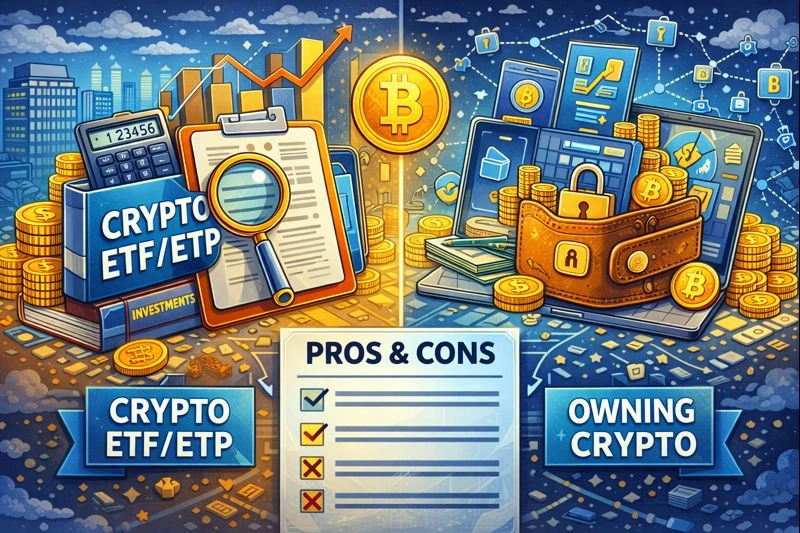
As crypto becomes more integrated into traditional finance, investors and organizations increasingly face a structural choice: gain exposure through crypto ETFs or ETPs, or own crypto directly.
This page provides a deeper, beginner-friendly explanation of both approaches, expanding on their advantages, limitations, and long-term trade-offs, including integration with existing accounts, investment infrastructure, and corporate processes.
What Are Crypto ETFs and ETPs?
Crypto ETFs (Exchange-Traded Funds) and crypto ETPs (Exchange-Traded Products) are regulated financial instruments that track the price of cryptocurrencies or crypto-related indices and trade on traditional stock exchanges.
Depending on their structure, these products may:
- Hold crypto assets through regulated custodians
- Track prices synthetically via derivatives
- Represent baskets of crypto assets
For investors, ETFs and ETPs behave like traditional securities: they are bought, held, and sold through brokerage or investment accounts, without direct interaction with blockchains.
What Does Owning Crypto Mean?
Owning crypto means purchasing cryptocurrencies directly and holding them in a wallet. This can take two main forms:
- Self-custody, where the user controls private keys
- Custodial holding, where an exchange or third party controls keys
Direct ownership allows interaction with blockchain networks themselves, including:
- Sending and receiving assets
- Staking and governance participation
- Using decentralized applications
Ownership is technical, not contractual: control depends on who holds the private keys.
Core Difference: Financial Exposure vs Asset Ownership
The fundamental distinction between these models is what you actually own.
With crypto ETFs and ETPs:
- You own a financial instrument
- Your exposure is contractual
- Blockchain access is fully abstracted
With direct crypto ownership:
- You own the crypto asset itself
- You interact with the network directly
- Control depends on custody choices
This distinction shapes every trade-off that follows.
Advantages of Crypto ETFs and ETPs
Crypto ETFs and ETPs are designed to fit seamlessly into existing financial systems.
Simpler Integration With Existing Accounts
One of the strongest advantages is easy integration. Crypto ETFs and ETPs can typically be held in:
- Brokerage accounts
- Retirement and pension accounts
- Tax-advantaged investment wrappers
- Portfolio management platforms
This allows investors to gain crypto exposure without changing how they manage their finances.
Familiar Processes for Individuals and Institutions
ETFs and ETPs align with established:
- Compliance workflows
- Reporting standards
- Custody and settlement processes
For businesses and institutions, this is critical. Companies can allocate capital using:
- Existing treasury processes
- Approved custodians
- Established risk frameworks
No new wallet infrastructure or key management policies are required.
Lower Operational and Educational Barrier
Crypto ETFs and ETPs remove the need to:
- Manage private keys
- Understand blockchain mechanics
- Handle network fees or addresses
This makes them accessible to users who want exposure but not operational responsibility.
Regulatory and Accounting Compatibility
ETFs and ETPs are typically easier to:
- Account for on balance sheets
- Report under existing accounting standards
- Integrate into regulated investment mandates
This is particularly important for corporations, funds, and fiduciaries.
Limitations of Crypto ETFs and ETPs
Despite their convenience, these products have structural constraints.
No Direct Ownership or Blockchain Use
ETF and ETP holders cannot:
- Withdraw crypto to a wallet
- Use assets on-chain
- Participate in staking or governance
Exposure is limited strictly to price movements.
Ongoing Fees and Tracking Differences
Management fees and operational costs can:
- Reduce long-term performance
- Create tracking differences versus spot crypto prices
Over long time horizons, these costs can be significant.
Counterparty and Structural Risk
Investors depend on:
- Issuers
- Custodians
- Market makers
Failures, legal actions, or structural issues can impact access or pricing, even if the underlying crypto network functions normally.
Advantages of Owning Crypto Directly
Direct ownership offers a fundamentally different value proposition.
Full Asset Control (With Self-Custody)
With self-custody, users:
- Control private keys
- Can move assets at any time
- Are independent of market hours and intermediaries
Access is governed by blockchain rules, not institutional processes.
Participation in the Crypto Ecosystem
Owning crypto enables:
- Staking and yield participation
- Governance voting
- Use of decentralized finance and applications
These functions are not available through ETFs or ETPs.
Alignment With Decentralization Principles
Direct ownership reflects crypto’s original design:
- Permissionless access
- User sovereignty
- Reduced reliance on intermediaries
For some users, this philosophical alignment is as important as financial exposure.
Challenges of Owning Crypto
Direct ownership introduces responsibilities that ETFs avoid.
Key Management and Security Responsibility
Users must manage:
- Private keys
- Backup and recovery phrases
- Secure storage
Errors can result in irreversible loss.
Higher Operational and Learning Curve
Owning crypto requires understanding:
- Wallets and addresses
- Network fees and confirmations
- Custody risks
This can be intimidating for beginners.
Custodial Risk When Using Exchanges
If crypto is held on exchanges rather than self-custody, users face:
- Withdrawal limits
- Exchange freezes
- Platform failures
This reintroduces intermediary risk without the protections of regulated securities.
Corporate and Enterprise Considerations
For companies, the choice is often driven by process rather than ideology.
Crypto ETFs and ETPs are easier to:
- Integrate into existing treasury systems
- Approve under corporate governance policies
- Manage through existing custodians and auditors
Direct crypto ownership may require:
- New internal controls
- Key management policies
- Updated risk and compliance frameworks
As a result, many enterprises prefer ETFs or ETPs for exposure, even if they accept reduced control.
When Crypto ETFs and ETPs Make Sense
They are often suitable for:
- Investors seeking price exposure only
- Users constrained by regulatory or tax structures
- Companies and institutions using existing financial infrastructure
They prioritize integration, simplicity, and compliance.
When Owning Crypto Makes Sense
Direct ownership may be preferable for:
- Users seeking on-chain utility
- Long-term holders aligned with decentralization
- Participants in staking or decentralized finance
It prioritizes control, flexibility, and participation.
Expanded Trade-Off Summary
| Dimension | Crypto ETFs / ETPs | Owning Crypto |
|---|---|---|
| What you own | Financial instrument | Crypto asset |
| Blockchain access | None | Direct |
| Integration | Excellent with existing accounts | Requires new tools |
| Fees | Ongoing management fees | Network and custody costs |
| Control | Low | High (with self-custody) |
| Corporate suitability | High | Operationally complex |
| Ecosystem participation | None | Full |
Final Takeaway
Crypto ETFs / ETPs vs owning crypto is a structural choice, not a simple preference.
ETFs and ETPs integrate smoothly into existing financial systems for individuals and businesses, making them well-suited for traditional portfolios and corporate processes.
Direct ownership offers deeper control, flexibility, and participation—but requires greater responsibility and operational change.
Understanding these trade-offs allows investors and organizations to choose the exposure model that truly fits their goals, constraints, and long-term strategy.
Ready to Take Control of Your Crypto?
Go deeper into self‑custody, software wallets, hardware wallets, and practical guides.

Java‑certified engineer and P2PStaking CEO, I secure validators across Solana, Polkadot, Kusama, Mina, and Near. My articles reflect hands‑on wallet ops and real recovery drills so you can set up self‑custody safely, step by step.