CEX.IO is one of the longest‑serving cryptocurrency exchanges. Since launching in 2013 as a Bitcoin mining pool (GHash.io) that briefly controlled more than half of the network hash rate1, the company has shifted toward a compliance‑first trading platform. Today CEX.IO claims more than 15 million users worldwide and operates under U.S. Money Services Business registration and multiple Money Transmitter Licenses.
This guide explains how the platform works, highlights its strengths and weaknesses and clarifies who will benefit from using it. All facts presented here are backed by reliable sources; where jurisdictional details are unclear, we note that features may vary by geography.
Origins and Legitimacy
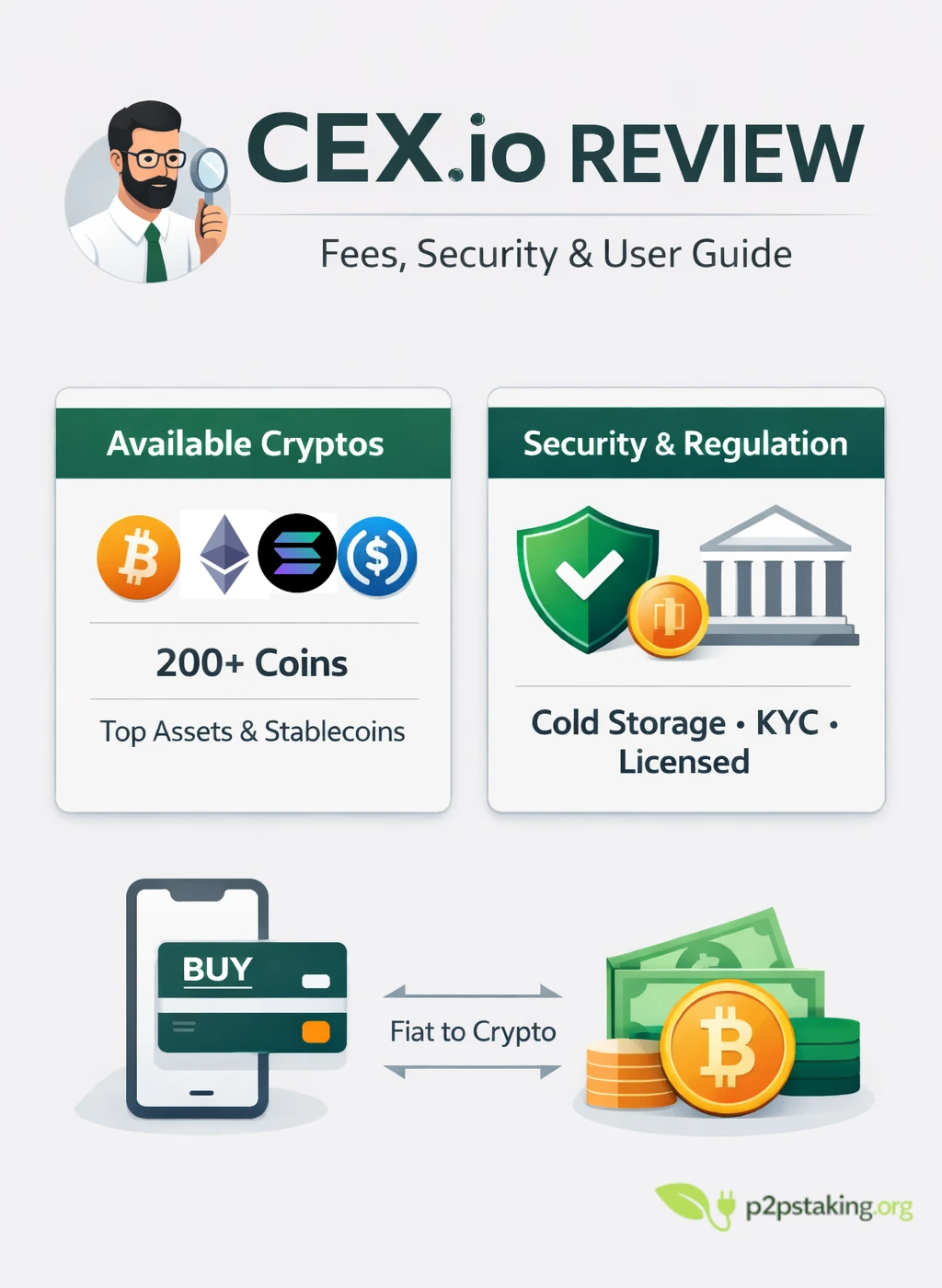
CEX.IO was founded by Ukrainian entrepreneur Oleksandr Lutskevych. The exchange evolved from a mining service into a regulated crypto on‑ramp. It holds registration with the U.S. Financial Crimes Enforcement Network (FinCEN) and has obtained money‑transmitter licences2 in more than 30 states. In Europe, CEX.IO is authorised under Gibraltar’s Distributed Ledger Technology regime and is registered with regulators in the UK and Cyprus. The company has not reported any major security breaches and says 98 % of customer funds are kept in multisignature cold storage.
Available Cryptocurrencies and Markets
CEX.IO lists over 200 digital assets, including Bitcoin, Ethereum, Solana, XRP, Cardano and Polkadot. The selection prioritises liquidity and established projects rather than thousands of illiquid tokens, so speculative altcoin hunters may find the catalogue limited. Key markets and tools include:
- Spot trading : a full order‑book exchange with TradingView charts and market, limit and stop‑limit orders.
- Instant buy/sell : a simple fiat on‑ramp that lets users buy or sell crypto via card, PayPal or mobile wallets.
- Margin trading : leverage of around 2–3× for BTC/USD and ETH/USD pairs, with some reports of leverage up to 20× on select products. Availability varies by jurisdiction.
- Earn products : staking and savings features offering yields up to around 12 % per year.
- API access : REST and WebSocket APIs for algorithmic trading and data feeds.
These services make CEX.IO a middle‑ground platform: it offers more than a simple broker but remains less complex than professional derivatives exchanges.
Fees and Costs
Fees on CEX.IO are tiered based on 30‑day trading volume. The entry‑level rate is 0.25 % per trade for both makers and takers. Fees decline gradually at higher volumes and reach 0.10 % only when monthly turnover exceeds $10 million. There is no native token to obtain fee discounts.
Other charges include:
- Margin fees : opening and closing a leveraged position each incur a 0.1 % fee, with a 1 % liquidation fee.
- Deposit and withdrawal fees : card deposits and Apple/Google Pay incur roughly 0.49 – 4.99 %, SEPA transfers cost €2.99, SWIFT transfers cost 0.1 % in and 0.3 % + $25 out, and PayPal deposits/withdrawals cost 3.99 % + $5. Crypto deposits are free; withdrawals incur blockchain network fees.
- Inactivity fee : a maintenance fee applies after 12 months of inactivity on small balances.
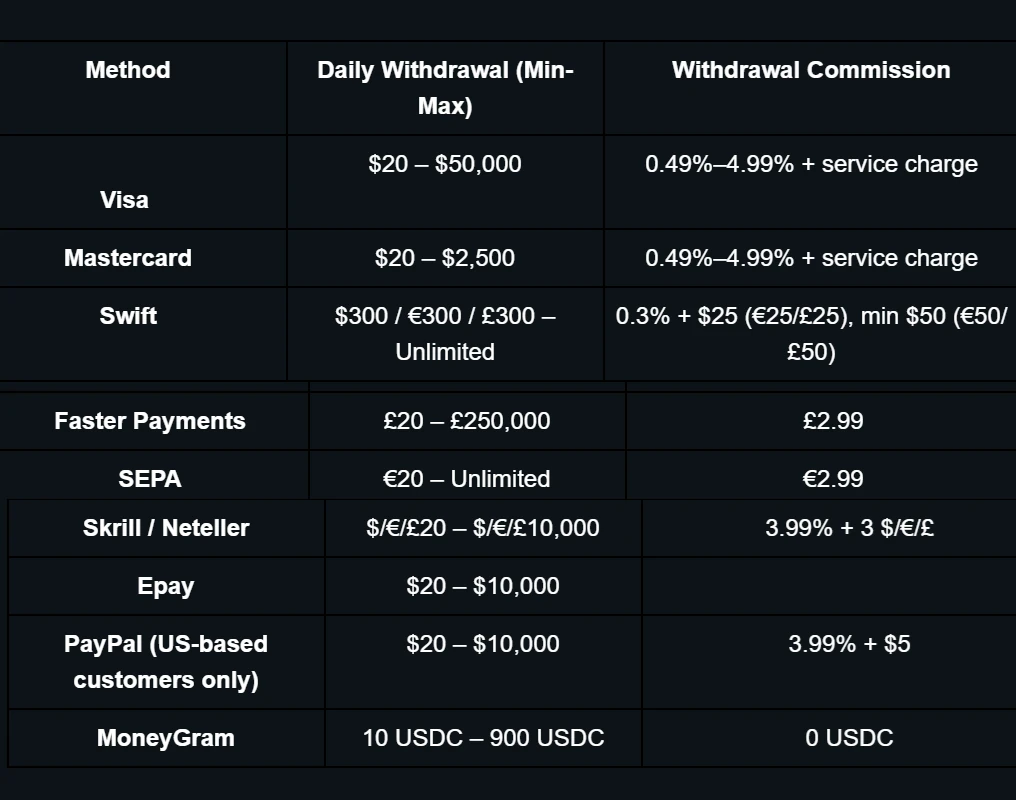
While the trading fee structure is transparent, overall costs are higher than on low‑cost exchanges. Beginner and occasional users should pay particular attention to card and PayPal fees.
Payment Methods
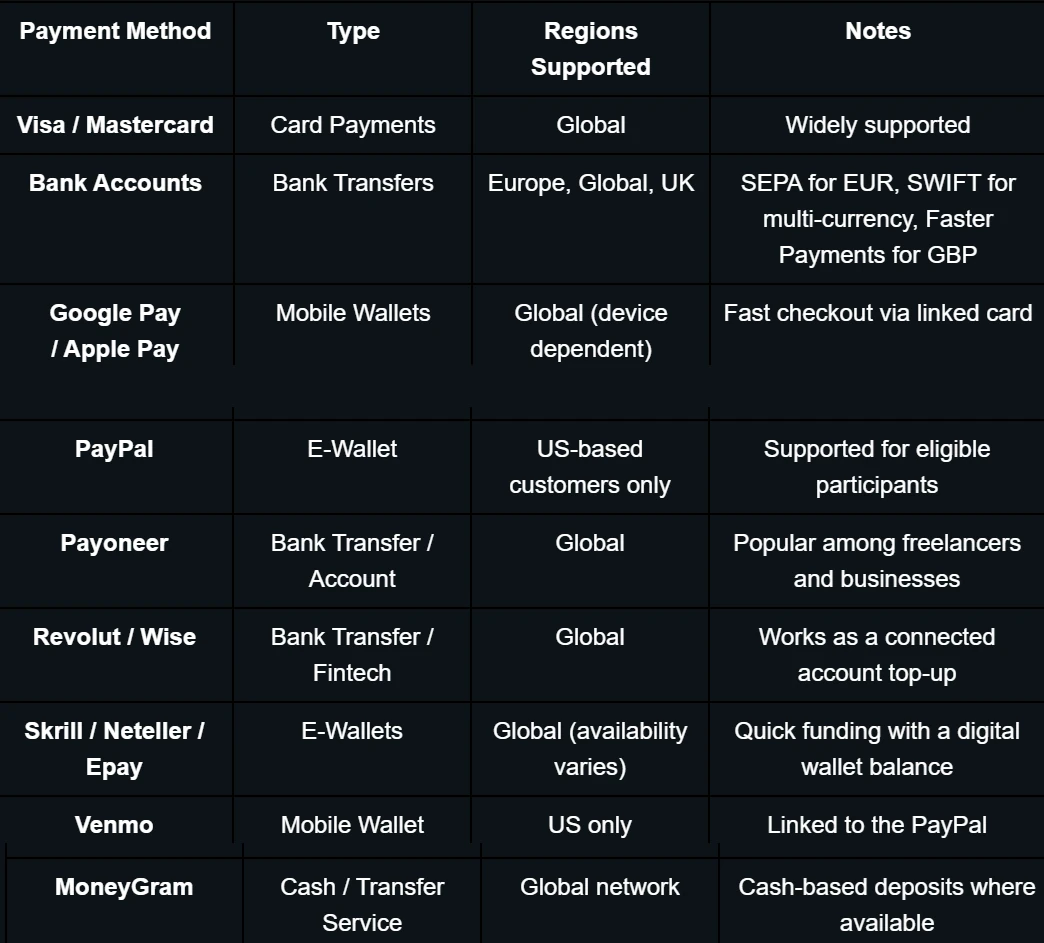
CEX.IO is notable for its variety of funding options. Users can deposit and withdraw via Visa and Mastercard, bank transfers (SEPA, SWIFT, ACH), PayPal, Skrill, Neteller, Google Pay, Apple Pay and MoneyGram. Deposits made with cards are usually instant, while bank transfers take from one to several business days. Minimum deposits start around $20. Not all methods are available in every country; for example, PayPal and certain local transfer systems operate only in specific regions.
Security and Regulation
Security is a core focus at CEX.IO. The platform stores most funds offline in multisignature cold wallets3. Accounts require two‑factor authentication and device verification. Payment processing is certified to PCI DSS standards, and strict KYC/AML procedures are mandatory.
For fiat balances, certain USD accounts are insured by partner banks up to $250,000 via the FDIC. Cryptocurrency balances are not insured. Because the exchange is custodial, users do not control their private keys; it is therefore advisable to withdraw assets to a personal wallet when not actively trading.
Geographic Availability
CEX.IO advertises service availability in more than 160 countries. However, some jurisdictions restrict specific products (for example, margin trading or staking).
Supported Countries
The table below lists countries and territories where CEX.IO permits account creation. Service availability may vary by product type, and regulatory changes can affect the list without notice. Countries under broad sanctions (e.g., North Korea, Cuba, Iran, Syria) are excluded.
| Albania | Algeria | American Samoa | Andorra | Angola |
| Anguilla | Antarctica | Antigua and Barbuda | Argentina | Armenia |
| Aruba | Australia | Austria | Azerbaijan | Bahamas |
| Bahrain | Bangladesh | Barbados | Belarus | Belgium |
| Belize | Benin | Bermuda | Bhutan | Bolivia, Plurinational State of |
| Bonaire, Sint Eustatius and Saba | Botswana | Bouvet Island | Brazil | British Indian Ocean Territory |
| Brunei Darussalam | Bulgaria | Burkina Faso | Cabo Verde | Cambodia |
| Cameroon | Canada | Cayman Islands | Chad | Chile |
| China | Christmas Island | Cocos (Keeling) Islands | Colombia | Comoros |
| Congo | Congo, The Democratic Republic of the | Cook Islands | Costa Rica | Croatia |
| Curaçao | Cyprus | Czech Republic | Denmark | Djibouti |
| Dominica | Dominican Republic | Ecuador | Egypt | El Salvador |
| Equatorial Guinea | Eritrea | Estonia | Eswatini | Falkland Islands (Malvinas) |
| Faroe Islands | Fiji | Finland | France | French Guiana |
| French Polynesia | French Southern Territories | Gabon | Gambia | Georgia |
| Germany | Ghana | Gibraltar | Greece | Greenland |
| Grenada | Guadeloupe | Guatemala | Guernsey | Haiti |
| Heard Island and McDonald Islands | Holy See (Vatican City State) | Honduras | Hong Kong | Hungary |
| Iceland | India | Indonesia | Ireland | Isle of Man |
| Israel | Italy | Jamaica | Jersey | Jordan |
| Kazakhstan | Kenya | Kiribati | Korea, Republic of | Kosovo |
| Kuwait | Kyrgyzstan | Latvia | Lesotho | Liberia |
| Libya | Liechtenstein | Lithuania | Luxembourg | Macao |
| Madagascar | Malawi | Malaysia | Maldives | Malta |
| Marshall Islands | Martinique | Mauritania | Mauritius | Mayotte |
| Mexico | Micronesia, Federated States of | Moldova, Republic of | Monaco | Mongolia |
| Montenegro | Montserrat | Morocco | Mozambique | Myanmar |
| Namibia | Nauru | Nepal | Netherlands | New Caledonia |
| New Zealand | Nicaragua | Niger | Nigeria | Niue |
| Norfolk Island | North Macedonia | Northern Mariana Islands | Norway | Oman |
| Palau | Panama | Papua New Guinea | Paraguay | Peru |
| Philippines | Pitcairn | Poland | Portugal | Qatar |
| Réunion | Romania | Russian Federation | Rwanda | Saint Barthélemy |
| Saint Helena, Ascension and Tristan da Cunha | Saint Kitts and Nevis | Saint Lucia | Saint Martin (French part) | Saint Pierre and Miquelon |
| Saint Vincent and the Grenadines | Samoa | San Marino | Sao Tome and Principe | Saudi Arabia |
| Senegal | Serbia | Seychelles | Sierra Leone | Singapore |
| Sint Maarten (Dutch part) | Slovakia | Slovenia | Solomon Islands | South Africa |
| Spain | Sri Lanka | Suriname | Svalbard and Jan Mayen | Sweden |
| Switzerland | Taiwan, Province of China | Tajikistan | Tanzania, United Republic of | Thailand |
| Timor‑Leste | Togo | Tokelau | Tonga | Trinidad and Tobago |
| Turks and Caicos Islands | Tuvalu | Türkiye | Turkmenistan | United Arab Emirates |
| United Kingdom | United States (see state table below) | Uruguay | Uzbekistan | Wallis and Futuna |
| Western Sahara | Zambia |
U.S. States Supported
CEX.IO gradually adds U.S. jurisdictions as it obtains money‑transmitter licences. A 2019 press release reported that residents of the following states and the District of Columbia could open accounts:
| Alaska | Arizona | Arkansas | California | Colorado |
| Delaware | District of Columbia | Indiana | Iowa | Kansas |
| Kentucky | Maryland | Massachusetts | Michigan | Minnesota |
| Mississippi | Missouri | Montana | Nevada | New Hampshire |
| New Mexico | Oklahoma | Pennsylvania | Rhode Island | South Dakota |
| Utah | West Virginia | Wisconsin | Wyoming |
Later announcements indicate that the list has expanded to more than 30 states; users should verify current availability during registration. Note that features such as margin trading and staking may be restricted in certain states or territories.
User Experience
The CEX.IO interface emphasises simplicity. The standard dashboard allows users to buy, sell and convert crypto in a few clicks. TradingView charts and multiple order types provide sufficient depth for intermediate traders. Mobile applications for iOS and Android include price alerts and order notifications. While experienced traders may find the advanced “Exchange Plus” interface less sophisticated than professional platforms, it offers enough functionality for most retail use cases.
User Feedback and Reputation
Customer reviews are mixed. On Trustpilot the exchange scores around 3.2/5, with common complaints about withdrawal delays, strict KYC procedures and inconsistent customer support. Some users appreciate the ease of buying crypto and the platform’s regulatory pedigree, while others criticise hidden fees and account limits. A round‑the‑clock support team is available via live chat and is rated 3.8/5 by reviewers.
Pros and Cons
| Strength | Description | Ideal for |
|---|---|---|
| Regulated and legitimate platform | Holds FinCEN registration and money‑transmitter licences in dozens of U.S. states; authorised by EU and UK regulators. | Users prioritising compliance and legal oversight. |
| Wide selection of major cryptocurrencies | Lists more than 200 established coins and tokens. | Investors seeking exposure to leading cryptocurrencies without venturing into obscure tokens. |
| Multiple deposit methods | Supports cards, SEPA/SWIFT/ACH transfers, PayPal, Skrill, Neteller, Google Pay, Apple Pay and more. | Newcomers who want an easy fiat on‑ramp. |
| Instant buy and intuitive interface | Quick purchase/conversion tools and user‑friendly design. | First‑time buyers and casual investors. |
| Earn products and Visa card | Staking and savings with yields up to 12 % APY; Visa debit card available in the European Economic Area. | Users looking to earn passive income or spend crypto seamlessly. |
| API and moderate leverage | REST/WebSocket API and leverage options up to around 20×. | Semi‑professional traders and developers. |
| Limitation | Explanation | Who is affected? |
|---|---|---|
| Higher trading and funding fees | Entry‑level trading fees of 0.25 % and deposit/withdrawal fees for cards, PayPal and SWIFT. | High‑frequency traders and cost‑conscious investors. |
| Inactivity fee and account limits | Maintenance fee after a year of inactivity; low initial deposit/withdrawal limits for new accounts. | Occasional users and small‑balance holders. |
| Customer support and KYC complaints | Reports of slow verification and withdrawal delays. | Users needing rapid assistance or concerned about privacy. |
| Smaller asset selection than mega‑exchanges | 200+ assets still falls short of the thousands offered by certain competitors. | Altcoin enthusiasts seeking very new or obscure tokens. |
| No demo account | There is no risk‑free demo mode for practising. | New traders wanting to test strategies without funding an account. |
Who Should Use CEX.IO?
CEX.IO is best suited to:
- Beginners and first‑time buyers who value an easy fiat on‑ramp, simple interface and regulatory oversight.
- Mainstream investors in Europe and North America seeking a bridge between traditional banking and crypto, with staking and savings products as added benefits.
- Intermediate traders who need spot and moderate leverage trading with API support but do not require advanced derivatives or ultra‑low fees.
The platform is less appealing to high‑frequency traders, cost‑sensitive users and those seeking access to thousands of altcoins or complex derivatives. For those profiles, platforms like Binance, Bitget or MEXC offer lower fees and broader asset coverage.
Final Verdict
CEX.IO combines simplicity, regulatory compliance and solid functionality. Its long track record and multi‑jurisdictional licences make it a trustworthy entry point to digital assets. However, the platform’s fees are higher than many competitors’, and some users report slow verification and customer‑support experiences. If you prioritise safety and ease of use over rock‑bottom fees or exotic altcoins, CEX.IO is a strong choice. If you prefer lower costs and a wider token catalogue, consider alternative exchanges.
If you decide that CEX.IO matches your needs, you can support our work by registering through our affiliate link. This does not affect your fees but helps fund the research and guides we publish.

Java‑certified engineer and P2PStaking CEO, I secure validators across Solana, Polkadot, Kusama, Mina, and Near. My articles reflect hands‑on wallet ops and real recovery drills so you can set up self‑custody safely, step by step.
Ready to Take Control of Your Crypto?
Go deeper into self‑custody, software wallets, hardware wallets, and practical guides.
FAQ — CEX.io Review
Is CEX.io a safe crypto exchange?
Yes. CEX.io operates under multiple regulatory frameworks. It is registered as a Money Services Business (MSB) with FinCEN in the United States and holds money transmitter licenses across many U.S. states. It is also registered and authorized in several European jurisdictions.
This regulatory positioning makes it one of the more compliant exchanges in the market.
What are CEX.io fees?
CEX.io trading fees start at 0.25% per trade and decrease based on 30-day trading volume.
Additional costs depend on how you fund your account:
Card purchases: up to ~4.99%
SEPA transfers: ~€2.99
SWIFT: percentage + fixed fee
PayPal: ~3.99% + fixed fee
Crypto deposits are free, but withdrawals include network fees.
Which countries support CEX.io?
CEX.io is available in over 160 countries worldwide.
However, availability depends on local regulations, and some countries are restricted, especially those under international sanctions.
In the United States, the platform operates in multiple states, but access to certain features (such as staking or margin trading) may vary depending on local laws.
Is CEX.io available in the United States?
Yes, CEX.io operates in many U.S. states and is registered with FinCEN.
However, not all services are available nationwide. Some states restrict specific features like staking or margin trading, and availability should always be confirmed during account registration.
What cryptocurrencies are available on CEX.io?
CEX.io offers over 200 cryptocurrencies, including:
-Bitcoin (BTC)
-Ethereum (ETH)
-Solana (SOL)
-XRP
-Cardano (ADA)
-Polkadot (DOT)
-stablecoins like USDT and USDC
The platform focuses on liquid, established assets rather than listing thousands of speculative tokens.
Is CEX.io good for beginners?
Yes. CEX.io is particularly well-suited for beginners thanks to:
simple interface
– instant crypto purchases
– multiple fiat payment methods
– clear onboarding process
It is designed to make the transition from fiat to crypto as smooth as possible.