This Binance review provides a practical, experience-based, and educational overview of Binance as a centralized crypto exchange.
It focuses on how the platform works in practice, the trade-offs of its custodial model, and how users typically experience its features, fees, and onboarding process.
Key Takeaways
- Binance is a centralized crypto exchange offering spot trading, derivatives, fiat on/off-ramps, and custodial network participation features.
- Users commonly appreciate its broad asset coverage, deep liquidity, and feature-rich platform, while regularly mentioning interface complexity, support responsiveness, and regulatory friction.
- The platform is well suited for users who want access to a wide range of crypto market infrastructure tools, but less appropriate for those prioritizing simplicity or self-custody.
This content is educational, not financial advice. Do your own research and follow local laws/regulations.
Disclosure: Some links may be affiliate links. If you buy through them, we may earn a commission at no extra cost to you. We keep our comparisons independent and research-based (read our Disclosure Policy).
Overview of Binance
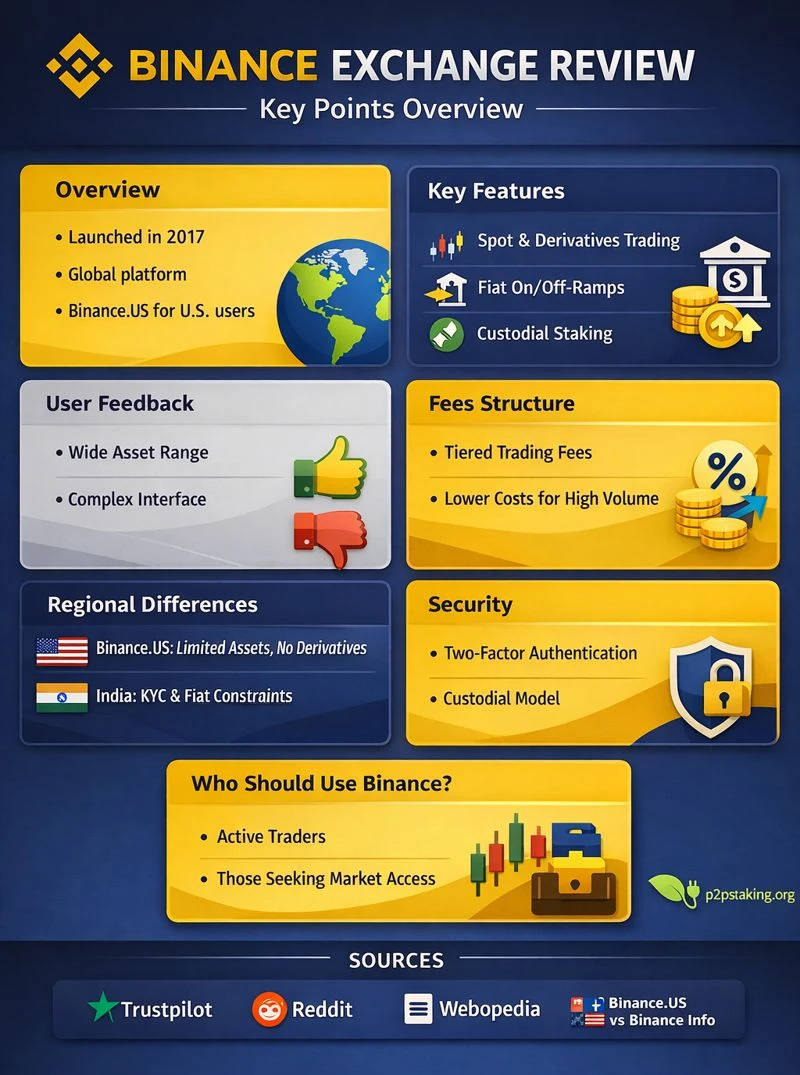
Binance was launched in 2017 and operates under the Binance Group, a global organization providing crypto-related infrastructure and services.
Key characteristics:
- Launch year: 2017
- Operating entity: Binance Group (multiple regional entities)
- Geographic reach: Global, with regional platforms and restrictions depending on jurisdiction
- Positioning: Multi-product, high-liquidity exchange serving retail and advanced users
- Scale indicators: One of the largest exchanges by reported trading volume and number of listed assets
Binance’s long-standing presence has made it a core access point to crypto markets, but also places it under heightened regulatory scrutiny, which directly impacts user experience in some regions.
Binance Review Features and Products
Binance Exchange Functionality
Binance provides a full set of centralized exchange functions:
- Spot trading: Buying and selling crypto assets using market, limit, and conditional order types
- Order types: Market, limit, stop-limit, and other advanced variations depending on the interface
- Fiat on- and off-ramps: Bank transfers, cards, and third-party payment providers (region-dependent)
- Account and portfolio management: Balances, transaction history, and performance views within the custodial account
- API access: Available for users who need programmatic access for trading or data retrieval
Most core features are available globally, though fiat support and specific tools vary by country.
Binance Products and Services
Beyond basic trading, Binance offers a wide range of optional services:
- Derivatives products: Futures and leveraged instruments, often restricted by jurisdiction
- Earn products: Savings-style and locked products that keep assets under Binance custody
- Custodial staking and network participation: Users can delegate participation to Binance without managing keys directly
- Advanced tools: Margin trading, institutional-grade interfaces, and data services
These products expand functionality but also increase complexity and custodial exposure, which users should factor into their usage.
User Experience: How Does It Feel to Use Binance?
Binance For Beginners
For new users, Binance can feel dense but functional:
- The interface exposes many features early, which can be overwhelming
- Basic actions like buying, selling, depositing, and withdrawing are available through simplified views
- Educational prompts and tooltips exist, but do not fully remove the learning curve
Beginners often report that basic usage is possible quickly, while deeper understanding takes time.
For Advanced Users and Traders
For experienced users, Binance is generally perceived as powerful and flexible:
- Advanced trading views provide depth charts, order book visibility, and multiple order types
- Interfaces are customizable and designed for active usage
- Performance during high-volume periods is usually reported as stable, though not immune to congestion
The platform is often described as feature-rich rather than minimalist.
What Users Like and Dislike About Binance
This section summarizes recurring patterns from public user feedback sources.
Individual experiences vary and should not be treated as guarantees.
What Users Commonly Like
Frequently mentioned positives include:
- Wide selection of supported assets, including major and smaller-cap tokens
- High liquidity, which generally results in reliable order execution
- Broad feature set, allowing many activities within a single platform
- Global accessibility, subject to regional rules
What Users Commonly Dislike
Recurring criticisms include:
- Customer support delays, especially during account or compliance issues
- Verification and compliance friction, particularly when regulations change
- Interface complexity, which some users find difficult to navigate
- Occasional withdrawal constraints, often tied to network congestion or internal controls
These themes appear consistently across large user samples rather than isolated complaints.
Fees on Binance
Binance uses a tiered and activity-based fee structure.
Fee Structure Overview
- Trading fees: Maker/taker model for spot trading are among the lowest of all crypto exchnages
- Fee tiers: Fees may change based on trading volume or account status
- Deposit fees: Typically low or zero for crypto deposits; fiat depends on method
- Withdrawal fees: Network-dependent and vary by asset
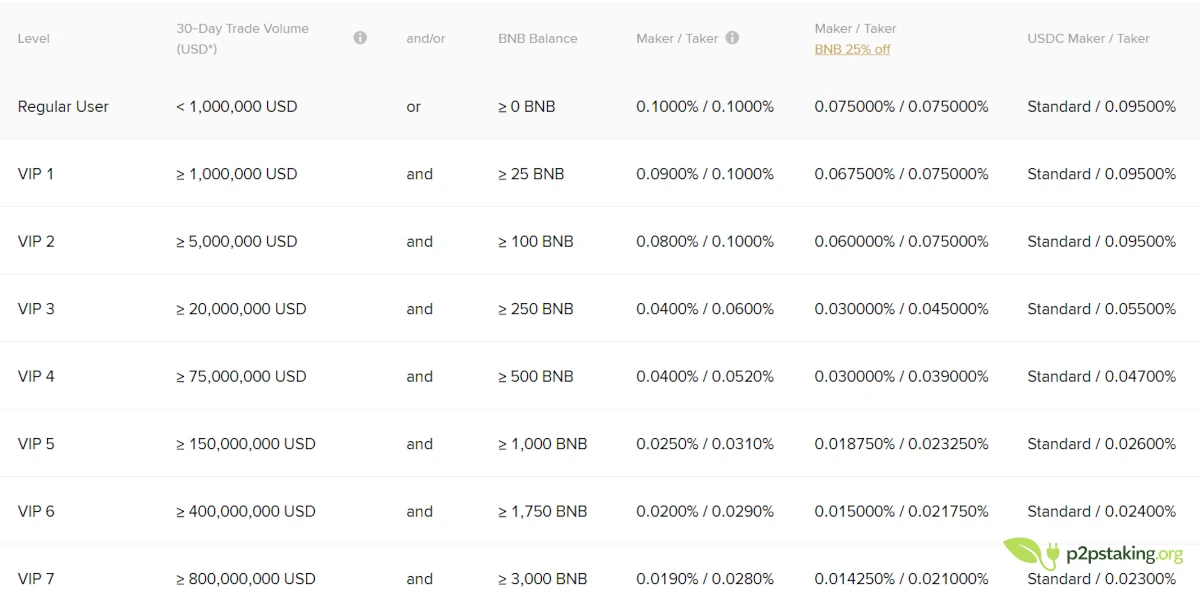
Fees are transparent but variable, requiring users to check Binance fee conditions 1 per transaction.
When Fees Are Generally Advantageous
The structure tends to align with:
- Active traders executing higher volumes
- Users primarily trading on spot markets
- Users operating within well-supported fiat corridors
A concrete example comes from p2pstaking.org’s own operations as a validator.
As part of normal network participation, staking rewards are periodically converted into other assets to cover server and infrastructure costs denominated in US dollars. This results in regular spot market transactions, not speculative trading.
Before using Binance, these weekly conversions were executed on a platform charging approximately 0.4% per trade, leading to around USD 875 in cumulative fees over a comparable period.
After moving these transactions to Binance’s spot market, the total fee cost for the same activity was reduced by roughly a factor of four, without changing transaction frequency or volume.
When Fees May Be Less Favorable
Costs may be higher for:
- Small, infrequent transactions
- Certain fiat withdrawal methods
- Users in regions with limited banking support
This reflects infrastructure and regulatory constraints rather than optimization choices.
Security Overview
Binance provides multiple account-level security controls, including:
- Two-factor authentication (2FA)
- Withdrawal address whitelisting
- Device and session management
- Internal risk monitoring systems
It is important to note that Binance operates under a custodial model, meaning users do not control private keys for assets held on the platform.
For a detailed assessment of incidents, audits, and security history, see our dedicated analysis: Is Binance safe?
Supported Coins and Assets
Binance supports hundreds of crypto assets, including:
- Layer 1 and Layer 2 network tokens
- Utility and governance tokens
- Stablecoins and wrapped assets
💰500+ available coins and 🔀1500+ trading pairs
The exchange publishes listing and delisting criteria, and asset availability may vary by region.
The breadth of listings is one of Binance’s defining characteristics.
Geographic Availability and Restrictions
Binance operates globally but with significant regional differences:
- Some countries have access to a full feature set
- Others face restrictions on derivatives, fiat services, or onboarding
- Certain jurisdictions are entirely excluded
Users must verify local eligibility and feature availability before relying on the platform.
Two regions where these differences are particularly pronounced are the United States and India.
Binance in the United States (Binance.US)
In the United States, Binance does not operate the global platform. Instead, U.S. users access the exchange through Binance.US, a separate and independently operated entity designed to comply with U.S. regulatory requirements.
Key specificities of Binance.US include:
- Separate platform and infrastructure from Binance.com
- Significantly reduced asset selection, compared to the global exchange
- No access to derivatives, futures, or leveraged products
- More limited staking and earn features, depending on regulatory approvals
- Stricter onboarding and KYC requirements, aligned with U.S. compliance standards
- Fiat on- and off-ramps primarily focused on USD, via U.S. banking partners
From a user perspective, Binance.US functions as a more constrained spot-focused exchange, prioritizing regulatory compliance over feature breadth.
Users familiar with Binance.com should not assume feature parity when operating from the U.S.
Binance in India
Binance is accessible in India through Binance, but operates in a highly constrained regulatory environment that directly affects usage conditions.
Key specificities of Binance in India include:
- Mandatory and enhanced KYC requirements for continued access
- Limited or inconsistent fiat on- and off-ramp availability, depending on local banking support
- Compliance with Indian Virtual Digital Asset (VDA) regulations, including transaction reporting obligations
- Tax-related friction, as crypto transactions are subject to specific local tax rules
- Periodic service disruptions or feature adjustments, reflecting regulatory developments
In practice, many users in India rely more heavily on crypto-to-crypto transactions, while fiat interactions may be slower, more complex, or temporarily unavailable.
This environment makes Binance in India functionally usable, but operationally more restrictive than in regions with stable fiat integration.
Is There a Binance App?
Yes. Binance offers mobile applications for iOS and Android.
The app supports:
- Spot and derivatives trading
- Deposits and withdrawals
- Account and security management
- Market monitoring and notifications
While powerful, the app reflects the same complexity trade-off as the desktop interface.
How to Use Binance: Getting Started
Sign Up on Binance
- Account creation requires an email or phone number
- Basic access is possible immediately after registration
- Initial limits apply before verification
Binance Identity Verification (KYC)
- KYC is mandatory for most functions
- Verification is required to unlock higher limits and fiat services
- Unverified accounts face significant restrictions
Trustpilot user reviews for Binance 2 consistently highlight friction around account registration, identity verification (KYC), and account access controls.
Many users report that verification or compliance reviews can temporarily restrict withdrawals or account actions.
For this reason, and as outlined in our How to choose a Crypto Exchange guide, it is prudent to test the full workflow—deposit, trade, and withdrawal—using a small amount first.
This approach helps users validate account functionality and compliance status before relying on the platform for larger balances.
Depositing Funds on Binance
- Crypto deposits are supported across many networks
- Fiat deposits depend on region and payment method
- Processing times vary by network and provider
Trading on Binance
- Users can place basic trades via simplified views
- Advanced interfaces offer full order control
- Recurring purchase features exist in some regions
Withdrawing Funds From Binance
- Withdrawals are available to crypto wallets and fiat accounts
- Minimums and fees depend on asset and network
- Processing times can vary during network congestion
Customer Support: How It Works
Binance provides:
- Help center documentation
- Ticket-based support and chat systems
User feedback often notes adequate documentation, but slow resolution for complex cases.
Who Should Use Binance?
Binance is well suited for:
- Users seeking broad market access and high liquidity
- Users comfortable navigating feature-rich platforms
- Users needing access to multiple crypto infrastructure tools
Less suited for:
- Users prioritizing self-custody and key control
- Users wanting very simple, minimal interfaces
- Users in heavily restricted jurisdictions
Ready to Take Control of Your Crypto?
Go deeper into self‑custody, software wallets, hardware wallets, and practical guides.

Java‑certified engineer and P2PStaking CEO, I secure validators across Solana, Polkadot, Kusama, Mina, and Near. My articles reflect hands‑on wallet ops and real recovery drills so you can set up self‑custody safely, step by step.
Footnotes
1: Binance Fees