Rebalancing a crypto portfolio is not a trading tactic. It is a portfolio management discipline.
At its core, rebalancing a crypto portfolio means restoring your digital asset allocation to predefined targets after market movements distort them. Because crypto markets are volatile by nature, allocations rarely remain stable for long. Gains compound quickly, drawdowns happen abruptly, and what started as a measured exposure can become disproportionate.
Rebalancing brings structure back into that environment.
It applies at two levels. First, inside your crypto holdings: the balance between Bitcoin, Ethereum, stablecoins, and altcoins. Second, at the broader level of your overall wealth: the balance between crypto and other asset classes such as equities, fixed income, or cash1.
If you initially decided that crypto should represent 5% of your total portfolio, but a strong bull market pushes that exposure to 15%, rebalancing a crypto portfolio means reducing that allocation and reallocating capital elsewhere. The goal is not to predict the market. It is to restore the structure you originally defined.
Disclaimer
The perspectives presented here reflect our analytical view on cryptocurrency allocation strategy and portfolio construction. This content is for educational and informational purposes only and does not constitute investment advice, financial advice, or a recommendation to allocate capital to any specific asset. All investment decisions involve risk and should be made based on individual circumstances and, where appropriate, consultation with a qualified professional.

What Is Rebalancing a Crypto Portfolio?
Rebalancing a crypto portfolio is the process of adjusting your digital asset holdings to match predetermined allocation targets.
Within crypto, this typically involves restoring balance between assets that reflect different theses. Bitcoin is often approached as a monetary asset with long-term scarcity characteristics. Ethereum and other smart contract platforms represent technological bets on decentralized finance, tokenization, and digital asset infrastructure. Altcoins may reflect more specialized or experimental developments.
Over time, one category may significantly outperform the others. When that happens, your portfolio composition changes—even if you take no action. Rebalancing a crypto portfolio corrects that drift.
Outside crypto, the same principle applies. If digital assets grow faster than other components of your wealth, your overall risk exposure increases. Rebalancing restores alignment between crypto and the rest of your financial assets.
In both cases, the objective is consistency between intention and exposure.
Why Does Rebalancing a Crypto Portfolio Matter?
Crypto volatility is structural. Large price movements are common and can reshape a portfolio in a matter of weeks. Without a framework for adjustment, allocations can become concentrated in a single asset or narrative.
Rebalancing a crypto portfolio matters because it limits unintended concentration risk. It ensures that no single asset dominates simply because it appreciated more quickly than the rest.
It also creates a systematic way to take profits. When prices rise sharply, rebalancing naturally involves reducing overweight positions. This allows gains to be secured without attempting to identify market tops. Conversely, during downturns, restoring target allocations may require increasing exposure to underweight assets. In this sense, rebalancing encourages disciplined accumulation when prices are lower.
Most importantly, rebalancing reduces emotional decision-making. Instead of reacting to headlines or short-term momentum, decisions are guided by predefined allocation thresholds. The process becomes rule-based rather than sentiment-driven.
Rebalancing a crypto portfolio does not eliminate risk. It does not guarantee improved returns. It simply ensures that volatility does not dictate your portfolio structure.
How to Rebalance a Crypto Portfolio
Rebalancing a crypto portfolio begins with clarity. You must first define your target allocations.
This includes two dimensions: the percentage of total wealth allocated to crypto, and the distribution within crypto itself. For example, you may decide that crypto represents 10% of your overall portfolio, with 60% of that in Bitcoin, 30% in Ethereum, and 10% in other assets.
Once targets are defined, the next step is measurement. Calculate the current market value of each holding and express it as a percentage of the total. The difference between the current allocation and the target allocation determines whether adjustment is required.
Execution can take different forms. You may sell part of an overweight asset and reallocate the proceeds. Alternatively, you may direct new capital toward underweight positions. Some investors combine both methods.
Operational precision matters. Rebalancing a crypto portfolio often involves exchanges, self-custody wallets, and network transfers. Address verification, correct network selection, and transaction fee estimation are essential. Portfolio discipline must be matched with operational discipline.
Rebalancing does not require constant action. It requires defined rules and periodic review.
When Should You Avoid or Postpone Rebalancing a Crypto Portfolio?
Rebalancing a crypto portfolio should be planned, not reactive. It is not a weekly exercise driven by short-term price fluctuations.
If you do not have clearly defined allocation targets, rebalancing becomes arbitrary. In that case, the first step is to establish a coherent allocation framework before executing transactions.
Transaction costs may also justify postponement, particularly for smaller portfolios. If fees and spreads represent a significant percentage of capital, the benefit of immediate correction may be limited.
Tax considerations are equally important. In many jurisdictions, selling crypto assets triggers capital gains taxation. A rebalance that appears minor in percentage terms may have meaningful tax consequences in absolute terms. Planning around holding periods and reporting obligations is essential.
Because of crypto’s volatility, reviewing allocations at least quarterly is often reasonable. In more dynamic market phases, monthly reviews may be appropriate. The appropriate frequency depends on portfolio size, risk tolerance, and the time you are willing to dedicate to active management.
Consistency is more important than precision. A structured review calendar reduces impulsive decisions.
What Are the Hidden Costs of Rebalancing a Crypto Portfolio?
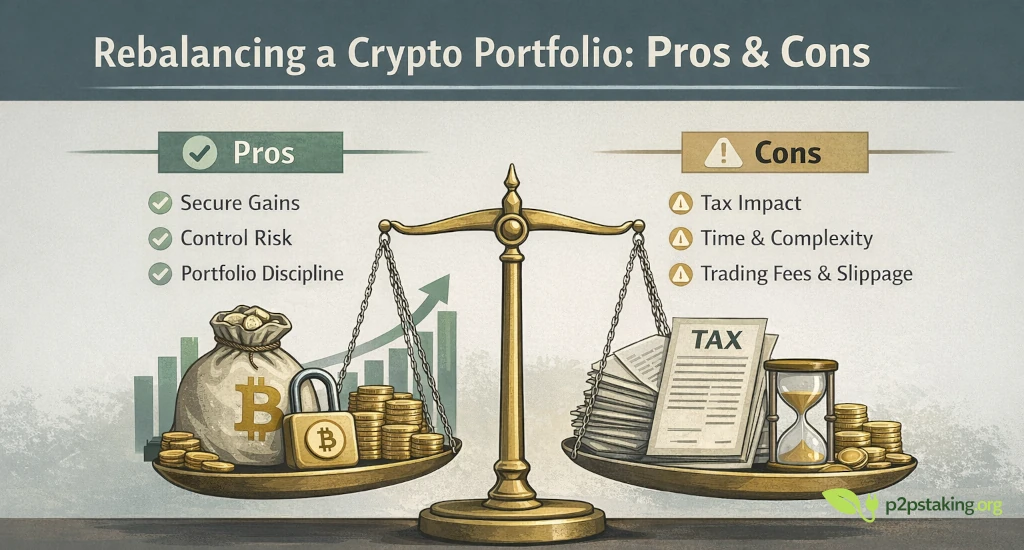
The most significant hidden cost of rebalancing a crypto portfolio is taxation.
Selling digital assets generally crystallizes capital gains or losses. In many countries, even exchanging one cryptocurrency for another constitutes a taxable event. This can reduce the effective capital available for reinvestment and increase reporting complexity. Accurate record-keeping, including acquisition prices and transaction history, is essential. In many cases, consulting a qualified tax professional is advisable before making substantial adjustments.
Time and operational complexity are also meaningful costs. Calculating allocations, executing trades securely, transferring funds between platforms, and updating records require attention and discipline. As portfolios grow, this administrative burden increases.
Other costs exist but are usually secondary: trading fees, bid-ask spreads, slippage in less liquid markets, and temporary custody risk during transfers. While these factors should be considered, taxation and complexity typically have the most durable impact over time.
What Are the Hidden Gains of Rebalancing a Crypto Portfolio?
Rebalancing a crypto portfolio does more than correct percentages. It embeds discipline into the investment process.
One of its hidden gains is systematic profit realization. After strong market appreciation, reducing overweight positions secures part of the gains without relying on market timing. This creates gradual de-risking during expansion phases.
Another gain is structured exposure during downturns. When prices decline, rebalancing may require increasing allocations to underweight assets. This introduces disciplined accumulation rather than reactive selling.
Over time, rebalancing reinforces portfolio coherence. Exposure remains aligned with conviction and predefined limits. The portfolio reflects planning rather than momentum.
These benefits are not guarantees of performance. They are mechanisms for maintaining structural balance in a volatile environment.
Three Common Strategies for Rebalancing a Crypto Portfolio
There are several established approaches to rebalancing a crypto portfolio.
A calendar-based strategy relies on fixed intervals. The portfolio is reviewed and adjusted quarterly, semi-annually, or annually. This approach is simple and predictable, though significant allocation drift may occur between review dates.
A threshold-based strategy activates when allocation deviates beyond a predefined percentage from target weights. For example, if Ethereum exceeds its target allocation by more than five percentage points, rebalancing is triggered. This method reduces unnecessary transactions but requires regular monitoring.
A contribution-based strategy uses new capital to restore balance rather than selling existing positions. This can reduce taxable events and transaction costs, though it may not fully correct substantial imbalances if no new capital is added.
Each strategy reflects trade-offs between simplicity, responsiveness, and administrative effort. There is no universal model. The appropriate approach depends on personal discipline, tax environment, and portfolio scale.
Ready to Take Control of Your Crypto?
Go deeper into self‑custody, software wallets, hardware wallets, and practical guides.

Java‑certified engineer and P2PStaking CEO, I secure validators across Solana, Polkadot, Kusama, Mina, and Near. My articles reflect hands‑on wallet ops and real recovery drills so you can set up self‑custody safely, step by step.
FAQ Rebalancing Crypto Portfolio
What is crypto portfolio rebalancing?
Crypto portfolio rebalancing is the process of restoring your digital asset allocation to predefined target weights. It involves adjusting holdings when price movements cause certain assets—such as Bitcoin, Ethereum, or altcoins—to represent a larger or smaller percentage of the portfolio than originally intended.
Is rebalancing the same as trading?
No. Rebalancing is a risk management practice, not a speculative activity. Trading aims to anticipate short-term price movements. Rebalancing focuses on maintaining strategic allocation levels over time.
Why is rebalancing important in crypto markets?
Crypto markets are highly volatile. Without periodic adjustments, strong price movements can significantly distort portfolio allocation. Rebalancing helps manage concentration risk, secure portions of accumulated gains, and maintain alignment with predefined investment objectives.
How often should you rebalance a crypto portfolio?
There is no universal rule. Many investors review their crypto allocation quarterly. In more volatile market conditions, monthly reviews may be appropriate. The appropriate frequency depends on portfolio size, risk tolerance, and the time available for portfolio management.
Should crypto be rebalanced within a broader investment portfolio?
Yes, if crypto represents a predefined percentage of total net worth. For example, if digital assets were initially allocated at 5% of a portfolio but grow to 15% after a bull market, rebalancing may involve reducing crypto exposure to restore the original allocation.
Does rebalancing improve returns?
Rebalancing does not guarantee higher returns. Its primary objective is risk control and allocation discipline. It may reduce concentration and enforce systematic profit realization, but it does not eliminate volatility.
Are crypto-to-crypto swaps taxable when rebalancing?
In many jurisdictions, exchanging one cryptocurrency for another is considered a taxable event. Selling digital assets may trigger capital gains or losses. Tax treatment varies by country, so understanding local regulations and maintaining accurate transaction records is essential.
What are the main costs associated with rebalancing?
The primary costs typically include taxation, transaction fees, and the operational time required to calculate allocations and execute trades securely. For larger portfolios, reporting and compliance complexity may also increase.
Can you rebalance without selling assets?
Yes. One method is contribution-based rebalancing, where new capital is allocated to underweight assets instead of selling overweight positions. This approach may reduce taxable events but may not fully correct significant imbalances.
Is rebalancing suitable for long-term investors?
Yes, provided it aligns with a defined allocation strategy. Long-term investors often use rebalancing to maintain risk exposure within predetermined limits rather than reacting emotionally to short-term market movements.
Footernotes
1: Does Crypto Have a Place in Your Portfolio?