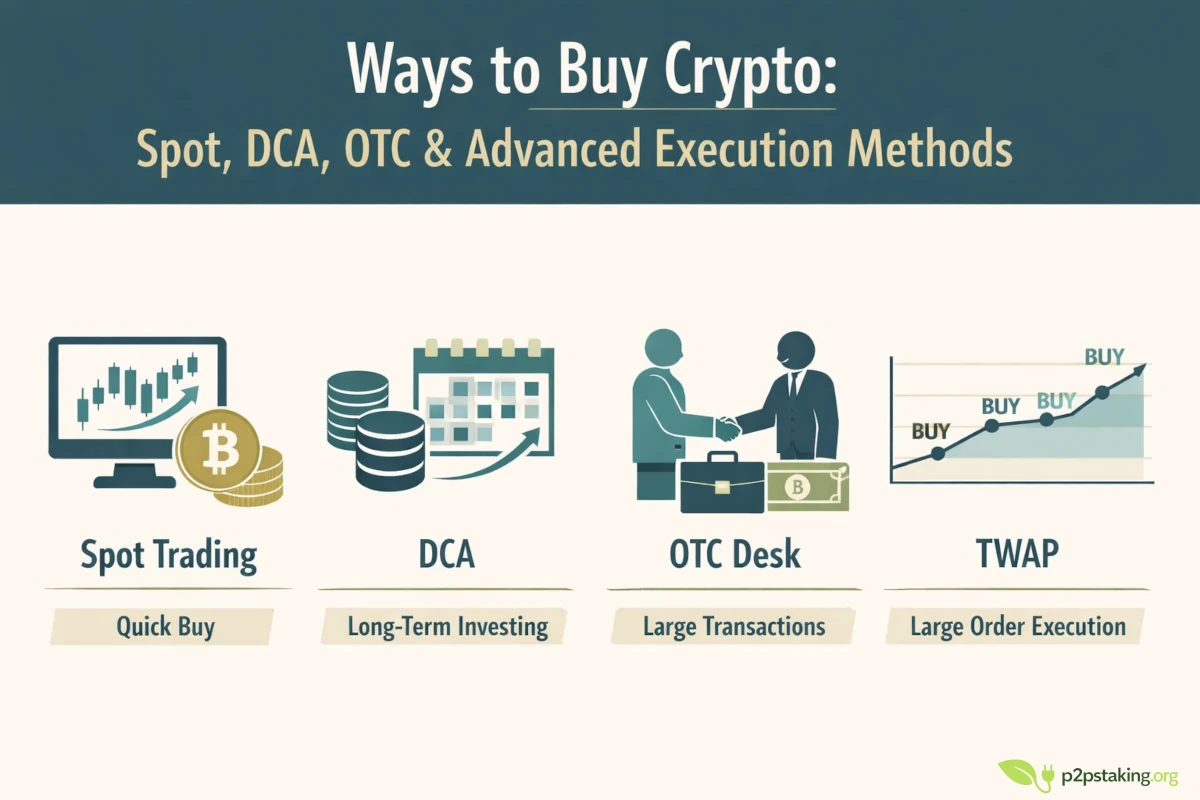
Crypto spot trading refers to the direct buying and selling of cryptocurrencies for immediate settlement at the current market price. When you execute a spot trade, you own the actual asset — whether it’s Bitcoin, Ethereum, or another token.
Unlike futures or leveraged trading, there is no contract involved and no expiration date. You simply exchange one asset for another at the “spot” price, meaning the price available right now.
For active traders, crypto spot trading forms the foundation of market participation. It is the simplest way to enter and exit positions while maintaining full control over the underlying asset.
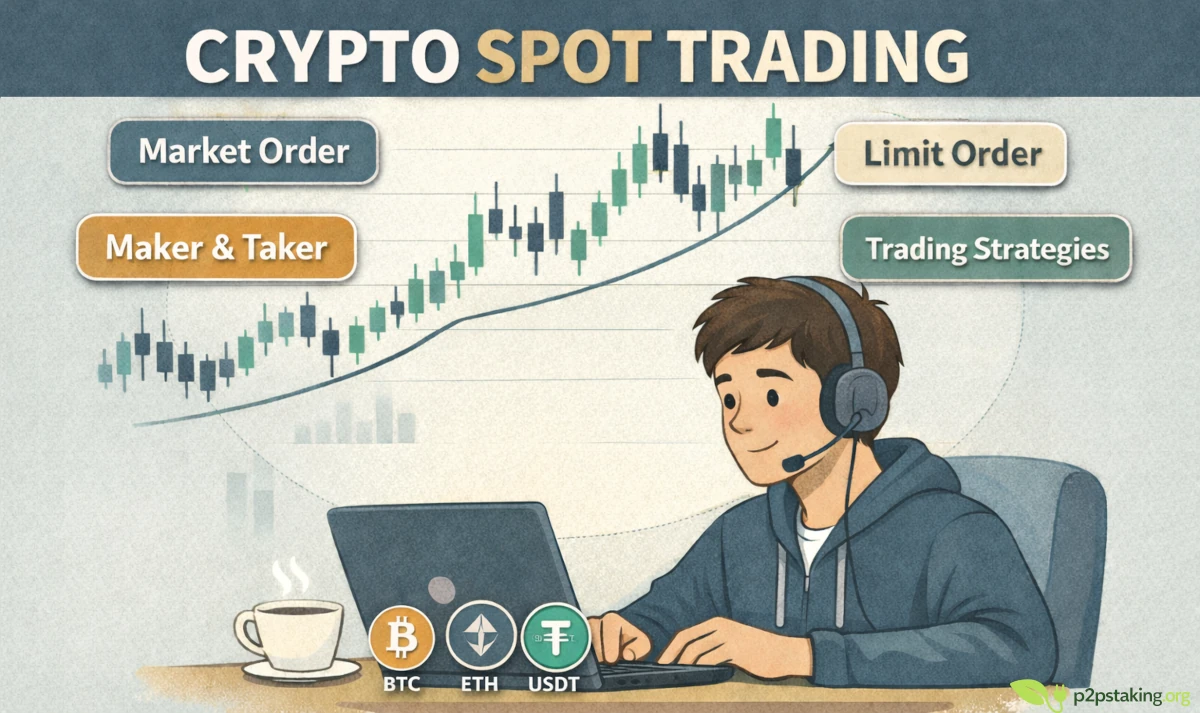
How Crypto Spot Trading Works in Practice
In practical terms, crypto spot trading means opening a position by buying an asset and closing it later by selling it.
For example, if you buy BTC using USDT on the BTC/USDT pair, you now hold Bitcoin. If the price rises, you can sell it back into USDT and realize your profit.
This is crypto trading explained in its most direct form: you exchange assets at market price, settlement happens instantly, and your balance updates immediately.
Active traders often monitor liquidity, price momentum, and order book activity before entering or exiting a position. Execution timing matters, especially in volatile markets.
understanding the Order Book in Crypto Spot Trading
The order book is where all active buy and sell orders are displayed.
On one side, you have bids — traders willing to buy at specific prices. On the other side, you have asks — traders willing to sell.
The difference between the highest bid and lowest ask is called the spread. A tight spread usually indicates strong liquidity, while a wide spread 1 may signal lower activity.
For active crypto spot trading, understanding the order book helps you anticipate slippage, identify liquidity clusters, and avoid entering positions where large orders could move the price quickly.
Market Order vs Limit Order in Crypto Spot Trading
Execution strategy plays a critical role in active trading.
Market Order
A market order executes immediately at the best available price. It guarantees execution but not price precision.
Traders often use market orders when entering a breakout or reacting to fast-moving momentum. However, in thin markets, slippage can occur.
Limit Order
A limit order allows you to specify the exact price at which you want to buy or sell.
Execution is not guaranteed, but you control the price. Limit orders are commonly used for scaling into positions, setting structured exits, or reducing fees.
For active participants, combining market and limit orders strategically is part of effective crypto spot trading.
Best Order Type for Beginners in Crypto Spot Trading
If you are new to crypto spot trading and simply want to buy your first position, choosing the right order type can make the experience much smoother.
For most beginners, a market order is the easiest option. It executes immediately at the best available price, which means you don’t need to analyze the order book or worry about whether your order will fill. On highly liquid pairs like BTC/USDT or ETH/USDT, slippage is usually minimal.
A limit order can be useful if you want more price control. You set the exact price at which you are willing to buy, and the order executes only if the market reaches that level. This is helpful if you believe the price may dip slightly before continuing higher.
However, for someone who is not actively trading and just wants exposure, over-optimizing the entry price often adds unnecessary complexity. The difference of a few dollars matters less than understanding position size and long-term risk.
In short:
- If you want simplicity and immediate execution → use a market order.
- If you want price precision and are willing to wait → use a limit order.
Maker vs Taker: Why Fees Matter
Every trade on a spot exchange involves either adding liquidity or removing it.
If you place a limit order that sits in the order book, you are considered a maker. If you execute against an existing order using a market order, you are a taker.
Exchanges typically charge lower fees to makers because they provide liquidity. For active traders who execute frequently, the difference between maker and taker fees can significantly impact long-term profitability.
Understanding this dynamic is essential in crypto spot trading strategies.
Trading Pairs and Stablecoins in Spot Markets
Spot markets operate through trading pairs, such as BTC/USDT or ETH/BTC.
The first asset is the base currency, and the second is the quote currency. In BTC/USDT, you are buying or selling Bitcoin against USDT.
Stablecoins like USDT or USDC play an important role in capital management. They allow traders to stay in a USD-equivalent position without leaving the exchange.
They are also a practical way to lock in profits without fully exiting the crypto ecosystem. Instead of converting gains back into fiat and withdrawing to a bank account, traders can move into stablecoins and remain on-chain, ready to re-enter the market when opportunities arise.
For active participants, this flexibility matters. Holding stablecoins preserves capital during volatile periods while keeping funds immediately available for new trades. It simplifies portfolio management and reduces friction between positions, especially in fast-moving markets.
Crypto Spot Trading Strategies for Active Traders
There are multiple crypto spot trading strategies that active participants use, depending on market conditions.
Breakout trading involves entering when price moves beyond key resistance levels. Range trading focuses on buying near support and selling near resistance in sideways markets.
Some traders scale into positions gradually rather than entering all at once. Others use momentum strategies, reacting to strong volume and price acceleration.
Regardless of the approach, risk management remains central. Position sizing, stop-loss placement, and liquidity awareness matter more than the strategy itself.
Advantages of Crypto Spot Trading
One of the main advantages of crypto spot trading is simplicity. There is no leverage, no liquidation risk, and no complex contract structure.
You own the asset directly. This reduces structural risk compared to derivatives markets.
Spot trading also offers flexibility. You can hold long-term, trade short-term, or combine both approaches depending on your strategy.
For active traders who want exposure without leverage pressure, spot markets provide a clean and transparent environment.
Risks and Limitations of Spot Trading
Despite its simplicity, crypto spot trading still carries risk.
Volatility can be extreme, especially in smaller-cap tokens. Liquidity varies between trading pairs and exchanges, which can increase slippage.
Overtrading is another common issue. Active traders may enter too many positions, driven by emotion rather than structure.
Exchange risk must also be considered. Funds held on centralized platforms depend on the platform’s operational stability and security.
Understanding these limitations is part of responsible trading.
Ready to Take Control of Your Crypto?
Go deeper into self‑custody, software wallets, hardware wallets, and practical guides.

Java‑certified engineer and P2PStaking CEO, I secure validators across Solana, Polkadot, Kusama, Mina, and Near. My articles reflect hands‑on wallet ops and real recovery drills so you can set up self‑custody safely, step by step.
Spot Trading FAQ
What Is a Spot Market?
A spot market is a marketplace where assets are bought and sold for immediate delivery. In crypto, this means transactions settle instantly, and ownership of the asset transfers right away.
Spot markets differ from futures or derivatives markets, where contracts represent future obligations rather than direct asset ownership.
What Is Spot Price?
The spot price is the current market price at which an asset can be bought or sold for immediate settlement.
In crypto spot trading, the spot price constantly changes based on supply and demand in the order book.
What Are the Advantages of Spot Trading?
Spot trading offers direct asset ownership, no leverage risk, simpler mechanics, and transparent pricing.
For many active traders, it provides enough flexibility without the added complexity of margin or derivatives trading.
Footnotes