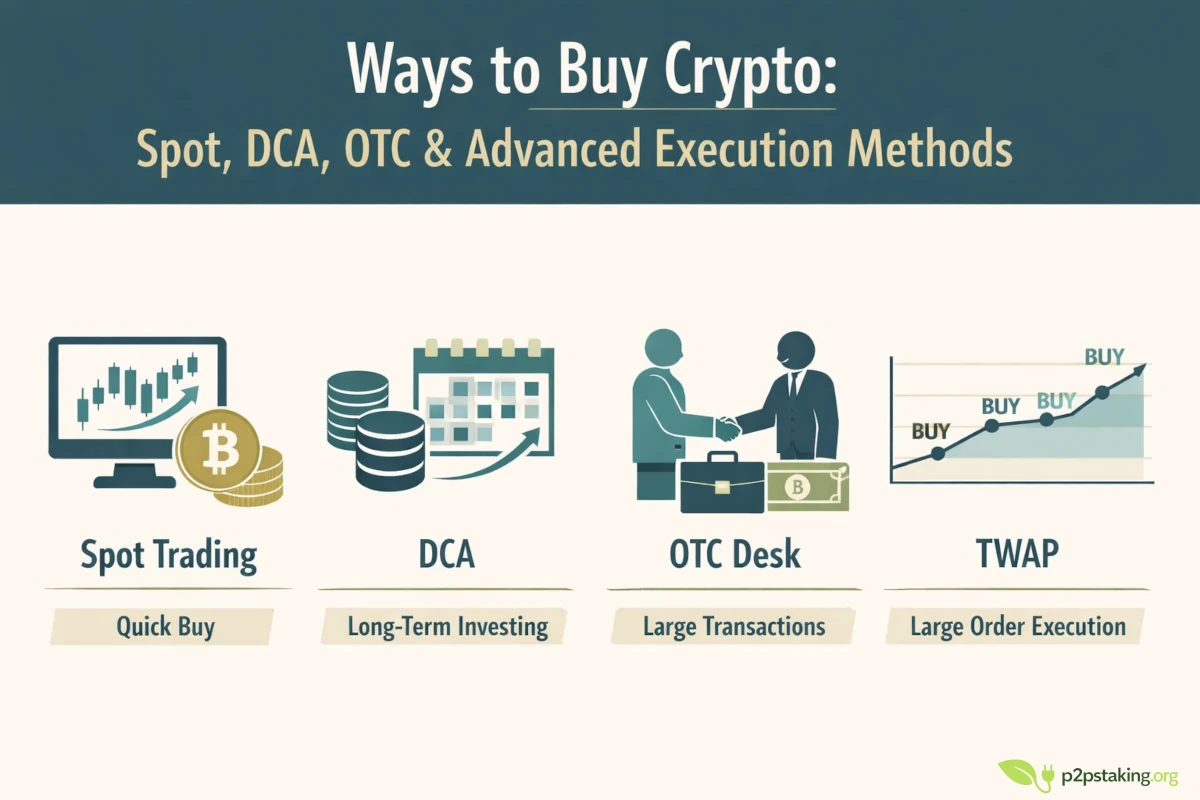
A crypto TWAP order stands for Time-Weighted Average Price. It is a trading method that splits a large buy or sell order into smaller pieces and executes them gradually over a set period of time.
Instead of placing one big order that could move the market, TWAP spreads the execution out. The goal is simple: reduce market impact and aim for a smoother average entry or exit price.
TWAP is not an investment strategy like long-term accumulation. It is an execution method, typically available on advanced trading interfaces or algorithmic trading tools on major exchanges.
How Does TWAP Work?
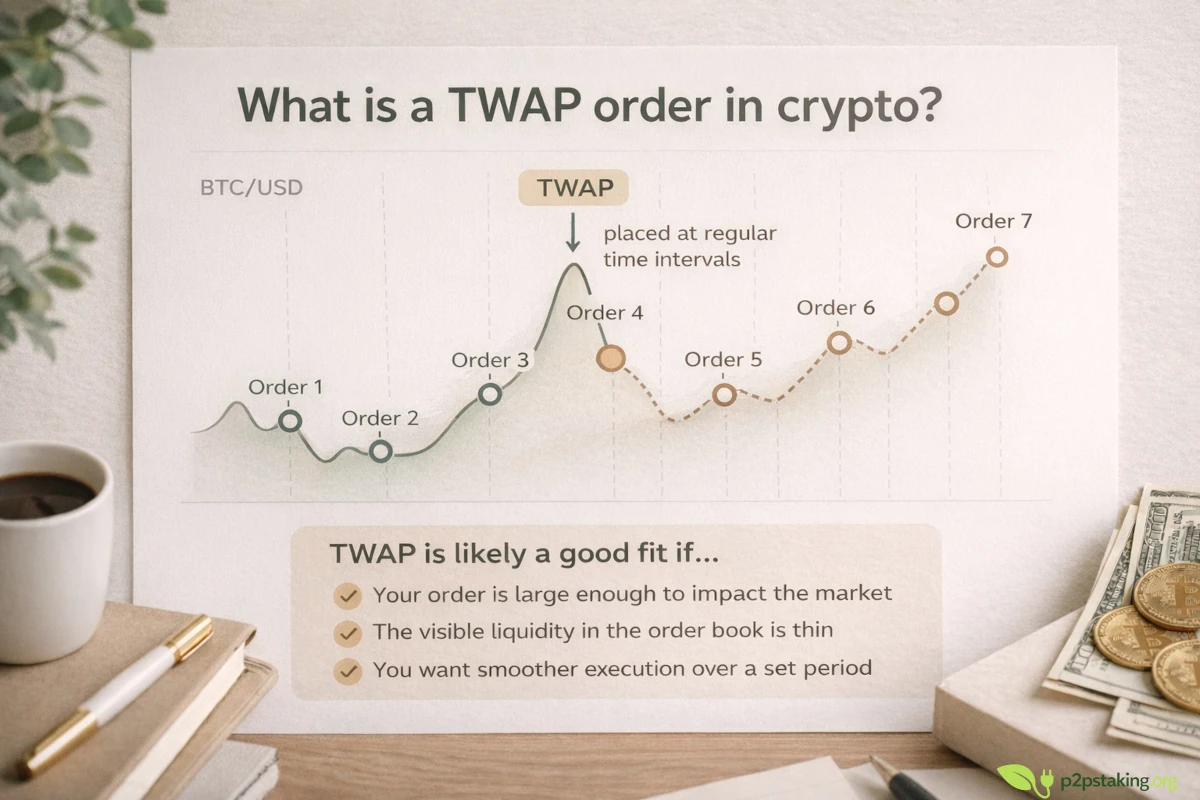
At its core, a TWAP order divides a total amount into equal parts and executes them at regular time intervals.
For example, imagine you want to buy $100,000 worth of BTC over 5 hours. A TWAP algorithm might split that into 60 smaller orders and execute one every five minutes. Each portion is sent to the market automatically.
The “time-weighted” part means that the order is distributed evenly across time, not based on price movements or volume spikes. The system does not try to predict the market. It simply follows the schedule you defined.
This approach helps reduce slippage 1, which happens when a large market order consumes multiple levels of the order book and pushes the price higher (or lower). By spreading execution, TWAP aims to avoid signaling your full size to the market at once.
Slippage is the difference between the expected price of a trade and the actual price at which it is executed. It typically occurs in volatile markets or when liquidity is insufficient, causing an order to be filled across multiple levels of the order book. The larger the trade relative to available market depth, the greater the potential slippage.
How to Set Up a Crypto TWAP Order
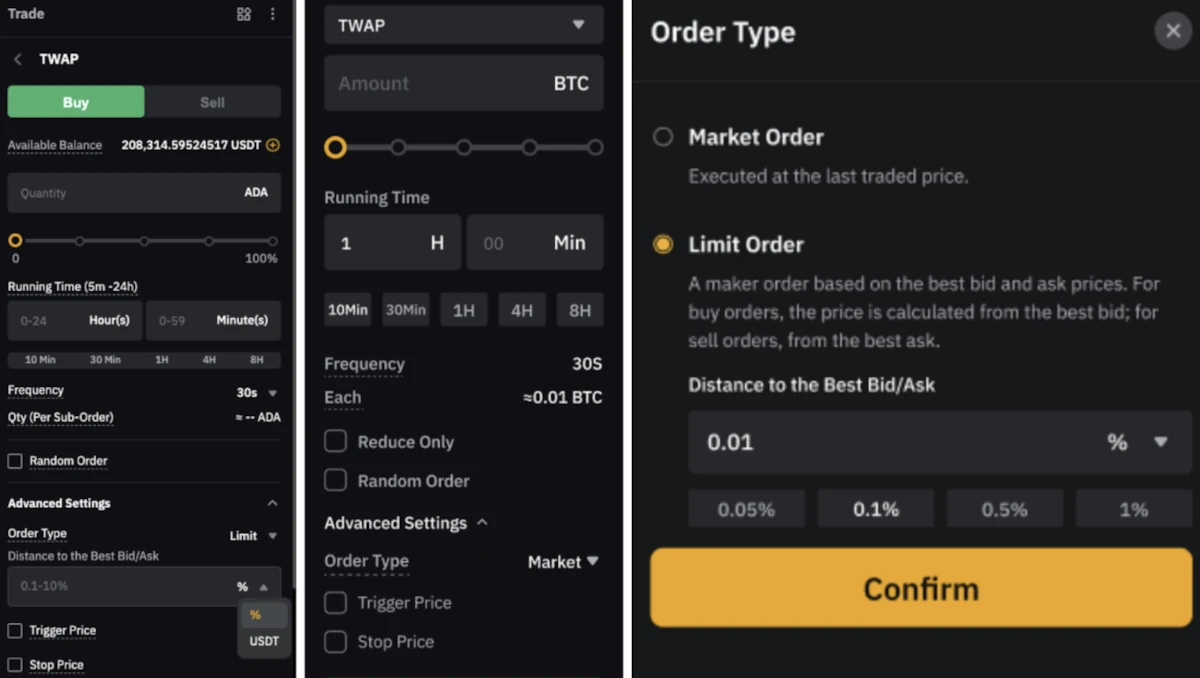
When creating a TWAP order on a crypto exchange, you usually define a few key parameters.
First, you choose the total amount you want to buy or sell. This is the full size that will eventually be executed.
Next, you select the duration of execution. This could be one hour, several hours, or even a full day. The longer the duration, the smaller each individual order will be.
Some platforms also allow you to define the execution frequency, such as placing an order every minute or every five minutes. In some cases, you can set price limits to prevent execution outside a specific range.
Once confirmed, the exchange’s algorithm automatically places the smaller orders according to your schedule. You do not need to manually intervene unless you decide to cancel the strategy.
When Should You Use a Crypto TWAP Order?
A TWAP order becomes relevant when the size of the asset you want to trade is large relative to the liquidity available in the order book.
What really matters is not just your order size in absolute terms, but how that size compares to the visible depth within your acceptable price range. If your trade represents a significant portion of the available volume near the current market price, executing it in one single order can quickly move the market against you.
In that situation, TWAP becomes useful because it distributes your order over time. Instead of consuming a large part of the order book at once, you allow liquidity to replenish between executions, reducing immediate market impact.
Two main elements influence this liquidity dynamic.
The first is the exchange you are using. Large exchanges with high overall trading volumes typically offer deeper order books and tighter spreads. Smaller exchanges may have thinner liquidity, meaning the same order size could have a much stronger impact.
The second is the trading pair itself. Major assets like Bitcoin or Ethereum usually have strong liquidity on popular pairs such as BTC/USDT. Smaller-cap tokens or less common pairs often have much lower depth, even on large exchanges.
In other words, liquidity depends on the combination of the exchange and the specific asset pair. A large exchange does not guarantee deep liquidity for every token, and a highly liquid asset may still be thinly traded on a smaller platform.
If your order size is small relative to the available depth, a simple market or limit order is often sufficient. If your order is large relative to the order book but still manageable over time, TWAP can be an efficient execution method. If your trade is extremely large compared to both the exchange volume and the asset’s daily activity, OTC trading may offer better conditions.
TWAP vs DCA: What’s the Difference?
TWAP is often confused with DCA, but they serve different purposes.
Dollar-Cost Averaging (DCA) is a long-term investment strategy. You buy a fixed amount regularly over weeks or months, regardless of short-term price movements.
TWAP, on the other hand, is a short-term execution strategy. It is designed to execute a specific large order more efficiently over a limited period, such as a few hours.
If your goal is gradual accumulation over time, DCA is likely more suitable. If your goal is to execute one large order with reduced market impact, TWAP is the relevant tool.
TWAP vs OTC: Which One for Larger Orders?
TWAP operates directly on exchange order books. Your trade is still executed in the public market, just in smaller pieces.
OTC (Over-the-Counter) trading happens off-exchange through a broker or specialized desk. Large buyers and sellers are matched privately, without affecting the visible order book.
TWAP is typically suitable for intermediate trade sizes. The market still has enough liquidity to absorb your order over time, but not enough to handle it in one single transaction without slippage.
If your trade size is very large relative to the daily volume of the asset or the exchange, even a TWAP strategy might not be sufficient. In that case, OTC may provide better price stability and discretion.
The right choice depends on liquidity conditions, your order size, and how sensitive the market is to large trades.
Who Is TWAP Designed For?
TWAP is commonly used by active traders, crypto funds, high-net-worth individuals, and companies allocating capital into digital assets.
It is particularly relevant for participants who execute medium-to-large transactions and care about price efficiency. It is less useful for beginners buying small amounts, where a standard market or limit order is usually enough.
Retail investors can use TWAP, but it becomes meaningful mainly when trade size starts to represent a noticeable portion of the available liquidity in the order book.
Limitations and Risks of TWAP
TWAP does not guarantee the best possible average price. If the market moves strongly in one direction during the execution period, you may end up with a worse result than expected.
It is also exposed to volatility. In fast-moving markets, prices can shift significantly between each scheduled order.
Fees can accumulate as well, since the strategy involves multiple smaller trades rather than one single transaction.
Finally, TWAP availability depends on the exchange. Not all platforms offer advanced execution tools, and liquidity conditions vary widely across exchanges and trading pairs.
Final Decision Framework
TWAP is most relevant when you are operating in the “middle zone.” Your order is too large for a single trade without impact, but not large enough to require a full OTC desk.
If liquidity on your chosen exchange and asset pair is moderate — not deep enough for instant absorption, but sufficient over time — TWAP becomes a practical and efficient execution method.
Understanding liquidity conditions, exchange depth, and your own trade size is what ultimately determines whether TWAP is the right acquisition method for your crypto transaction.
Ready to Take Control of Your Crypto?
Go deeper into self‑custody, software wallets, hardware wallets, and practical guides.

Java‑certified engineer and P2PStaking CEO, I secure validators across Solana, Polkadot, Kusama, Mina, and Near. My articles reflect hands‑on wallet ops and real recovery drills so you can set up self‑custody safely, step by step.
Footnotes
1/ Slippage explained on Reddit