

Buying crypto is not the starting point of an investment strategy — it is the execution layer of it.
Once allocation decisions have been clarified — how much capital to deploy, over what horizon, and within what broader portfolio context — the practical question becomes: how should that capital enter the market? There are several ways to buy crypto, and each method serves a different structural purpose.
The way a long-term allocation is deployed differs fundamentally from how a tactical position might be initiated. A small recurring purchase does not raise the same execution considerations as a six-figure allocation sensitive to liquidity and slippage. Choosing the right method is therefore not about convenience, but about alignment between strategy and execution.
Before examining each approach individually, it is worth understanding how different acquisition methods solve different execution problems.
How to Choose the Right Way to Buy Crypto
The most important variable is capital size. The larger the amount relative to market liquidity, the more careful execution becomes. Small recurring purchases can usually be executed without much concern for market impact.
However, as position size increases, questions of slippage, order book depth, and timing start to matter. A large market order placed impulsively can materially move the price against you, especially in thinner markets. At that point, splitting the order or structuring execution becomes less of an option and more of a necessity.
Market conditions also play a significant role.
In periods of high volatility, price swings can be sharp and unpredictable. A single entry point may expose you to immediate drawdowns that are psychologically difficult to handle.
In contrast, spreading purchases over time can reduce the emotional pressure of trying to “catch the right moment.” When liquidity is thin, even moderate orders can have disproportionate impact, making gradual execution more prudent.
During strong trending markets, however, excessively slow deployment may result in opportunity cost. There is always a trade-off between price certainty and execution speed.
Finally, the clarity of your objective matters. Are you building a long-term strategic position? Are you entering tactically based on a thesis? Are you accumulating for treasury purposes or simply diversifying personal capital? The method should align with the goal. Buying crypto is not a standalone action; it is part of a broader capital decision.
With these variables in mind, we can now examine the different ways to buy crypto and how they function in practice.
Comparing the Different Ways to Buy Crypto
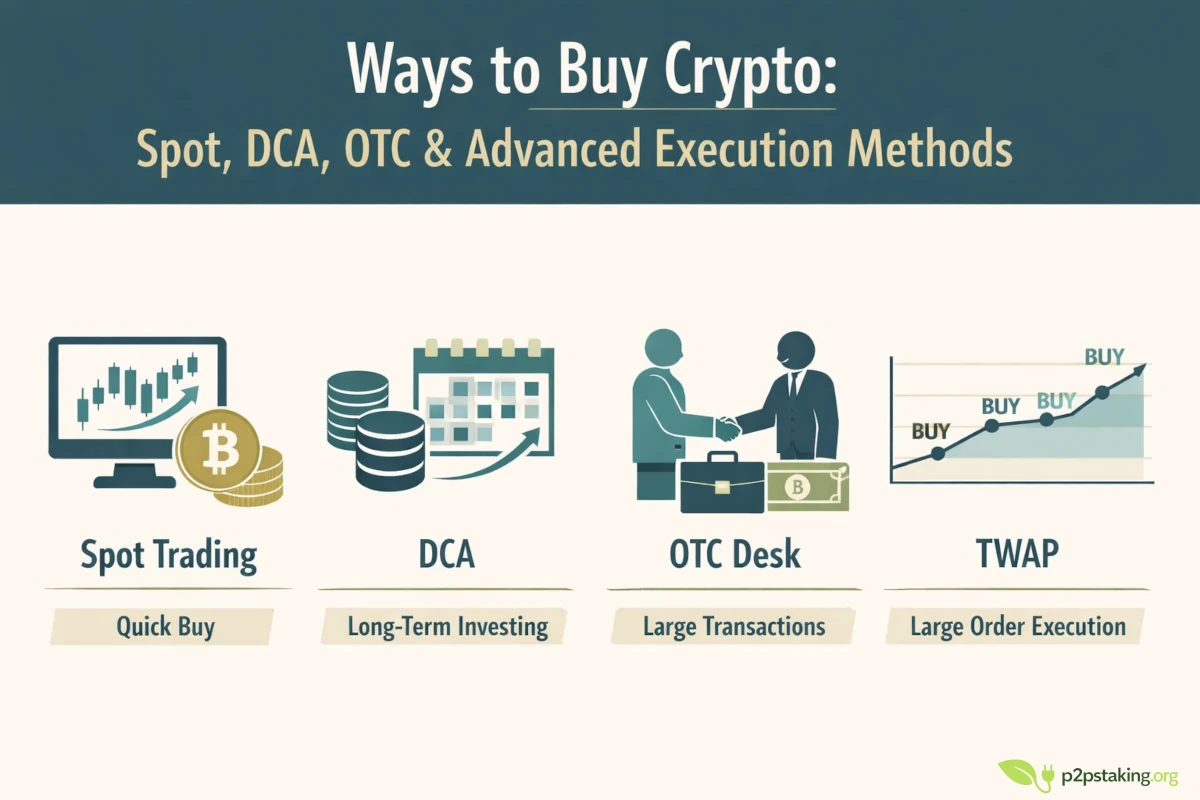
Each acquisition method prioritizes a different dimension of the buying process.
Spot trading emphasizes immediacy. It allows you to gain exposure quickly and directly through an exchange order book. Its strength lies in simplicity, but that simplicity can mask execution risks when orders are large or liquidity is uneven.
Dollar-cost averaging, by contrast, prioritizes timing discipline. Instead of committing all capital at once, it spreads purchases across time. This approach reduces the emotional and tactical burden of choosing a single entry point, although it may result in a higher average price in strongly rising markets.
TWAP focuses on execution efficiency. Rather than buying based on a fixed calendar schedule, it distributes a larger order evenly across a defined time window. The goal is not long-term averaging, but minimizing visible market impact and reducing slippage.
OTC trading shifts the transaction away from public order books entirely. It is designed for larger transactions where discretion and price stability are more important than immediate transparency. However, it introduces a different set of considerations, including counterparty evaluation and negotiated spreads.
Understanding these distinctions is more important than identifying a universally “best” option. Each method exists because it solves a different execution problem.
Spot Trading
Spot trading is the most direct way to buy crypto. You place an order — either at market price or at a specified limit — and receive the asset once the trade is executed.
For smaller allocations and highly liquid assets, this method is often sufficient. It offers immediacy and clarity: you know exactly when you have entered the market. However, in fast-moving conditions or with larger position sizes, market orders can sweep through multiple levels of the order book, leading to slippage. Limit orders provide more control, but may not execute if the market does not reach your price.
Spot trading favors speed over structural precision. For a deeper examination of how to use this method effectively, including limit versus market order considerations, see our guide to spot trading strategies in crypto markets.
Dollar-Cost Averaging (DCA)
Dollar-cost averaging consists of dividing capital into smaller tranches and purchasing at regular intervals. Rather than trying to predict short-term market movements, you accept that entry timing is uncertain and manage that uncertainty by spreading exposure.
This method is particularly well-suited to long-term accumulation strategies. It reduces the psychological pressure of committing capital at a single moment and smooths the impact of volatility over time. However, it is not a guarantee of better performance. In sustained upward trends, gradual deployment may lead to a higher overall entry price compared to a well-timed lump sum.
DCA is less about predicting markets and more about imposing structure on decision-making. For a deeper look at how to design and optimize this approach, see our guide to advanced dollar-cost averaging strategies.
TWAP (Time-Weighted Average Price)
TWAP is a structured execution approach that divides a larger order into smaller slices executed evenly over a predefined time period. Unlike DCA, which is typically calendar-based, TWAP is designed to minimize market impact during a specific transaction window.
This method is particularly relevant when capital size is large relative to liquidity. By distributing the order across time, the buyer avoids placing a single large visible order that could push the market upward. TWAP requires a degree of discipline and, in some cases, technical setup, but it can significantly improve execution quality for substantial allocations.
TWAP is less about long-term accumulation and more about precision. For a detailed breakdown of how time-weighted execution works in crypto markets, explore our guide to TWAP execution strategies.
OTC Desks
Over-the-counter trading removes the transaction from the public order book and executes it privately between counterparties. This approach is often used for high-value transactions where minimizing visible market impact is important.
OTC desks can provide smoother execution for large orders and may offer pricing stability in volatile conditions. However, they introduce counterparty considerations and often require minimum transaction sizes. The negotiation of spreads and settlement terms becomes part of the process.
For smaller investors, OTC may be unnecessary. For larger allocations, it can be an effective tool when used appropriately.
Fiat On-Ramps
Fiat on-ramps convert traditional currency into crypto assets 1 through integrated payment rails. They are typically the first step in the acquisition process and are often used to purchase stablecoins before deploying capital into other assets.
Although convenient, on-ramps can involve layered costs — including payment processing fees and conversion spreads. These costs may appear small individually but can meaningfully affect the effective purchase price, especially on frequent transactions.
Choosing the right on-ramp is less about sophistication and more about cost awareness and settlement efficiency. For a closer look at how fiat entry points work and how to evaluate them effectively, see our guide to fiat-to-crypto on-ramp strategies.
Conclusion
Crypto markets offer multiple ways to gain exposure, but execution should never be treated as an afterthought. The method chosen directly influences pricing efficiency, risk exposure, and ultimately the quality of the position being built.
Serious capital deserves structured deployment. Whether through spot execution, progressive accumulation, algorithmic distribution, or negotiated OTC transactions, the objective remains the same: align method with mandate. Clarity in execution is often what separates disciplined investors from reactive participants.
Ready to Take Control of Your Crypto?
Go deeper into self‑custody, software wallets, hardware wallets, and practical guides.

Java‑certified engineer and P2PStaking CEO, I secure validators across Solana, Polkadot, Kusama, Mina, and Near. My articles reflect hands‑on wallet ops and real recovery drills so you can set up self‑custody safely, step by step.
Footnotes
