Building a crypto allocation portfolio is not just about deciding whether to own Bitcoin.
It is about structuring exposure inside a volatile, rapidly evolving asset class.
Once you’ve determined that cryptocurrency deserves a place in your broader portfolio (see our framework on cryptocurrency allocation strategy), the next question becomes:
How should that crypto exposure be structured internally?
Should it be 100% Bitcoin?
Bitcoin and Ethereum?
A broader mix of large-cap and smaller assets?
Should yield-generating assets play a role?
This page answers that question — not from a speculative perspective, but from a portfolio construction standpoint.
We are not discussing how much crypto you should own overall.
We are discussing how to design the internal architecture of that allocation.
Disclaimer
The perspectives presented here reflect our analytical view on cryptocurrency allocation strategy and portfolio construction. This content is for educational and informational purposes only and does not constitute investment advice, financial advice, or a recommendation to allocate capital to any specific asset. All investment decisions involve risk and should be made based on individual circumstances and, where appropriate, consultation with a qualified professional.
Mixed Bitcoin–Ethereum Crypto Allocation Portfolio Have Historically Improved Risk-Adjusted Returns
Before discussing structure, it helps to ground the conversation in historical data.
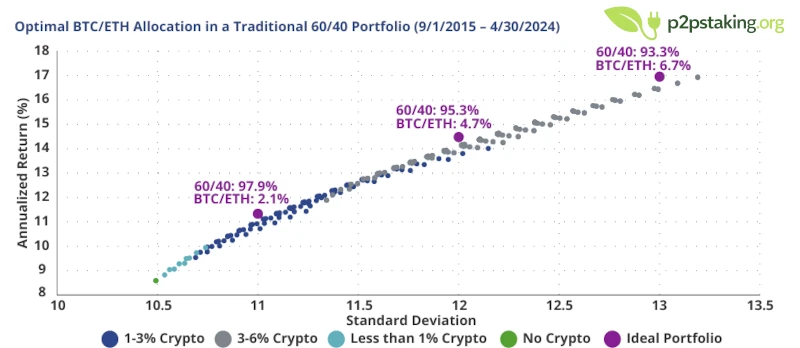
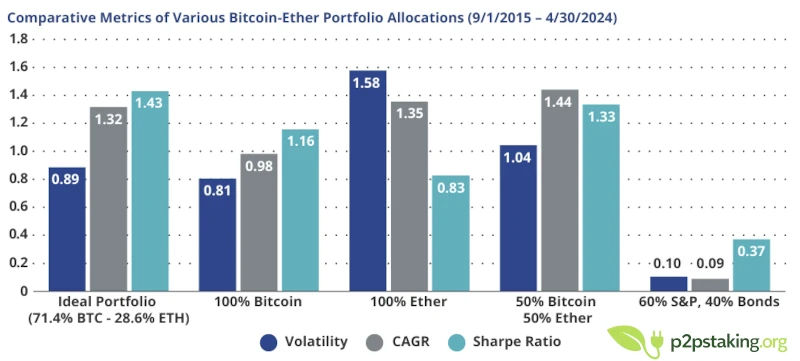
Source: VanEck Research 1 (2015–2024)
Between September 2015 and April 2024:
- A 100% Bitcoin portfolio delivered strong returns.
- A 100% Ether portfolio delivered even higher CAGR, but with significantly higher volatility.
- A 50/50 Bitcoin–Ether allocation improved the Sharpe ratio compared to holding either asset alone.
- The “ideal” allocation (based on backtested optimization) delivered superior risk-adjusted performance versus 100% Bitcoin.
The key insight is not that Ethereum will outperform Bitcoin in the future.
The insight is structural:
Combining assets with different adoption cycles and economic roles can improve portfolio efficiency.
Bitcoin and Ethereum have historically exhibited:
- Different growth phases
- Different volatility patterns
- Different fundamental drivers
When combined, these differences have — at least in the past — enhanced risk-adjusted outcomes.
Of course, past performance does not guarantee future results.
But structurally, this evidence supports the idea that a thoughtful crypto allocation may benefit from more than a single asset.
Defining the Scope of a Crypto Allocation
A crypto allocation sits inside a broader investment portfolio.
You might own:
- Equities
- Bonds
- Real assets
- Private investments
- Cash
Crypto is one component of that total capital structure.
Within that component, the objective is not maximal speculation.
The objective is coherent exposure.
A well-designed crypto allocation should:
- Reflect different economic theses
- Avoid unnecessary overlap
- Maintain manageable complexity
- Allow disciplined rebalancing
This is where structure matters.
The Core–Satellite Framework in Crypto
One of the most practical ways to structure a crypto allocation is through a Core–Satellite model.
This approach creates hierarchy instead of randomness.
Core Layer: Bitcoin as the Monetary Anchor
Bitcoin typically serves as the structural core of a crypto portfolio.
It represents:
- Digital scarcity
- A non-sovereign monetary network
- The dominant liquidity base of the crypto ecosystem
- The primary beneficiary of the “digital reserve asset” thesis
Bitcoin captures the macro adoption narrative — store of value, monetary hedge, institutional inflows.
For a deeper analysis of its strategic role, see our full guide on Bitcoin allocation in a portfolio.
The key point here is architectural:
Bitcoin provides the monetary foundation.
Infrastructure Layer: Ethereum and Smart Contract Exposure
Adding Ethereum introduces a different economic vector.
While Bitcoin captures the reserve-asset narrative, Ethereum captures:
- Smart contract infrastructure
- Decentralized finance (DeFi) activity
- Tokenization of real-world assets
- On-chain settlement and programmable financial logic
This is a distinct adoption thesis.
Owning Ethereum is not just “more crypto.”
It is exposure to financial infrastructure innovation.
As decentralized applications expand — whether in lending, derivatives, tokenization, or digital identity — Ethereum (and similar large-cap smart contract platforms) may capture value through network activity.
In other words:
Bitcoin represents digital money.
Ethereum represents programmable finance.
The combination provides exposure to both.
Optional Yield Component: Staking and On-Chain Income
Another structural difference between Bitcoin and certain smart contract platforms is yield potential.
Some proof-of-stake assets allow:
- Staking rewards
- Participation in network validation
- Basic lending mechanisms
This introduces a cash-flow dimension to the portfolio.
While Bitcoin’s return is purely price-driven, certain smart contract assets offer:
- Network income
- Protocol-level yield
- Participation economics
This does not eliminate volatility.
It does not guarantee returns.
But it alters the asset profile.
From a portfolio construction perspective, this matters.
Assets that combine price appreciation potential with native yield can behave differently over long horizons than purely non-yielding assets.
Why Adding More Assets Does Not Automatically Reduce Risk
It is tempting to assume that more crypto assets equal more diversification.
In practice, that assumption is often flawed.
The Illusion of Diversification in Crypto
During strong bull markets, correlations appear low.
During stress events, correlations often converge sharply toward one.
Many smaller crypto assets share:
- Liquidity risk
- Retail-driven momentum
- Narrative dependency
- Funding cycle exposure
In bear markets, a large percentage of smaller tokens experience extreme drawdowns — and some never recover.
Diversification inside crypto is not the same as diversification across asset classes.
Owning 20 small-cap tokens does not necessarily reduce risk.
It may increase it.
Complexity Escalates Quickly
As the number of positions increases:
- Monitoring becomes harder
- Rebalancing becomes more frequent
- Tax tracking becomes more complex
- Emotional discipline weakens
Portfolio sprawl often leads to:
- Overexposure to weak assets
- Inconsistent decision-making
- Drift away from original allocation intent
From a capital allocation standpoint, simplicity has value.
Concentration vs Breadth: A Strategic Trade-Off
A common fear among investors is “missing out” on emerging narratives.
This often leads to over-diversification.
However, consider this:
- The largest crypto assets already capture significant ecosystem activity.
- As adoption expands, capital often flows first into the highest-liquidity networks.
- Major platforms tend to absorb new innovation over time.
You do not need exposure to every narrative at inception.
If structural adoption accelerates meaningfully, there is usually time to evaluate and incorporate new assets rationally.
A disciplined investor may choose to:
- Concentrate on dominant assets
- Periodically reassess market structure
- Replace underperforming or obsolete assets rather than endlessly add new ones
This approach reduces noise while preserving optionality.
For guidance on maintaining discipline over time, see our framework on rebalancing a crypto portfolio.
Practical Allocation Models Inside a Crypto Portfolio
There is no universal formula.
But certain structural templates tend to be more coherent than others.
Importantly, we do not prescribe exact percentages here — that depends on your total portfolio, risk tolerance, and investment horizon.
Instead, we focus on structure.
1. BTC-Dominant Structure
Characteristics:
- Bitcoin as the clear majority position
- Limited exposure to one or two smart contract platforms
- Minimal satellite positions
Advantages:
- Simplicity
- Clear thesis alignment
- Lower management complexity
This structure prioritizes the reserve-asset narrative.
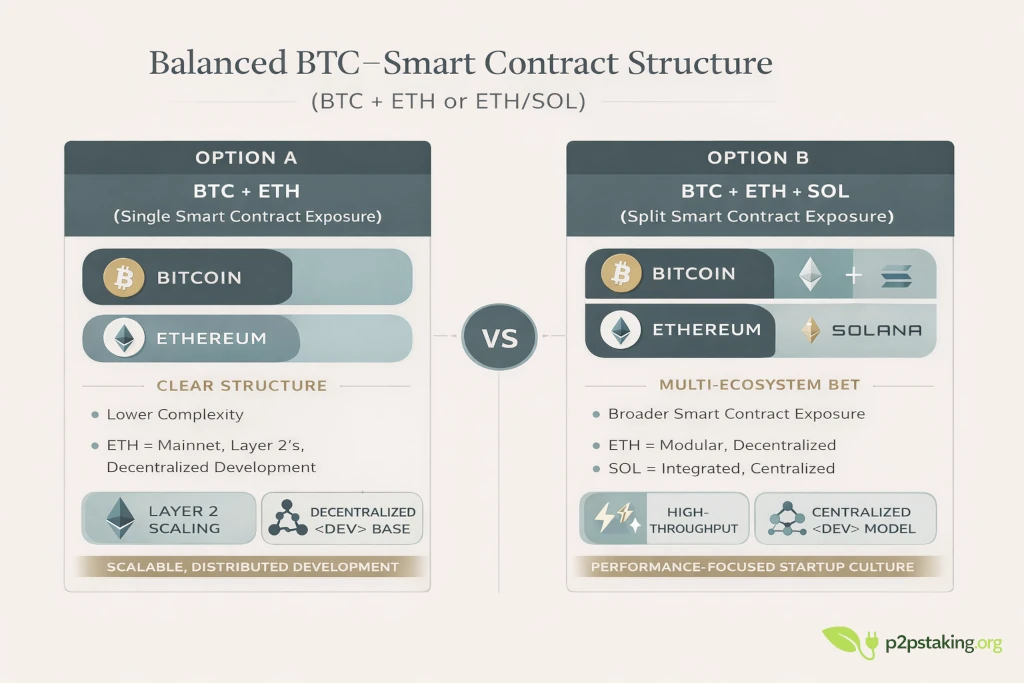
2. Balanced BTC–Smart Contract Structure (BTC + ETH or ETH/SOL)
Characteristics:
- Meaningful exposure to both the monetary layer and the smart contract layer
- Participation in on-chain economic activity
- Optional yield component through staking
- Diversified adoption pathways within crypto
In its simplest form, this structure combines:
- Bitcoin as the monetary anchor
- Ethereum as the core smart contract platform
However, the smart contract layer itself has evolved.
During the most recent bull cycle, Solana captured a significant share of on-chain activity — particularly in areas such as:
- High-frequency trading environments
- Consumer-facing applications
- NFT and meme-driven volume
- Fast, low-cost transactional use cases
In certain periods, Solana narrowed the gap with Ethereum in terms of transaction volume and user engagement.
This raises a structural question:
Should smart contract exposure be concentrated in Ethereum alone, or diversified across major platforms like Ethereum and Solana?
From a portfolio construction perspective, there are two coherent ways to approach this.
Option A: BTC + ETH (Single Smart Contract Exposure)
- Clear structure
- Lower complexity
- Exposure to the most established programmable blockchain
- Staking yield potential
Importantly, owning Ethereum is not just owning a single chain.
Ethereum today represents:
- The Ethereum mainnet
- Its expanding Layer 2 ecosystem (rollups scaling activity)
- A broad, globally distributed developer base
- A relatively decentralized governance and validator structure
In that sense, ETH exposure often implies exposure to a wider modular ecosystem — one that prioritizes decentralization, security, and long-term infrastructure robustness.
This approach prioritizes institutional adoption, network depth, and structural resilience.
Option B: BTC + ETH + SOL (Split Smart Contract Exposure)
- Exposure to multiple smart contract ecosystems
- Participation in Ethereum’s modular, decentralized ecosystem
- Participation in Solana’s high-throughput, vertically integrated model
Solana represents a different bet.
Where Ethereum evolves through layered scaling and decentralized governance, Solana operates more like a high-performance startup ecosystem:
- Faster iteration cycles
- Tighter coordination
- More centralized development dynamics
- Strong influence from the core Solana team
This structure acknowledges that:
- Smart contract adoption is not guaranteed to consolidate into a single architecture.
- Different technical philosophies may dominate different use cases.
- Innovation cycles can temporarily favor alternative ecosystems.
Choosing to include Solana is not simply adding “another L1.”
It is allocating capital across two distinct models of blockchain evolution:
- Ethereum: modular, layered, decentralization-first.
- Solana: integrated, performance-first, ecosystem-driven.
The decision ultimately reflects how much architectural diversification you want within your smart contract exposure — without losing overall portfolio coherence.
3. Core + Limited Satellite Sleeve
Characteristics:
- Core allocation in BTC and ETH
- Small, capped exposure to 1–3 higher-risk assets
- Clear sizing limits
The satellite sleeve functions as optionality.
It should:
- Be small relative to the core
- Be thesis-driven
- Have defined evaluation criteria
The purpose is not aggressive speculation.
It is structured exposure to innovation.
Managing Downside Risk in Multi-Crypto Exposure
Risk in crypto is nonlinear.
Drawdowns of 60–80% are not uncommon.
Managing downside risk requires:
- Position size discipline
- Awareness of liquidity concentration
- Avoiding overexposure to correlated assets
- Maintaining clarity on thesis validity
It may also involve thinking in terms of:
- Risk contribution rather than dollar allocation
- Volatility weighting
- Periodic rebalancing
For a deeper quantitative discussion, see our guide on risk-adjusted crypto allocation.
A Disciplined Framework for Expanding a Crypto Allocation
The strongest crypto portfolios tend to share three characteristics:
1. Clarity of Structure
Each asset has a role.
- Monetary hedge
- Infrastructure exposure
- Optional innovation
Nothing is held “just in case.”
2. Controlled Complexity
Fewer assets.
Clear sizing logic.
Periodic review.
3. Adaptive Reassessment
Markets evolve.
Protocols rise and decline.
Narratives shift.
Technologies mature.
A disciplined investor does not chase every new token.
They reassess systematically.
If a new asset meaningfully captures structural adoption, it can be introduced thoughtfully — potentially replacing weaker positions rather than expanding indefinitely.
Final Perspective: Architecture Over Excitement
Crypto markets reward enthusiasm.
Portfolio construction rewards discipline.
A well-structured crypto allocation:
- Recognizes Bitcoin’s monetary dominance
- Acknowledges Ethereum’s infrastructure thesis
- Understands the limited role of higher-risk assets
- Avoids over-diversification
- Maintains manageable complexity
Most importantly, it treats crypto as part of a broader capital allocation framework — not as a speculative playground.
For guidance on integrating crypto exposure within your overall portfolio strategy, return to our full framework on cryptocurrency allocation strategy.
The goal is not to own everything.
The goal is to own the right exposure — structured coherently, sized rationally, and managed with discipline over time.
Ready to Take Control of Your Crypto?
Go deeper into self‑custody, software wallets, hardware wallets, and practical guides.

Java‑certified engineer and P2PStaking CEO, I secure validators across Solana, Polkadot, Kusama, Mina, and Near. My articles reflect hands‑on wallet ops and real recovery drills so you can set up self‑custody safely, step by step.
Footnotes
1: Optimal Crypto Allocation for Portfolios