Over the past two years, Bitcoin allocation in a portfolio has shifted from a fringe discussion to a legitimate topic within institutional research. Major asset managers such as BlackRock, Morgan Stanley1, and Morningstar now analyze Bitcoin exposure within diversified multi-asset frameworks.
This shift does not represent universal endorsement. It reflects normalization. Bitcoin is no longer dismissed outright; it is assessed within portfolio construction models.
For investors, the relevant question is no longer whether Bitcoin exists as an investable asset, but how Bitcoin allocation in a portfolio should be structured, sized, and monitored within a disciplined capital framework.
Bitcoin allocation should always be evaluated within the broader context of a structured cryptocurrency allocation strategy. Position sizing, risk budgeting, and portfolio integration matter more than narrative conviction.
Disclaimer
The perspectives presented here reflect our analytical view on cryptocurrency allocation strategy and portfolio construction. This content is for educational and informational purposes only and does not constitute investment advice, financial advice, or a recommendation to allocate capital to any specific asset. All investment decisions involve risk and should be made based on individual circumstances and, where appropriate, consultation with a qualified professional.

Why Consider Bitcoin Allocation in a Portfolio?
Any discussion of Bitcoin allocation in a portfolio must begin with its structural characteristics.
Monetary Scarcity and Predictability
Bitcoin’s supply is programmatically capped and transparently scheduled. Unlike fiat currencies, its issuance cannot be altered by discretionary policy decisions.
This monetary predictability is one of the core reasons Bitcoin is evaluated as a portfolio asset. Whether viewed as digital scarcity, macro hedge, or speculative growth instrument, its supply framework is fixed.
Scarcity alone does not justify allocation — but predictability allows modeling.
Longevity and Network Resilience
Bitcoin has operated continuously since 2009. Over multiple cycles, it has developed:
- Deep global liquidity
- Institutional custody infrastructure
- Regulated investment vehicles
- Increasing balance sheet adoption
- Massive miner infrastructures over the world that secure the network
Durability matters in portfolio construction. Assets that survive multiple market regimes gain analytical legitimacy.
Institutional Recognition
Institutional research increasingly explores Bitcoin allocation in a portfolio context. Publications from BlackRock, Morgan Stanley, and Morningstar discuss modest allocation ranges within diversified portfolios.
This does not eliminate risk. It signals that Bitcoin has crossed a threshold from experimental asset to analyzable component within multi-asset models.
Bitcoin Is Structurally Different from Other Crypto Assets
Understanding Bitcoin allocation in a portfolio requires clear differentiation from broader digital assets.
No Central Issuer or Project Leadership
Bitcoin has no CEO, no foundation directing monetary policy, and no roadmap controlled by a central team.
Many alternative crypto projects depend on identifiable development groups. Their value can shift materially if:
- Key developers leave
- Governance changes
- Strategic pivots occur
- Tokenomics are redesigned
Bitcoin operates differently. Its governance is decentralized and conservative. Changes are incremental and require broad consensus.
This reduces project-specific risk. It does not eliminate market risk.
Monetary Focus vs Platform Ambition
Many digital assets aim to function as programmable platforms, infrastructure layers, or ecosystem tokens. Their investment thesis depends on competitive positioning and developer activity.
Bitcoin’s thesis is narrower: a decentralized, scarce digital monetary asset.
That focus contributes to durability. It also explains why many investors treat Bitcoin allocation in a portfolio separately from broader crypto exposure.
For a broader discussion of structuring exposure across digital assets, see our guide on crypto allocation in portfolio.
The Role of Bitcoin in a Diversified Portfolio
Bitcoin allocation in a portfolio is typically justified through three structural roles.
1. A High-Volatility Allocation Sleeve
Bitcoin exhibits structurally higher volatility than equities, commodities, or bonds.
As a result, even a small capital allocation can meaningfully influence total portfolio volatility. This makes disciplined sizing essential.
2. An Asymmetric Return Component
Bitcoin’s historical return profile has been non-linear, characterized by large expansion phases followed by deep contractions.
From a portfolio perspective, the rationale is often asymmetric exposure: limited capital allocation with the potential to influence long-term return distribution disproportionately.
The asymmetry only works when downside risk remains contained relative to total capital.
3. Conditional Diversification
Bitcoin’s correlation with traditional risk assets fluctuates across macro regimes.
At times it behaves independently.
At other times it moves alongside broader liquidity cycles.
Bitcoin allocation in a portfolio should therefore assume conditional diversification rather than structural decoupling.
Managing Bitcoin Allocation in a Portfolio Through Market Cycles
Bitcoin’s volatility is cyclical and pronounced.
Unlike traditional assets, Bitcoin has historically experienced multi-year expansion phases followed by significant drawdowns. This creates a unique portfolio challenge: allocation drift.
During bull markets, a 3 % Bitcoin allocation in a portfolio can expand to 6 % or more without additional capital deployment. Concentration increases silently.
During bear markets, exposure contracts sharply, raising questions about maintaining or rebuilding allocation.
Managing Bitcoin allocation in a portfolio therefore requires:
- Predefined allocation bands
- Periodic review
- Discipline during both expansion and contraction phases
The objective is not short-term timing. It is preventing unintended concentration or emotional resizing.
For a broader framework covering digital assets more generally, refer to our cryptocurrency allocation strategy guide.
Position Sizing: How Much Bitcoin in a Portfolio?
Position sizing determines whether Bitcoin functions as a satellite exposure or a dominant risk driver.
While allocation should always reflect individual circumstances, institutional research commonly references modest ranges.
Within diversified portfolios:
- Around 2–3 % represents measured exposure aligned with many institutional perspectives.
- Around 4 % constitutes a strong allocation while remaining defensible within multi-asset structures.
- Around 5 % begins to create a structurally significant exposure that materially increases portfolio volatility.
- Above 5 %, Bitcoin allocation in a portfolio transitions toward concentrated risk positioning.
The difference between 3 % and 5 % may appear small numerically, but its impact on volatility contribution can be meaningful.
Sizing should be driven by risk capacity, not conviction alone.
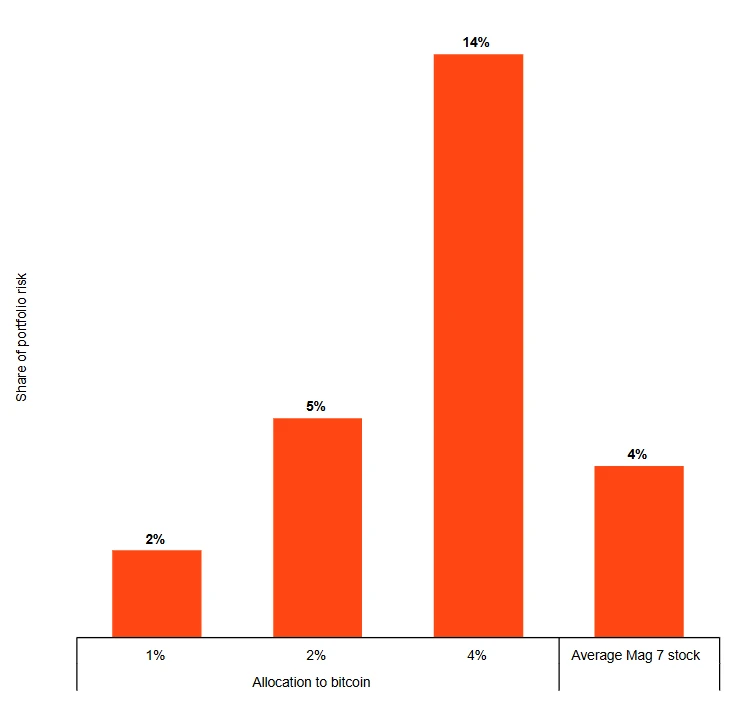
Source: BlackRock Investment Institute with data from Bloomberg, December 2024. Notes: The chart shows bitcoin’s share of portfolio risk in a hypothetical 60-40 stock-bond portfolio at different allocations based on risk contribution. It also shows what share “magnificent 7” stocks (Alphabet, Amazon, Apple, Meta, Microsoft, Nvidia and Tesla) add to overall risk on average based on their current index weights.
A more detailed exploration of Bitcoin allocation percentages and their portfolio impact can be developed within a dedicated sizing framework.
Bitcoin Allocation vs Broader Crypto Exposure
Bitcoin allocation in a portfolio is often treated as the core digital asset exposure.
Broader crypto allocation introduces additional layers of risk:
- Platform competition
- Governance uncertainty
- Development dependency
- Higher idiosyncratic volatility
While diversification within crypto can increase upside optionality, it also increases structural complexity.
This is why many portfolio frameworks distinguish clearly between Bitcoin allocation and broader digital asset allocation.
For structured multi-asset digital exposure, see our guide on crypto allocation in portfolio.
Common Mistakes in Bitcoin Allocation in a Portfolio
Allowing allocation drift after strong price appreciation
Failure to rebalance can unintentionally increase concentration risk.
Equating scarcity with stability
Fixed supply does not reduce short-term volatility.
Ignoring regime shifts
Bitcoin’s correlation profile evolves across macro cycles.
Confusing Bitcoin with other tokens
Structural differences matter in portfolio construction.
Conclusion
Bitcoin allocation in a portfolio is a structural decision, not a narrative bet.
Over the past two years, institutional research has increasingly acknowledged that modest Bitcoin exposure may have a place within diversified portfolios. At the same time, its volatility demands disciplined sizing and risk budgeting.
Bitcoin’s durability, decentralized governance, and monetary focus differentiate it from other digital assets. These characteristics explain why many investors treat Bitcoin allocation separately within portfolio construction.
Integrated thoughtfully, Bitcoin can function as an asymmetric allocation sleeve within a diversified framework.
Integrated without structure, it can dominate risk unintentionally.
Allocation defines the difference.
Ready to Take Control of Your Crypto?
Go deeper into self‑custody, software wallets, hardware wallets, and practical guides.

Java‑certified engineer and P2PStaking CEO, I secure validators across Solana, Polkadot, Kusama, Mina, and Near. My articles reflect hands‑on wallet ops and real recovery drills so you can set up self‑custody safely, step by step.
Footnotes